Recombinant Rotavirus X VP4 protein (His tag)
Recombinant Rotavirus X VP4 protein (His tag)
Be the first to review this product! Submit a review
|
(0 Publication)
Recombinant Rotavirus X VP4 protein (His tag) is a Human rotavirus B219 Fragment protein, in the 1 to 249 aa range, expressed in Yeast, with >85%, suitable for SDS-PAGE.
別名を表示する
Outer capsid protein VP4, Hemagglutinin
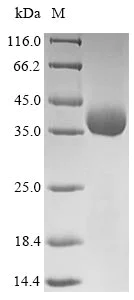
- SDS-PAGE
Supplier Data
SDS-PAGE - Recombinant Rotavirus X VP4 protein (His tag) (AB238376)
(Tris-Glycine gel) Discontinuous SDS-PAGE (reduced) with 5% enrichment gel and 15% separation gel of ab238376.
組合せ製品
Reagents, Controls & Accessories
AB234592
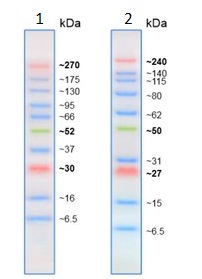
Prestained Protein Ladder - Extra broad molecular weight (6.5 - 270 kDa)
- 0
- 0

Reactivity data
配列情報
出荷温度及び保存条件
製品の状態
出荷温度
短期保存温度
長期保存温度
保管に関する情報
補足情報
This supplementary information is collated from multiple sources and compiled automatically.
Biological function summary
The infectivity of rotaviruses depends significantly on the activity of VP4. VP4 forms part of a complex with the viral capsid proteins including VP6 and VP7 contributing to the stability and infection potential of the virus. The protein is cleaved by trypsin into two subunits VP5* and VP8* which increases the virus's ability to bind and penetrate host cells. This cleavage is an important step in the viral life cycle enhancing the infectivity of the virus.
Pathways
The mechanism of VP4 is tightly linked to cellular pathways involving viral entry and replication. During infection VP4's interaction with cell surface molecules facilitates the entry of the virus directly impacting viral proliferation pathways. It shows significant interaction with cellular receptors like integrins which play a role in cell adhesion processes and signal transduction. These interactions can influence downstream effects on host cell functions and viral replication efficiency.
一般的な情報
機能
Outer capsid protein VP4. Spike-forming protein that mediates virion attachment to the host epithelial cell receptors and plays a major role in cell penetration, determination of host range restriction and virulence. Rotavirus attachment and entry into the host cell probably involves multiple sequential contacts between the outer capsid proteins VP4 and VP7, and the cell receptors. It is subsequently lost, together with VP7, following virus entry into the host cell. Following entry into the host cell, low intracellular or intravesicular Ca(2+) concentration probably causes the calcium-stabilized VP7 trimers to dissociate from the virion. This step is probably necessary for the membrane-disrupting entry step and the release of VP4, which is locked onto the virion by VP7.. Outer capsid protein VP5*. Forms the spike 'foot' and 'body' and acts as a membrane permeabilization protein that mediates release of viral particles from endosomal compartments into the cytoplasm. During entry, the part of VP5* that protrudes from the virus folds back on itself and reorganizes from a local dimer to a trimer. This reorganization may be linked to membrane penetration.. Outer capsid protein VP8*. Forms the head of the spikes and mediates the recognition of specific host cell surface glycans. It is the viral hemagglutinin and an important target of neutralizing antibodies.
配列の類似性
Belongs to the rotavirus VP4 family.
翻訳後修飾
Outer capsid protein VP4. Proteolytic cleavage by trypsin results in activation of VP4 functions and greatly increases infectivity. The penetration into the host cell is dependent on trypsin treatment of VP4. It produces two peptides, VP5* and VP8* that remain associated with the virion. Cleavage of VP4 by trypsin probably occurs in vivo in the lumen of the intestine prior to infection of enterocytes. Trypsin seems to be incorporated into the three-layered viral particles but remains inactive as long as the viral outer capsid is intact and would only be activated upon the solubilization of the latter.
ターゲットの情報
Abcam product promise
Please note: All products are 'FOR RESEARCH USE ONLY. NOT FOR USE IN DIAGNOSTIC OR THERAPEUTIC PROCEDURES'.
For licensing inquiries, please contact partnerships@abcam.com