Recombinant human TAK1 protein (GST tag N-Terminus)
Recombinant human TAK1 protein (GST tag N-Terminus)
Be the first to review this product! Submit a review
|
(0 Publication)
Recombinant human TAK1 protein (GST tag N-Terminus) is a Human Full Length protein, in the 1 to 579 aa range, expressed in Wheat germ, with >80%, suitable for SDS-PAGE, ELISA, WB, FuncS.
別名を表示する
TAK1, MAP3K7, Mitogen-activated protein kinase kinase kinase 7, Transforming growth factor-beta-activated kinase 1, TGF-beta-activated kinase 1
- FuncS
Unknown
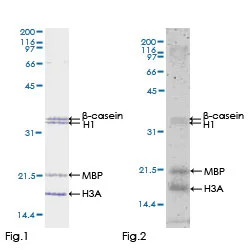
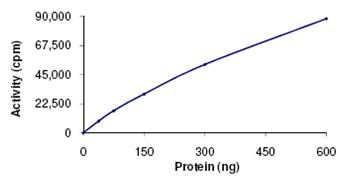
Functional Studies - Recombinant human TAK1 protein (GST tag N-Terminus) (AB132950)
Kinase assay using ab132950 and [gamma 32P] ATP.
Fig 1 : SDS-PAGE gel
Fig 2 : Autoradiograph of SDS-PAGE gel Kinase substrates :
H3 histone, family 3A - calf thymus - Molecular weight : approx. 16.5-17 kDa on SDS-PAGE
Myelin basic protein - bovine brain - Molecular weight : approx. 21-22 kDa on SDS-PAGE
Histone H1.0 - calf thymus - Molecular weight : approx. 32-33 kDa on SDS-PAGE
Beta-casein protein - bovine milk - Molecular weight : approx. 33-34 kDa on SDS-PAGE
- SDS-PAGE
Supplier Data
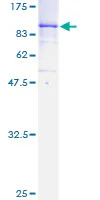
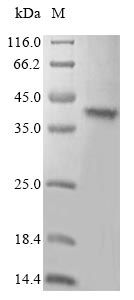
SDS-PAGE - Recombinant human TAK1 protein (GST tag N-Terminus) (AB132950)
12.5% SDS-PAGE analysis of ab132950 stained with Coomassie Blue.
組合せ製品
Proteins & Peptides
AB60837
Recombinant human PKA beta (catalytic subunit) protein (GST tag N-Terminus)
- 0
- 0
Proteins & Peptides
AB56268
Recombinant human cAMP Protein Kinase Catalytic subunit (GST tag N-Terminus)
- 0
- 0
Reactivity data
配列情報
出荷温度及び保存条件
製品の状態
精製方法
出荷温度
短期保存温度
長期保存温度
分注に関する情報
保管に関する情報
補足情報
This supplementary information is collated from multiple sources and compiled automatically.
Biological function summary
TAK1 is involved in several cellular processes necessary for maintaining balance and responding to stress. TAK1 forms a complex with proteins like TAB1 TAB2 and TAB3 which are important for its activation and signaling function. This complex facilitates TAK1's involvement in inflammation and immune response indicating its significance in mediating cellular survival and apoptosis.
Pathways
TAK1 operates within the NF-κB and MAPK pathways two critical routes for cellular response to inflammation and stress. In the NF-κB pathway TAK1 activates IKK which triggers the degradation of IκB freeing NF-κB to move into the nucleus and activate transcription. In the MAPK pathway TAK1 directly influences JNK and p38 cascades revealing regulatory connections to proteins like MEK and ERK.
一般的な情報
機能
Serine/threonine kinase which acts as an essential component of the MAP kinase signal transduction pathway (PubMed : 10094049, PubMed : 11460167, PubMed : 12589052, PubMed : 16845370, PubMed : 16893890, PubMed : 21512573, PubMed : 8663074, PubMed : 9079627). Plays an important role in the cascades of cellular responses evoked by changes in the environment (PubMed : 10094049, PubMed : 11460167, PubMed : 12589052, PubMed : 16845370, PubMed : 16893890, PubMed : 21512573, PubMed : 8663074, PubMed : 9079627). Mediates signal transduction of TRAF6, various cytokines including interleukin-1 (IL-1), transforming growth factor-beta (TGFB), TGFB-related factors like BMP2 and BMP4, toll-like receptors (TLR), tumor necrosis factor receptor CD40 and B-cell receptor (BCR) (PubMed : 16893890, PubMed : 9079627). Once activated, acts as an upstream activator of the MKK/JNK signal transduction cascade and the p38 MAPK signal transduction cascade through the phosphorylation and activation of several MAP kinase kinases like MAP2K1/MEK1, MAP2K3/MKK3, MAP2K6/MKK6 and MAP2K7/MKK7 (PubMed : 11460167, PubMed : 8663074). These MAP2Ks in turn activate p38 MAPKs and c-jun N-terminal kinases (JNKs); both p38 MAPK and JNK pathways control the transcription factors activator protein-1 (AP-1) (PubMed : 11460167, PubMed : 12589052, PubMed : 8663074). Independently of MAP2Ks and p38 MAPKs, acts as a key activator of NF-kappa-B by promoting activation of the I-kappa-B-kinase (IKK) core complex (PubMed : 12589052, PubMed : 8663074). Mechanistically, recruited to polyubiquitin chains of RIPK2 and IKBKG/NEMO via TAB2/MAP3K7IP2 and TAB3/MAP3K7IP3, and catalyzes phosphorylation and activation of IKBKB/IKKB component of the IKK complex, leading to NF-kappa-B activation (PubMed : 10094049, PubMed : 11460167). In osmotic stress signaling, plays a major role in the activation of MAPK8/JNK1, but not that of NF-kappa-B (PubMed : 16893890). Promotes TRIM5 capsid-specific restriction activity (PubMed : 21512573). Phosphorylates RIPK1 at 'Ser-321' which positively regulates RIPK1 interaction with RIPK3 to promote necroptosis but negatively regulates RIPK1 kinase activity and its interaction with FADD to mediate apoptosis (By similarity). Phosphorylates STING1 in response to cGAMP-activation, promoting association between STEEP1 and STING1 and STING1 translocation to COPII vesicles (PubMed : 37832545).
配列の類似性
Belongs to the protein kinase superfamily. STE Ser/Thr protein kinase family. MAP kinase kinase kinase subfamily.
翻訳後修飾
Association with TAB1/MAP3K7IP1 promotes autophosphorylation at Ser-192 and subsequent activation. Association with TAB2/MAP3K7IP2, itself associated with free unanchored Lys-63 polyubiquitin chain, promotes autophosphorylation and subsequent activation of MAP3K7. Dephosphorylation at Ser-192 by PPM1B/PP2CB and at Thr-187 by PP2A and PPP6C leads to inactivation.. 'Lys-48'-linked polyubiquitination at Lys-72 is induced by TNFalpha, and leads to proteasomal degradation. Undergoes 'Lys-48'-linked polyubiquitination catalyzed by ITCH (By similarity). Requires 'Lys-63'-linked polyubiquitination for autophosphorylation and subsequent activation. 'Lys-63'-linked ubiquitination does not lead to proteasomal degradation. Deubiquitinated by CYLD, a protease that selectively cleaves 'Lys-63'-linked ubiquitin chains. Deubiquitinated by Y.enterocolitica YopP.. (Microbial infection) Cleaved and inactivated by the proteases 3C of coxsackievirus A16 and human enterovirus D68, allowing the virus to disrupt TRAF6-triggered NF-kappa-B induction.. (Microbial infection) Acetylation of Thr-184 and Thr-187 by Yersinia YopJ prevents phosphorylation and activation, thus blocking the MAPK signaling pathway.
ターゲットの情報
Abcam product promise
Please note: All products are 'FOR RESEARCH USE ONLY. NOT FOR USE IN DIAGNOSTIC OR THERAPEUTIC PROCEDURES'.
For licensing inquiries, please contact partnerships@abcam.com