JavaScript is disabled in your browser. Please enable JavaScript to view this website.
AB283466

Recombinant Human ST2 protein (Active)

Recombinant Human ST2 protein (Active)

Be the first to review this product! Submit a review

|

(0 Publication)

Recombinant Human ST2 protein (Active) is a Human Fragment protein, in the 19 to 328 aa range, expressed in HEK 293 cells, with >95%, suitable for SDS-PAGE, FuncS.

別名を表示する

DER4, ST2, T1, IL1RL1, Interleukin-1 receptor-like 1, Protein ST2
2 Images
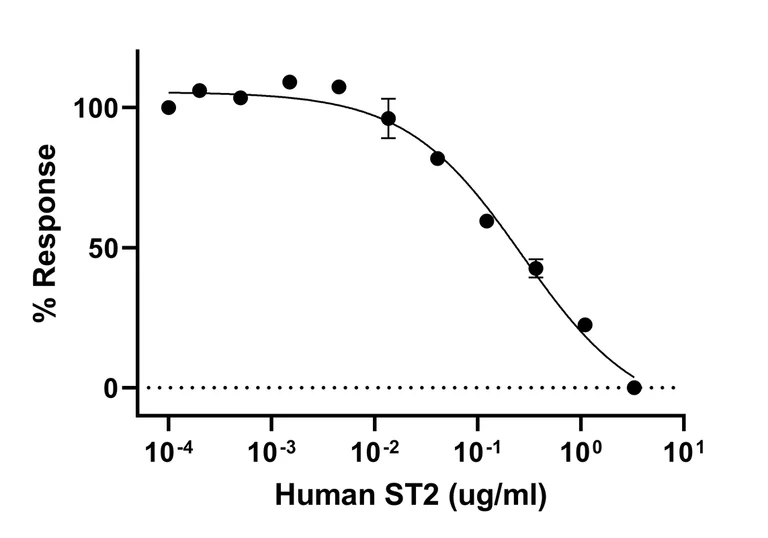
Functional Studies - Recombinant Human ST2 protein (Active) (AB283466)
  • FuncS

Supplier Data

Functional Studies - Recombinant Human ST2 protein (Active) (AB283466)

Fully biologically active determined by its ability to inhibit IL-33 dependent proliferation of D10S cells. The ED50 ≤ 0.27 µg/ml, corresponding to a specific activity of 3.7 x 10^3 units/mg.

SDS-PAGE - Recombinant Human ST2 protein (Active) (AB283466)
  • SDS-PAGE

Supplier Data

SDS-PAGE - Recombinant Human ST2 protein (Active) (AB283466)

SDS-page analysis of ab283466

Key facts

精製度

>95% SDS-PAGE

発現系

HEK 293 cells

タグ

Tag free

アプリケーション

FuncS, SDS-PAGE

applications

生物活性

Yes

生物学的活性

Fully biologically active determined by its ability to inhibit IL-33 dependent proliferation of D10S cells. The ED50 ≤ 0.27 μg/ml, corresponding to a specific activity of 3.7 x 10³ units/mg.

アクセッション番号

Q01638

アニマルフリー

Yes

キャリアフリー

No

種

Human

再構成

Reconstitute in PBS

バッファー組成

pH: 7.4 Constituents: 10.26% Trehalose, 0.727% Dibasic monohydrogen potassium phosphate, 0.248% Potassium phosphate monobasic

storage-buffer

Reactivity data

{ "title": "Reactivity Data", "filters": { "stats": ["", "Reactivity", "Dilution Info", "Notes"] }, "values": { "SDS-PAGE": { "reactivity":"TESTED_AND_REACTS", "dilution-info":"", "notes":"<p></p>" }, "FuncS": { "reactivity":"TESTED_AND_REACTS", "dilution-info":"", "notes":"<p></p>" } } }

配列情報

[{"linker":null,"sequence":"KFSKQSWGLENEALIVRCPRQGKPSYTVDWYYSQTNKSIPTQERNRVFASGQLLKFLPAAVADSGIYTCIVRSPTFNRTGYANVTIYKKQSDCNVPDYLMYSTVSGSEKNSKIYCPTIDLYNWTAPLEWFKNCQALQGSRYRAHKSFLVIDNVMTEDAGDYTCKFIHNENGANYSVTATRSFTVKDEQGFSLFPVIGAPAQNEIKEVEIGKNANLTCSACFGKGTQFLAAVLWQLNGTKITDFGEPRIQQEEGQNQSFSNGLACLDMVLRIADVKEEDLLLQYDCLALNLHGLRRHTVRLSRKNPIDHHS","proteinLength":"Fragment","predictedMolecularWeight":"35 kDa","actualMolecularWeight":null,"aminoAcidEnd":328,"aminoAcidStart":19,"nature":"Recombinant","expressionSystem":"HEK 293 cells","accessionNumber":"Q01638","tags":[]}]

出荷温度及び保存条件

製品の状態
Lyophilized
出荷温度
Ambient - Can Ship with Ice
短期保存温度
Ambient
長期保存温度
Ambient
True

補足情報

This supplementary information is collated from multiple sources and compiled automatically.

ST2 also known as IL-1RL1 or IL-1RL1 chimera protein is a member of the IL-1 receptor family. It has a molecular mass of approximately 55 kDa. This protein exists in different forms including a membrane-bound form and a soluble variant. Researchers typically find ST2 expressed in various tissues including the lungs gut and cardiovascular system. The expression level can vary significantly depending on the physiological or pathological state.
Biological function summary

ST2 interacts with interleukin-33 (IL-33) and functions as its receptor. The binding of IL-33 to ST2 activates immune responses particularly influencing T-helper 2 (Th2) cells. ST2 forms part of a receptor complex including IL-1 receptor accessory protein IL-1RAcP necessary for signal transduction. This interaction leads to the activation of nuclear factor kappa-light-chain-enhancer of activated B cells (NF-kB) and mitogen-activated protein kinase (MAPK) signaling pathways facilitating inflammatory responses.

Pathways

IL-33 signals through the ST2 receptor participating actively in the immune signaling pathway. This pathway plays a significant role in modulating inflammatory and immune responses. ST2 association with NF-kB broadly affects inflammatory signaling while its involvement with the MAPK pathway aids in cellular responses to cytokines and stress. The close relationship with the IL-33/ST2 axis highlights its importance in maintaining immune homeostasis and reacting to environmental stressors.

ST2 has significant associations with asthma and cardiovascular diseases. In asthma the IL-33/ST2 axis critically contributes to airway inflammation and hyperresponsiveness. Similarly in the context of cardiovascular diseases elevated levels of soluble ST2 are markers of heart failure with the ST2/IL-33 axis contributing to cardiac remodeling. ST2's connection with inflammatory processes implies it also interacts with other cytokines such as interleukin-6 (IL-6) exacerbating the disease states through shared pathways.

一般的な情報

機能

Receptor for interleukin-33 (IL-33) which plays crucial roles in innate and adaptive immunity, contributing to tissue homeostasis and responses to environmental stresses together with coreceptor IL1RAP (PubMed : 35238669). Its stimulation recruits MYD88, IRAK1, IRAK4, and TRAF6, followed by phosphorylation of MAPK3/ERK1 and/or MAPK1/ERK2, MAPK14, and MAPK8. Possibly involved in helper T-cell function (Probable) (PubMed : 16286016). Upon tissue injury, induces UCP2-dependent mitochondrial rewiring that attenuates the generation of reactive oxygen species and preserves the integrity of Krebs cycle required for persistent production of itaconate and subsequent GATA3-dependent differentiation of inflammation-resolving alternatively activated macrophages (By similarity).. Isoform B. Inhibits IL-33 signaling.

配列の類似性

Belongs to the interleukin-1 receptor family.

翻訳後修飾

Ubiquitinated at Lys-321 in a FBXL19-mediated manner; leading to proteasomal degradation. Ubiquitination by TRAF6 via 'Lys-27'-linked polyubiquitination and deubiquitination by USP38 serves as a critical regulatory mechanism for fine-tuning IL1RL1-mediated inflammatory response (PubMed:35238669).

製品プロトコール

ターゲットの情報

Receptor for interleukin-33 (IL-33) which plays crucial roles in innate and adaptive immunity, contributing to tissue homeostasis and responses to environmental stresses together with coreceptor IL1RAP (PubMed : 35238669). Its stimulation recruits MYD88, IRAK1, IRAK4, and TRAF6, followed by phosphorylation of MAPK3/ERK1 and/or MAPK1/ERK2, MAPK14, and MAPK8. Possibly involved in helper T-cell function (Probable) (PubMed : 16286016). Upon tissue injury, induces UCP2-dependent mitochondrial rewiring that attenuates the generation of reactive oxygen species and preserves the integrity of Krebs cycle required for persistent production of itaconate and subsequent GATA3-dependent differentiation of inflammation-resolving alternatively activated macrophages (By similarity).. Isoform B. Inhibits IL-33 signaling.
See full target information IL1RL1

Abcam product promise

当社は、高品質な試薬を通じてお客様の研究を力強くサポートすることをお約束いたします。ご使用いただく各段階で、常にお客様をサポートできる体制を整えております。万が一、製品が期待通りに機能しない場合は、「Abcam Product Promise」による当社保証制度に基づき、安心してご利用いただけます。
保証に関する詳細については利用規約をご確認ください。

Please note: All products are 'FOR RESEARCH USE ONLY. NOT FOR USE IN DIAGNOSTIC OR THERAPEUTIC PROCEDURES'.

For licensing inquiries, please contact partnerships@abcam.com