Recombinant Human SMP30 protein (denatured) (His tag N-Terminus)
Recombinant Human SMP30 protein (denatured) (His tag N-Terminus)
Be the first to review this product! Submit a review
|
(0 Publication)
Recombinant Human SMP30 protein (denatured) (His tag N-Terminus) is a Human Full Length protein, in the 1 to 299 aa range, expressed in Escherichia coli, with >85%, suitable for SDS-PAGE.
別名を表示する
SMP30, RGN, Regucalcin, RC, Gluconolactonase, Senescence marker protein 30, GNL, SMP-30
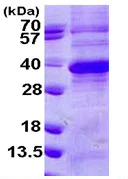
- SDS-PAGE
Unknown
SDS-PAGE - Recombinant Human SMP30 protein (denatured) (His tag N-Terminus) (AB113154)
15% SDS-PAGE showing ab113154 (3 μg) at approximately 35.4 kDa.
組合せ製品
Primary Antibodies
AB128870
Anti-Fatty Acid Synthase antibody [EPR7466]
20ul selling size|BOND RX™ Validated|RabMAb|Recombinant|KO Validated
- 4
- 2
Primary Antibodies
AB188230
Anti-RBP4 antibody [EPR18020-115]
BOND RX™ Validated|RabMAb|Recombinant|KO Validated
- 0
- 0
Primary Antibodies
AB236868
KO Validated|RabMAb|Recombinant|20ul selling size
- 0
- 0
Reactivity data
製品の詳細
配列情報
出荷温度及び保存条件
製品の状態
出荷温度
短期保存期間
短期保存温度
長期保存温度
分注に関する情報
保管に関する情報
補足情報
This supplementary information is collated from multiple sources and compiled automatically.
Biological function summary
SMP30 contributes to cellular longevity and protection against oxidative stress. This protein participates in several mechanisms that support cellular senescence and aging processes. SMP30 is part of a family of proteins that control intracellular calcium levels an important factor in cellular signaling and function. By maintaining calcium balance SMP30 enhances cell health and survival especially under conditions that challenge cellular stability.
Pathways
SMP30 plays important roles in the calcium signaling pathway and the oxidative stress response pathway. Within these pathways SMP30 interacts with proteins such as calmodulin and superoxide dismutase. Calmodulin links to calcium signaling while superoxide dismutase addresses oxidative stress management. These interactions place SMP30 centrally within pathways that govern cellular response to physiological and environmental changes.
一般的な情報
機能
Gluconolactonase with low activity towards other sugar lactones, including gulonolactone and galactonolactone. Can also hydrolyze diisopropyl phosphorofluoridate and phenylacetate (in vitro). Calcium-binding protein. Modulates Ca(2+) signaling, and Ca(2+)-dependent cellular processes and enzyme activities (By similarity).
配列の類似性
Belongs to the SMP-30/CGR1 family.
ターゲットの情報
Abcam product promise
Please note: All products are 'FOR RESEARCH USE ONLY. NOT FOR USE IN DIAGNOSTIC OR THERAPEUTIC PROCEDURES'.
For licensing inquiries, please contact partnerships@abcam.com