JavaScript is disabled in your browser. Please enable JavaScript to view this website.
AB99296

Recombinant Human Septin 2 protein (His tag N-Terminus)

Recombinant Human Septin 2 protein (His tag N-Terminus)

Be the first to review this product! Submit a review

|

(2 Publications)

Recombinant Human Septin 2 protein (His tag N-Terminus) is a Human Full Length protein, in the 1 to 361 aa range, expressed in Escherichia coli, with >90%, suitable for SDS-PAGE, Mass Spec.

別名を表示する

DIFF6, KIAA0158, NEDD5, SEPT2, SEPTIN2, Septin-2, Neural precursor cell expressed developmentally down-regulated protein 5, NEDD-5
1 Images
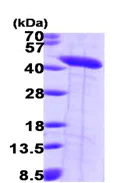
SDS-PAGE - Recombinant Human Septin 2 protein (His tag N-Terminus) (AB99296)
  • SDS-PAGE

Unknown

SDS-PAGE - Recombinant Human Septin 2 protein (His tag N-Terminus) (AB99296)

15% SDS-PAGE showing ab99296 (3μg).

Key facts

精製度

>90% SDS-PAGE

ab99296 is purified using conventional chromatography techniques.

発現系

Escherichia coli

タグ

His tag N-Terminus

アプリケーション

Mass Spec, SDS-PAGE

applications

生物活性

No

アクセッション番号

Q15019

アニマルフリー

No

キャリアフリー

No

種

Human

バッファー組成

pH: 8 Constituents: 10% Glycerol (glycerin, glycerine), 0.58% Sodium chloride, 0.316% Tris HCl, 0.0154% (R*,R*)-1,4-Dimercaptobutan-2,3-diol

storage-buffer

Reactivity data

{ "title": "Reactivity Data", "filters": { "stats": ["", "Reactivity", "Dilution Info", "Notes"] }, "values": { "SDS-PAGE": { "reactivity":"TESTED_AND_REACTS", "dilution-info":"", "notes":"<p></p>" }, "Mass Spec": { "reactivity":"TESTED_AND_REACTS", "dilution-info":"", "notes":"<p></p>" } } }

配列情報

[{"linker":null,"sequence":"MGSSHHHHHHSSGLVPRGSHMSKQQPTQFINPETPGYVGFANLPNQVHRKSVKKGFEFTLMVVGESGLGKSTLINSLFLTDLYPERVISGAAEKIERTVQIEASTVEIEERGVKLRLTVVDTPGYGDAINCRDCFKTIISYIDEQFERYLHDESGLNRRHIIDNRVHCCFYFISPFGHGLKPLDVAFMKAIHNKVNIVPVIAKADTLTLKERERLKKRILDEIEEHNIKIYHLPDAESDEDEDFKEQTRLLKASIPFSVVGSNQLIEAKGKKVRGRLYPWGVVEVENPEHNDFLKLRTMLITHMQDLQEVTQDLHYENFRSERLKRGGRKVENEDMNKDQILLEKEAELRRMQEMIARMQAQMQMQMQGGDGDGGALGHHV","proteinLength":"Full Length","predictedMolecularWeight":"43.6 kDa","actualMolecularWeight":null,"aminoAcidEnd":361,"aminoAcidStart":1,"nature":"Recombinant","expressionSystem":"Escherichia coli","accessionNumber":"Q15019","tags":[{"tag":"His","terminus":"N-Terminus"}]}]

出荷温度及び保存条件

製品の状態
Liquid
出荷温度
Blue Ice
短期保存温度
-20°C
長期保存温度
-20°C
分注に関する情報
Upon delivery aliquot
保管に関する情報
Avoid freeze / thaw cycle
False

補足情報

This supplementary information is collated from multiple sources and compiled automatically.

Septin 2 also known as septin-2 or SEPT2 is a GTP-binding protein with a molecular mass of approximately 41 kDa. It functions mechanically as a major component of the cytoskeletal structure playing an essential role in cellular organization and division. Septin 2 is expressed across various human tissues and cell types indicative of its fundamental role in maintaining cellular integrity. It participates in organizing the actin cytoskeleton and is necessary for cytokinesis.
Biological function summary

Septin 2 integrates into a filamentous network interacting closely with other septins to form hetero-oligomeric complexes essential for cellular dynamics. The protein contributes to the formation of diffusion barriers within membranes facilitating compartmentalization in the cells. As a structural element it supports cellular morphogenesis polarity and vesicle trafficking. The collaborative action within septin complexes ensures effective cell cycle progression and signal transduction.

Pathways

Septin 2 plays a part in key cellular pathways including the cell cycle and apoptosis pathways. The interaction of Septin 2 with proteins like Cdc42 and Rac1 impacts signaling cascades pivotal for actin cytoskeleton organization. The septin complex is important for modulating these pathways as it influences cellular responses to environmental cues. Through these pathways Septin 2 contributes to critical processes such as mitotic spindle positioning and stability.

Altered expression or function of Septin 2 is linked to cancer including gliomas where septin dysregulation affects tumor growth and metastasis. Additionally the protein has connections to neurodegenerative disorders such as Alzheimer's disease. Within these contexts proteins like Cdc42 and Rac1 further influence Septin 2's role modulating disease progression through pathways involved in cell migration and proliferation. Understanding Septin 2 in these disorders provides insight into potential therapeutic targets for intervention.

一般的な情報

機能

Filament-forming cytoskeletal GTPase. Forms a filamentous structure with SEPTIN12, SEPTIN6, SEPTIN2 and probably SEPTIN4 at the sperm annulus which is required for the structural integrity and motility of the sperm tail during postmeiotic differentiation (PubMed : 25588830). Required for normal organization of the actin cytoskeleton. Plays a role in the biogenesis of polarized columnar-shaped epithelium by maintaining polyglutamylated microtubules, thus facilitating efficient vesicle transport, and by impeding MAP4 binding to tubulin. Required for the progression through mitosis. Forms a scaffold at the midplane of the mitotic splindle required to maintain CENPE localization at kinetochores and consequently chromosome congression. During anaphase, may be required for chromosome segregation and spindle elongation. Plays a role in ciliogenesis and collective cell movements. In cilia, required for the integrity of the diffusion barrier at the base of the primary cilium that prevents diffusion of transmembrane proteins between the cilia and plasma membranes : probably acts by regulating the assembly of the tectonic-like complex (also named B9 complex) by localizing TMEM231 protein. May play a role in the internalization of 2 intracellular microbial pathogens, Listeria monocytogenes and Shigella flexneri.

配列の類似性

Belongs to the TRAFAC class TrmE-Era-EngA-EngB-Septin-like GTPase superfamily. Septin GTPase family.

細胞内局在性

Cytoskeleton

製品プロトコール

ターゲットの情報

Filament-forming cytoskeletal GTPase. Forms a filamentous structure with SEPTIN12, SEPTIN6, SEPTIN2 and probably SEPTIN4 at the sperm annulus which is required for the structural integrity and motility of the sperm tail during postmeiotic differentiation (PubMed : 25588830). Required for normal organization of the actin cytoskeleton. Plays a role in the biogenesis of polarized columnar-shaped epithelium by maintaining polyglutamylated microtubules, thus facilitating efficient vesicle transport, and by impeding MAP4 binding to tubulin. Required for the progression through mitosis. Forms a scaffold at the midplane of the mitotic splindle required to maintain CENPE localization at kinetochores and consequently chromosome congression. During anaphase, may be required for chromosome segregation and spindle elongation. Plays a role in ciliogenesis and collective cell movements. In cilia, required for the integrity of the diffusion barrier at the base of the primary cilium that prevents diffusion of transmembrane proteins between the cilia and plasma membranes : probably acts by regulating the assembly of the tectonic-like complex (also named B9 complex) by localizing TMEM231 protein. May play a role in the internalization of 2 intracellular microbial pathogens, Listeria monocytogenes and Shigella flexneri.
See full target information SEPTIN2

文献 (2)

Recent publications for all applications. Explore the full list and refine your search

Journal of hazardous materials 476:135177 PubMed39018595

2024

Chlordecone-induced hepatotoxicity and fibrosis are mediated by the proteasomal degradation of septins.

Applications

Unspecified application

Species

Unspecified reactive species

Thibaut Léger,Sarah Alilat,Pierre-Jean Ferron,Léonie Dec,Tahar Bouceba,Rachelle Lanceleur,Sylvie Huet,Yoann Devriendt-Renault,Julien Parinet,Bruno Clément,Valérie Fessard,Ludovic Le Hégarat

Neuron 101:1089-1098.e4 PubMed30713029

2019

Zika Virus Protease Cleavage of Host Protein Septin-2 Mediates Mitotic Defects in Neural Progenitors.

Applications

Unspecified application

Species

Unspecified reactive species

Hongda Li,Laura Saucedo-Cuevas,Ling Yuan,Danica Ross,Anide Johansen,Daniel Sands,Valentina Stanley,Alicia Guemez-Gamboa,Anne Gregor,Todd Evans,Shuibing Chen,Lei Tan,Henrik Molina,Nicholas Sheets,Sergey A Shiryaev,Alexey V Terskikh,Amy S Gladfelter,Sujan Shresta,Zhiheng Xu,Joseph G Gleeson
View all publications

Abcam product promise

当社は、高品質な試薬を通じてお客様の研究を力強くサポートすることをお約束いたします。ご使用いただく各段階で、常にお客様をサポートできる体制を整えております。万が一、製品が期待通りに機能しない場合は、「Abcam Product Promise」による当社保証制度に基づき、安心してご利用いただけます。
保証に関する詳細については利用規約をご確認ください。

Please note: All products are 'FOR RESEARCH USE ONLY. NOT FOR USE IN DIAGNOSTIC OR THERAPEUTIC PROCEDURES'.

For licensing inquiries, please contact partnerships@abcam.com