Recombinant Human RPS3 protein (His tag N-Terminus)
Recombinant Human RPS3 protein (His tag N-Terminus)
Be the first to review this product! Submit a review
|
(1 Publication)
Recombinant Human RPS3 protein (His tag N-Terminus) is a Human Full Length protein, in the 1 to 263 aa range, expressed in Escherichia coli, with >90%, suitable for Mass Spec, SDS-PAGE.
別名を表示する
OK/SW-cl.26, RPS3, Small ribosomal subunit protein uS3, 40S ribosomal protein S3
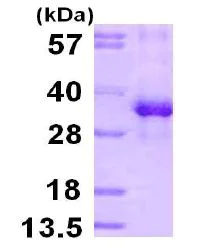
- SDS-PAGE
Unknown
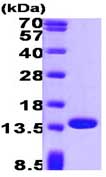
SDS-PAGE - Recombinant Human RPS3 protein (His tag N-Terminus) (AB113158)
ab113158 at 3 μg analysed by 15% SDS PAGE. The molecular weight on SDS-PAGE will appear higher than predicted.
組合せ製品
Reactivity data
配列情報
出荷温度及び保存条件
製品の状態
出荷温度
短期保存期間
短期保存温度
長期保存温度
分注に関する情報
保管に関する情報
補足情報
This supplementary information is collated from multiple sources and compiled automatically.
Biological function summary
Protein synthesis relies heavily on components like RPS3 within the ribosomal complex where it interacts with other ribosomal proteins and rRNA to ensure accurate translation. RPS3 also exhibits DNA repair activities independently of its ribosomal function. It binds to DNA damaged sites adding a layer of protection to help maintain genomic stability by facilitating repair processes.
Pathways
RPS3 participates actively in the mRNA translation and DNA repair pathways. Inside the ribosome biogenesis pathway RPS3 interacts closely with other ribosomal proteins like RPS19 and RPS20 to form functional ribosomal units. In the context of DNA repair it aligns with interaction networks that overlap with the NHEJ (Non-Homologous End Joining) pathway thereby influencing genomic maintenance alongside proteins such as XRCC5.
一般的な情報
機能
Component of the small ribosomal subunit (PubMed : 23636399, PubMed : 8706699). The ribosome is a large ribonucleoprotein complex responsible for the synthesis of proteins in the cell (PubMed : 23636399, PubMed : 8706699). Has endonuclease activity and plays a role in repair of damaged DNA (PubMed : 7775413). Cleaves phosphodiester bonds of DNAs containing altered bases with broad specificity and cleaves supercoiled DNA more efficiently than relaxed DNA (PubMed : 15707971). Displays high binding affinity for 7,8-dihydro-8-oxoguanine (8-oxoG), a common DNA lesion caused by reactive oxygen species (ROS) (PubMed : 14706345). Has also been shown to bind with similar affinity to intact and damaged DNA (PubMed : 18610840). Stimulates the N-glycosylase activity of the base excision protein OGG1 (PubMed : 15518571). Enhances the uracil excision activity of UNG1 (PubMed : 18973764). Also stimulates the cleavage of the phosphodiester backbone by APEX1 (PubMed : 18973764). When located in the mitochondrion, reduces cellular ROS levels and mitochondrial DNA damage (PubMed : 23911537). Has also been shown to negatively regulate DNA repair in cells exposed to hydrogen peroxide (PubMed : 17049931). Plays a role in regulating transcription as part of the NF-kappa-B p65-p50 complex where it binds to the RELA/p65 subunit, enhances binding of the complex to DNA and promotes transcription of target genes (PubMed : 18045535). Represses its own translation by binding to its cognate mRNA (PubMed : 20217897). Binds to and protects TP53/p53 from MDM2-mediated ubiquitination (PubMed : 19656744). Involved in spindle formation and chromosome movement during mitosis by regulating microtubule polymerization (PubMed : 23131551). Involved in induction of apoptosis through its role in activation of CASP8 (PubMed : 14988002). Induces neuronal apoptosis by interacting with the E2F1 transcription factor and acting synergistically with it to up-regulate pro-apoptotic proteins BCL2L11/BIM and HRK/Dp5 (PubMed : 20605787). Interacts with TRADD following exposure to UV radiation and induces apoptosis by caspase-dependent JNK activation (PubMed : 22510408).
配列の類似性
Belongs to the universal ribosomal protein uS3 family.
翻訳後修飾
Methylation by PRMT1 is required for import into the nucleolus and for ribosome assembly.. Sumoylation by SUMO1 enhances protein stability through increased resistance to proteolysis. Sumoylation occurs at one or more of the three consensus sites, Lys-18, Lys-214 and Lys-230.. Phosphorylation at Thr-221 by CDK1 occurs mainly in G2/M phase (PubMed:21871177). Phosphorylation by PRKCD occurs on a non-ribosomal-associated form which results in translocation of RPS3 to the nucleus and enhances its endonuclease activity (PubMed:19059439). Phosphorylated on Ser-209 by IKKB in response to activation of the NF-kappa-B p65-p50 complex which enhances the association of RPS3 with importin-alpha and mediates the nuclear translocation of RPS3 (PubMed:21399639). Phosphorylation by MAPK is required for translocation to the nucleus following exposure of cells to DNA damaging agents such as hydrogen peroxide (PubMed:17560175). Phosphorylation by PKB/AKT mediates RPS3 nuclear translocation, enhances RPS3 endonuclease activity and suppresses RPS3-induced neuronal apoptosis (PubMed:20605787).. Ubiquitinated; ubiquitination is prevented by interaction with HSP90 which stabilizes the protein (PubMed:16314389). Monoubiquitinated at Lys-214 by RNF10 and ZNF598 when a ribosome has stalled during translation of poly(A) sequences, leading to preclude synthesis of a long poly-lysine tail and initiate the ribosome quality control (RQC) pathway to degrade the potentially detrimental aberrant nascent polypeptide (PubMed:28065601, PubMed:28132843, PubMed:32011234, PubMed:34348161, PubMed:34469731). Deubiquitinated at Lys-214 by USP10, preventing degradation by the proteasome and promoting 40S ribosome subunit recycling following ribosome dissociation (PubMed:31981475, PubMed:34469731).. Ufmylated by UFL1.
ターゲットの情報
文献 (1)
Recent publications for all applications. Explore the full list and refine your search
Antioxidants (Basel, Switzerland) 13: PubMed38929092
2024
Applications
Unspecified application
Species
Unspecified reactive species
Abcam product promise
Please note: All products are 'FOR RESEARCH USE ONLY. NOT FOR USE IN DIAGNOSTIC OR THERAPEUTIC PROCEDURES'.
For licensing inquiries, please contact partnerships@abcam.com