Recombinant ヒト Ret protein (GST tag N-Terminus)
Recombinant human Ret protein (GST tag N-Terminus)
Be the first to review this product! Submit a review
|
(0 Publication)
Recombinant human Ret protein (GST tag N-Terminus) is a Human Fragment protein, in the 658 to 1114 aa range, expressed in Baculovirus infected Sf9 cells, with >80%, suitable for SDS-PAGE, WB, FuncS.
別名を表示する
CDHF12, CDHR16, PTC, RET, RET51, Proto-oncogene tyrosine-protein kinase receptor Ret, Cadherin family member 12, Proto-oncogene c-Ret
- FuncS
Unknown
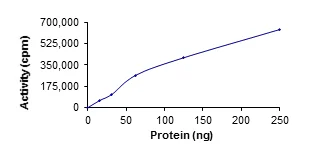
Functional Studies - Recombinant human Ret protein (GST tag N-Terminus) (AB84791)
The specific activity of Ret (ab84791) was determined to be 78 nmol/min/mg as per activity assay protocol
- FuncS
Unknown
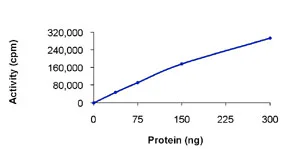
Functional Studies - Recombinant human Ret protein (GST tag N-Terminus) (AB84791)
The Specific activity of ab84791 was determined to be 67 nmol/min/mg.
- SDS-PAGE
Unknown
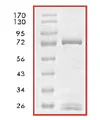
SDS-PAGE - Recombinant human Ret protein (GST tag N-Terminus) (AB84791)
SDS-PAGE showing ab84791 at approximately 74kDa.
- SDS-PAGE
Unknown
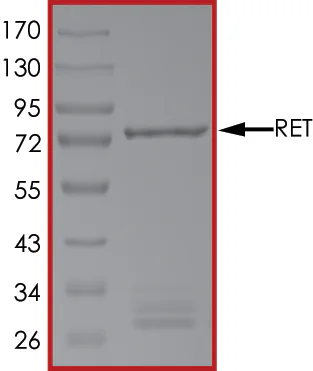
SDS-PAGE - Recombinant human Ret protein (GST tag N-Terminus) (AB84791)
SDS PAGE analysis of ab84791
組合せ製品
Reagents, Controls & Accessories
AB325997
Prestained Protein Ladder - Extra broad molecular weight (3-250 kDa, 5-color)

- 0
- 0

Primary Antibodies
AB134100
RabMAb|Recombinant|20ul selling size|KO Validated

- 4
- 8

Reactivity data
製品の詳細
配列情報
出荷温度及び保存条件
製品の状態
精製方法
出荷温度
短期保存温度
長期保存温度
分注に関する情報
保管に関する情報
補足情報
This supplementary information is collated from multiple sources and compiled automatically.
Biological function summary
The Ret protein facilitates several critical processes within the body. It functions as part of a complex with co-receptors called GFRα (GDNF family receptor alpha) which are required for binding ligands such as GDNF (glial cell line-derived neurotrophic factor). This binding activates downstream signaling pathways that influence cell growth differentiation and survival particularly within the nervous system. The proper functioning of Ret is essential for the development and maintenance of these cellular environments.
Pathways
Ret is an important component of the MAPK/ERK and PI3K/AKT signaling pathways. These pathways mediate various cellular responses including cell proliferation survival and apoptosis. The interactions of Ret with other proteins like SHC and GRB2 within these pathways create ripple effects that impact larger cellular networks. Through these pathways Ret connects with multiple proteins to modulate essential biological processes.
一般的な情報
機能
Receptor tyrosine-protein kinase involved in numerous cellular mechanisms including cell proliferation, neuronal navigation, cell migration, and cell differentiation in response to glia cell line-derived growth family factors (GDNF, NRTN, ARTN, PSPN and GDF15) (PubMed : 20064382, PubMed : 20616503, PubMed : 20702524, PubMed : 21357690, PubMed : 21454698, PubMed : 24560924, PubMed : 28846097, PubMed : 28846099, PubMed : 28953886, PubMed : 31118272). In contrast to most receptor tyrosine kinases, RET requires not only its cognate ligands but also coreceptors, for activation (PubMed : 21994944, PubMed : 23333276, PubMed : 28846097, PubMed : 28846099, PubMed : 28953886). GDNF ligands (GDNF, NRTN, ARTN, PSPN and GDF15) first bind their corresponding GDNFR coreceptors (GFRA1, GFRA2, GFRA3, GFRA4 and GFRAL, respectively), triggering RET autophosphorylation and activation, leading to activation of downstream signaling pathways, including the MAPK- and AKT-signaling pathways (PubMed : 21994944, PubMed : 23333276, PubMed : 24560924, PubMed : 25242331, PubMed : 28846097, PubMed : 28846099, PubMed : 28953886). Acts as a dependence receptor via the GDNF-GFRA1 signaling : in the presence of the ligand GDNF in somatotrophs within pituitary, promotes survival and down regulates growth hormone (GH) production, but triggers apoptosis in absence of GDNF (PubMed : 20616503, PubMed : 21994944). Required for the molecular mechanisms orchestration during intestine organogenesis via the ARTN-GFRA3 signaling : involved in the development of enteric nervous system and renal organogenesis during embryonic life, and promotes the formation of Peyer's patch-like structures, a major component of the gut-associated lymphoid tissue (By similarity). Mediates, through interaction with GDF15-receptor GFRAL, GDF15-induced cell-signaling in the brainstem which triggers an aversive response, characterized by nausea, vomiting, and/or loss of appetite in response to various stresses (PubMed : 28846097, PubMed : 28846099, PubMed : 28953886). Modulates cell adhesion via its cleavage by caspase in sympathetic neurons and mediates cell migration in an integrin (e.g. ITGB1 and ITGB3)-dependent manner (PubMed : 20702524, PubMed : 21357690). Also active in the absence of ligand, triggering apoptosis through a mechanism that requires receptor intracellular caspase cleavage (PubMed : 21357690). Triggers the differentiation of rapidly adapting (RA) mechanoreceptors (PubMed : 20064382). Involved in the development of the neural crest (By similarity). Regulates nociceptor survival and size (By similarity). Phosphorylates PTK2/FAK1 (PubMed : 21454698).. Isoform 1. Isoform 1 in complex with GFRAL induces higher activation of MAPK-signaling pathway than isoform 2 in complex with GFRAL.
配列の類似性
Belongs to the protein kinase superfamily. Tyr protein kinase family.
翻訳後修飾
Autophosphorylated on C-terminal tyrosine residues upon ligand stimulation.. Proteolytically cleaved by caspase-3. The soluble RET kinase fragment is able to induce cell death. The extracellular cell-membrane anchored RET cadherin fragment accelerates cell adhesion in sympathetic neurons.
細胞内局在性
Endosome membrane
ターゲットの情報
Abcam product promise
Please note: All products are 'FOR RESEARCH USE ONLY. NOT FOR USE IN DIAGNOSTIC OR THERAPEUTIC PROCEDURES'.
For licensing inquiries, please contact partnerships@abcam.com