Recombinant Human RanBP3 protein (His tag N-Terminus)
Recombinant Human RanBP3 protein (His tag N-Terminus)
Be the first to review this product! Submit a review
|
(0 Publication)
Recombinant Human RanBP3 protein (His tag N-Terminus) is a Human Fragment protein, in the 235 to 445 aa range, expressed in Escherichia coli, with >95%, suitable for SDS-PAGE, Mass Spec.
別名を表示する
Ran-binding protein 3, RanBP3, RANBP3

- SDS-PAGE
Supplier Data
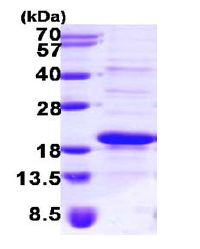
SDS-PAGE - Recombinant Human RanBP3 protein (His tag N-Terminus) (AB181938)
15% SDS-PAGE analysis of 3 μg ab181938 .
組合せ製品
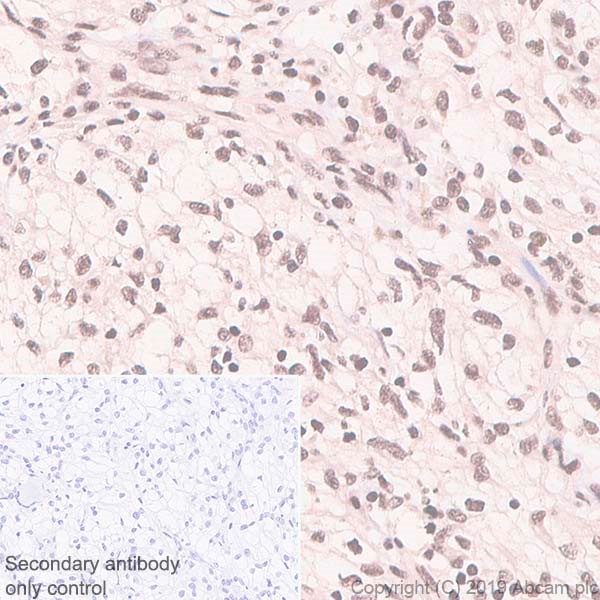
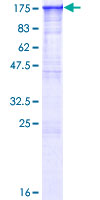
Reactivity data
配列情報
出荷温度及び保存条件
製品の状態
出荷温度
短期保存期間
短期保存温度
長期保存温度
分注に関する情報
保管に関する情報
補足情報
This supplementary information is collated from multiple sources and compiled automatically.
Biological function summary
RanBP3 modulates cargo recognition and assembly of export complexes. It plays a role in the nuclear transport of proteins impacting gene regulation and cell cycle progression. As part of a larger export complex RanBP3 works together with exportin-1 and the GTP-bound form of Ran to mediate the nuclear export process efficiently. This targeted export contributes to maintaining cellular homeostasis and influences cellular responses to environmental changes.
Pathways
RanBP3 importantly participates in the nucleocytoplasmic transport pathway. This pathway is important for the regulation of gene expression and signal transduction. RanBP3 interacts with proteins such as exportin-1 (CRM1) and CAS which coordinate the nuclear export of various proteins and RNAs. The pathway ensures the proper distribution of cellular components which is essential for cell function and survival.
一般的な情報
機能
Acts as a cofactor for XPO1/CRM1-mediated nuclear export, perhaps as export complex scaffolding protein. Bound to XPO1/CRM1, stabilizes the XPO1/CRM1-cargo interaction. In the absence of Ran-bound GTP prevents binding of XPO1/CRM1 to the nuclear pore complex. Binds to CHC1/RCC1 and increases the guanine nucleotide exchange activity of CHC1/RCC1. Recruits XPO1/CRM1 to CHC1/RCC1 in a Ran-dependent manner. Negative regulator of TGF-beta signaling through interaction with the R-SMAD proteins, SMAD2 and SMAD3, and mediating their nuclear export.
翻訳後修飾
Phosphorylation at Ser-126 promotes its import into the nucleus.
細胞内局在性
Nucleus
ターゲットの情報
Abcam product promise
Please note: All products are 'FOR RESEARCH USE ONLY. NOT FOR USE IN DIAGNOSTIC OR THERAPEUTIC PROCEDURES'.
For licensing inquiries, please contact partnerships@abcam.com