JavaScript is disabled in your browser. Please enable JavaScript to view this website.
AB217826

Recombinant ヒト PRAK/MK5 protein (GST tag N-Terminus)

Recombinant Human PRAK/MK5 protein (GST tag N-Terminus)

Be the first to review this product! Submit a review

|

(0 Publication)

Recombinant Human PRAK/MK5 protein (GST tag N-Terminus) is a Human Full Length protein, in the 1 to 473 aa range, expressed in Baculovirus infected Sf9 cells, with >85%, suitable for SDS-PAGE, WB.

別名を表示する

PRAK, MAPKAPK5, MAP kinase-activated protein kinase 5, MAPK-activated protein kinase 5, MAPKAP kinase 5, MAPKAP-K5, MAPKAPK-5, MK-5, MK5, p38-regulated/activated protein kinase
1 Images
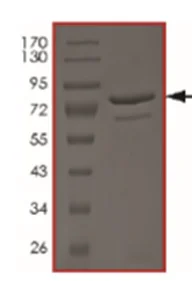
SDS-PAGE - Recombinant Human PRAK/MK5 protein (GST tag N-Terminus) (AB217826)
  • SDS-PAGE

Supplier Data

SDS-PAGE - Recombinant Human PRAK/MK5 protein (GST tag N-Terminus) (AB217826)

SDS-PAGE analysis of ab217826.

Key facts

精製度

>85% Densitometry

Affinity purified.

発現系

Baculovirus infected Sf9 cells

タグ

GST tag N-Terminus

アプリケーション

WB, SDS-PAGE

applications

生物活性

No

アクセッション番号

Q8IW41

アニマルフリー

No

キャリアフリー

No

種

Human

バッファー組成

pH: 7.5 Constituents: 25% Glycerol (glycerin, glycerine), 0.87% Sodium chloride, 0.79% Tris HCl, 0.31% Glutathione, 0.04% (R*,R*)-1,4-Dimercaptobutan-2,3-diol, 0.03% EDTA, 0.002% PMSF

storage-buffer

Reactivity data

{ "title": "Reactivity Data", "filters": { "stats": ["", "Reactivity", "Dilution Info", "Notes"] }, "values": { "SDS-PAGE": { "reactivity":"TESTED_AND_REACTS", "dilution-info":"", "notes":"<p></p>" }, "WB": { "reactivity":"TESTED_AND_REACTS", "dilution-info":"", "notes":"<p></p>" } } }

製品の詳細

This product was previously labelled as PRAK

配列情報

[{"linker":null,"sequence":"MSEESDMDKAIKETSILEEYSINWTQKLGAGISGPVRVCVKKSTQERFALKILLDRPKARNEVRLHMMCATHPNIVQIIEVFANSVQFPHESSPRARLLIVMEMMEGGELFHRISQHRHFTEKQASQVTKQIALALRHCHLLNIAHRDLKPENLLFKDNSLDAPVKLCDFGFAKIDQGDLMTPQFTPYYVAPQVLEAQRRHQKEKSGIIPTSPTPYTYNKSCDLWSLGVIIYVMLCGYPPFYSKHHSRTIPKDMRRKIMTGSFEFPEEEWSQISEMAKDVVRKLLKVKPEERLTIEGVLDHPWLNSTEALDNVLPSAQLMMDKAVVAGIQQAHAEQLANMRIQDLKVSLKPLHSVNNPILRKRKLLGTKPKDSVYIHDHENGAEDSNVALEKLRDVIAQCILPQAGKGENEDEKLNEVMQEAWKYNRECKLLRDTLQSFSWNGRGFTDKVDRLKLAEIVKQVIEEQTTSHESQ","proteinLength":"Full Length","predictedMolecularWeight":"79 kDa","actualMolecularWeight":null,"aminoAcidEnd":473,"aminoAcidStart":1,"nature":"Recombinant","expressionSystem":"Baculovirus infected Sf9 cells","accessionNumber":"Q8IW41","tags":[{"tag":"GST","terminus":"N-Terminus"}]}]

出荷温度及び保存条件

製品の状態
Liquid
精製方法
Affinity purification
出荷温度
Dry Ice
短期保存温度
-80°C
長期保存温度
-80°C
分注に関する情報
Upon delivery aliquot
保管に関する情報
Avoid freeze / thaw cycle
False

補足情報

This supplementary information is collated from multiple sources and compiled automatically.

PRAK also known as MK5 is a serine/threonine protein kinase with a molecular weight of approximately 54 kDa. It is expressed in various tissues like the heart brain liver and skeletal muscle. PRAK belongs to the mitogen-activated protein kinase (MAPK) signaling pathway and gets activated by phosphorylation. Mechanically PRAK interacts with and phosphorylates other proteins which affects their activity and function playing an important role in regulating cellular processes such as stress response and the cell cycle.
Biological function summary

PRAK/MK5 is a critical component in the regulation of cellular responses to stress stimuli. It is a participant in the activation loop of the MAPK p38 signaling pathway where it serves to influence the phosphorylation state and activity of downstream effectors. PRAK is not typically known to be part of a large complex but it interacts directly with other kinases to amplify or dampen the stress response signal. This allows cells to adapt to varied stress conditions by modulating gene expression apoptosis and other cell fate decisions.

Pathways

PRAK/MK5 plays essential roles within the p38 MAPK and ERK signaling pathways. It closely associates with p38 MAPK which phosphorylates and activates PRAK enabling it to further disseminate the signal. In these pathways PRAK interplays with proteins such as MAPKAPK-2 and HSP27 facilitating diverse cellular activities like inflammation and differentiation. These signaling networks allow PRAK to serve as a link between external stimuli and internal cellular outcomes.

PRAK/MK5 influences cancer and cardiovascular diseases. Its activity connects closely with tumor suppression wherein it regulates actions involving proteins like p53 and HSP27 impacting cell cycle arrest and apoptosis. In cardiovascular contexts altered PRAK function can relate to heart disease since it regulates stress-induced cardiac responses. Understanding PRAK's interplay with these proteins sheds light on its potential as a therapeutic target for treating diseases related to stress signaling dysfunction.

一般的な情報

機能

Tumor suppressor serine/threonine-protein kinase involved in mTORC1 signaling and post-transcriptional regulation. Phosphorylates FOXO3, ERK3/MAPK6, ERK4/MAPK4, HSP27/HSPB1, p53/TP53 and RHEB. Acts as a tumor suppressor by mediating Ras-induced senescence and phosphorylating p53/TP53. Involved in post-transcriptional regulation of MYC by mediating phosphorylation of FOXO3 : phosphorylation of FOXO3 leads to promote nuclear localization of FOXO3, enabling expression of miR-34b and miR-34c, 2 post-transcriptional regulators of MYC that bind to the 3'UTR of MYC transcript and prevent MYC translation. Acts as a negative regulator of mTORC1 signaling by mediating phosphorylation and inhibition of RHEB. Part of the atypical MAPK signaling via its interaction with ERK3/MAPK6 or ERK4/MAPK4 : the precise role of the complex formed with ERK3/MAPK6 or ERK4/MAPK4 is still unclear, but the complex follows a complex set of phosphorylation events : upon interaction with atypical MAPK (ERK3/MAPK6 or ERK4/MAPK4), ERK3/MAPK6 (or ERK4/MAPK4) is phosphorylated and then mediates phosphorylation and activation of MAPKAPK5, which in turn phosphorylates ERK3/MAPK6 (or ERK4/MAPK4). Mediates phosphorylation of HSP27/HSPB1 in response to PKA/PRKACA stimulation, inducing F-actin rearrangement.

配列の類似性

Belongs to the protein kinase superfamily. CAMK Ser/Thr protein kinase family.

翻訳後修飾

Phosphorylated on Thr-182 ERK3/MAPK6 or ERK4/MAPK4; which is the regulatory phosphorylation site and is located on the T-loop/loop 12, leading to activation. Phosphorylation at Thr-182 by p38-alpha/MAPK14, p38-beta/MAPK11 is subject to debate. Phosphorylated at Ser-115 by PKA/PRKACA, leading to localization to the cytoplasm. Autophosphorylated (By similarity).

製品プロトコール

ターゲットの情報

Tumor suppressor serine/threonine-protein kinase involved in mTORC1 signaling and post-transcriptional regulation. Phosphorylates FOXO3, ERK3/MAPK6, ERK4/MAPK4, HSP27/HSPB1, p53/TP53 and RHEB. Acts as a tumor suppressor by mediating Ras-induced senescence and phosphorylating p53/TP53. Involved in post-transcriptional regulation of MYC by mediating phosphorylation of FOXO3 : phosphorylation of FOXO3 leads to promote nuclear localization of FOXO3, enabling expression of miR-34b and miR-34c, 2 post-transcriptional regulators of MYC that bind to the 3'UTR of MYC transcript and prevent MYC translation. Acts as a negative regulator of mTORC1 signaling by mediating phosphorylation and inhibition of RHEB. Part of the atypical MAPK signaling via its interaction with ERK3/MAPK6 or ERK4/MAPK4 : the precise role of the complex formed with ERK3/MAPK6 or ERK4/MAPK4 is still unclear, but the complex follows a complex set of phosphorylation events : upon interaction with atypical MAPK (ERK3/MAPK6 or ERK4/MAPK4), ERK3/MAPK6 (or ERK4/MAPK4) is phosphorylated and then mediates phosphorylation and activation of MAPKAPK5, which in turn phosphorylates ERK3/MAPK6 (or ERK4/MAPK4). Mediates phosphorylation of HSP27/HSPB1 in response to PKA/PRKACA stimulation, inducing F-actin rearrangement.
See full target information MAPKAPK5

Abcam product promise

当社は、高品質な試薬を通じてお客様の研究を力強くサポートすることをお約束いたします。ご使用いただく各段階で、常にお客様をサポートできる体制を整えております。万が一、製品が期待通りに機能しない場合は、「Abcam Product Promise」による当社保証制度に基づき、安心してご利用いただけます。
保証に関する詳細については利用規約をご確認ください。

Please note: All products are 'FOR RESEARCH USE ONLY. NOT FOR USE IN DIAGNOSTIC OR THERAPEUTIC PROCEDURES'.

For licensing inquiries, please contact partnerships@abcam.com