JavaScript is disabled in your browser. Please enable JavaScript to view this website.
AB128553

Recombinant ヒト PPM1G protein (GST tag N-Terminus)

Recombinant human PPM1G protein (GST tag N-Terminus)

Be the first to review this product! Submit a review

|

(0 Publication)

Recombinant human PPM1G protein (GST tag N-Terminus) is a Human Full Length protein, in the 1 to 546 aa range, expressed in Baculovirus infected Sf9 cells, with >95%, suitable for SDS-PAGE, WB, FuncS.

別名を表示する

PPM1C, PPM1G, Protein phosphatase 1G, Protein phosphatase 1C, Protein phosphatase 2C isoform gamma, Protein phosphatase magnesium-dependent 1 gamma, PP2C-gamma
4 Images
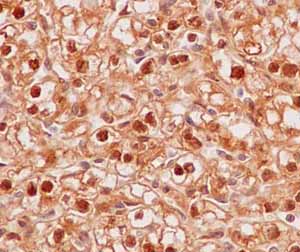
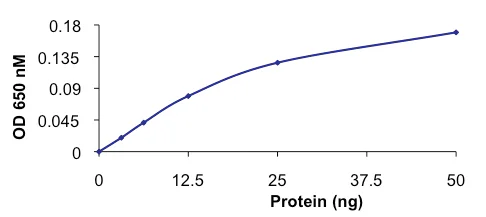
Functional Studies - Recombinant human PPM1G protein (GST tag N-Terminus) (AB128553)
  • FuncS

Unknown

Functional Studies - Recombinant human PPM1G protein (GST tag N-Terminus) (AB128553)

The specific activity of PPM1G (ab128553) was determined to be 2400 nmol/min/mg as per activity assay protocol
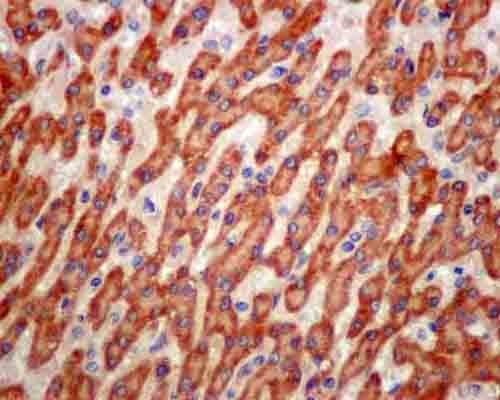
Functional Studies - Recombinant human PPM1G protein (GST tag N-Terminus) (AB128553)
  • FuncS

Unknown

Functional Studies - Recombinant human PPM1G protein (GST tag N-Terminus) (AB128553)

Biological activity of ab128553

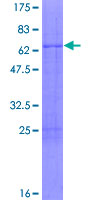
SDS-PAGE - Recombinant human PPM1G protein (GST tag N-Terminus) (AB128553)
  • SDS-PAGE

Unknown

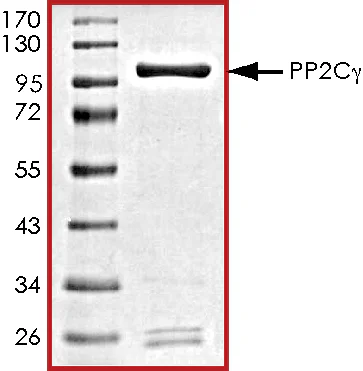
SDS-PAGE - Recombinant human PPM1G protein (GST tag N-Terminus) (AB128553)

SDS Page analysis of ab128553
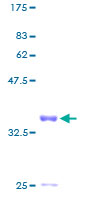
SDS-PAGE - Recombinant human PPM1G protein (GST tag N-Terminus) (AB128553)
  • SDS-PAGE

Unknown

SDS-PAGE - Recombinant human PPM1G protein (GST tag N-Terminus) (AB128553)

SDS PAGE analysis of ab128553

Key facts

精製度

>95% SDS-PAGE

Affinity purified.

発現系

Baculovirus infected Sf9 cells

タグ

GST tag N-Terminus

アプリケーション

SDS-PAGE, WB, FuncS

applications

生物活性

Yes

生物学的活性

The specific activity of ab128553 was determined to be 2,400 nmol/min/mg

アクセッション番号

O15355

アニマルフリー

No

キャリアフリー

No

種

Human

バッファー組成

pH: 7.5 Constituents: 25% Glycerol (glycerin, glycerine), 0.88% Sodium chloride, 0.79% Tris HCl, 0.31% Glutathione, 0.02% PMSF, 0.004% (R*,R*)-1,4-Dimercaptobutan-2,3-diol, 0.003% EDTA

storage-buffer

Reactivity data

{ "title": "Reactivity Data", "filters": { "stats": ["", "Reactivity", "Dilution Info", "Notes"] }, "values": { "SDS-PAGE": { "reactivity":"TESTED_AND_REACTS", "dilution-info":"", "notes":"<p></p>" }, "WB": { "reactivity":"TESTED_AND_REACTS", "dilution-info":"", "notes":"<p></p>" }, "FuncS": { "reactivity":"TESTED_AND_REACTS", "dilution-info":"", "notes":"<p></p>" } } }

配列情報

[{"linker":null,"sequence":"","proteinLength":"Full Length","predictedMolecularWeight":"105 kDa","actualMolecularWeight":null,"aminoAcidEnd":546,"aminoAcidStart":1,"nature":"Recombinant","expressionSystem":null,"accessionNumber":"O15355","tags":[{"tag":"GST","terminus":"N-Terminus"}]}]

出荷温度及び保存条件

製品の状態
Liquid
精製方法
Affinity purification
出荷温度
Dry Ice
短期保存温度
-80°C
長期保存温度
-80°C
分注に関する情報
Upon delivery aliquot
保管に関する情報
Avoid freeze / thaw cycle
True

補足情報

This supplementary information is collated from multiple sources and compiled automatically.

PPM1G also known as protein phosphatase 1G is a member of the protein phosphatase 2C (PP2C) family. This enzyme has a molecular mass of approximately 58 kDa. It localizes mainly in the nucleus and is expressed in various tissues including the brain testis and skeletal muscle. PPM1G functions as a serine/threonine phosphatase removing phosphate groups from target proteins and playing a role in the regulation of cellular stress responses and cell cycle progression.
Biological function summary

PPM1G contributes to several cellular functions by interacting with different substrates. As a component of the cellular machinery it is involved in processes such as RNA processing and regulation of mitosis. The enzyme participates in dephosphorylation events critical for the assembly and disassembly of the spliceosome complex which is important for accurate mRNA splicing. PPM1G's activity helps maintain the proper function of these cellular processes ensuring the stability and output of gene expression.

Pathways

Several significant cellular activities are influenced by PPM1G's regulatory mechanisms. It is implicated in the mitogen-activated protein kinase (MAPK) signaling pathway and the cell cycle regulation pathway. These pathways are vital for controlling cell growth and division. In these contexts PPM1G interacts with various other proteins such as p53 and cyclin-dependent kinases (CDKs) linking it to cell cycle checkpoints and stress responses. These interactions allow PPM1G to regulate and coordinate cellular responses to external and internal signals.

PPM1G has connections with illnesses like cancer and neurodegenerative diseases. In cancer its role in cell cycle regulation can affect tumor growth and progression often depending on its interactions with proteins like CDK. In neurodegenerative disorders PPM1G might play a part due to its involvement in RNA processing and protein dephosphorylation processes which are critical for neuron function. Any dysregulation in these interactions may contribute to disease pathology making PPM1G a point of interest for understanding and potentially treating these conditions.

一般的な情報

配列の類似性

Belongs to the PP2C family.

製品プロトコール

ターゲットの情報

See full target information PPM1G

Abcam product promise

当社は、高品質な試薬を通じてお客様の研究を力強くサポートすることをお約束いたします。ご使用いただく各段階で、常にお客様をサポートできる体制を整えております。万が一、製品が期待通りに機能しない場合は、「Abcam Product Promise」による当社保証制度に基づき、安心してご利用いただけます。
保証に関する詳細については利用規約をご確認ください。

Please note: All products are 'FOR RESEARCH USE ONLY. NOT FOR USE IN DIAGNOSTIC OR THERAPEUTIC PROCEDURES'.

For licensing inquiries, please contact partnerships@abcam.com