Recombinant Human PI 3 Kinase catalytic subunit alpha/PIK3CA protein (GST tag N-Terminus)
Recombinant Human PI 3 Kinase catalytic subunit alpha/PIK3CA protein (GST tag N-Terminus)
Be the first to review this product! Submit a review
|
(0 Publication)
Recombinant Human PI 3 Kinase catalytic subunit alpha/PIK3CA protein (GST tag N-Terminus) is a Human Fragment protein, in the 959 to 1068 aa range, expressed in Wheat germ, suitable for ELISA, WB.
別名を表示する
PI3-kinase subunit alpha, PI3K-alpha, PI3Kalpha, PtdIns-3-kinase subunit alpha, Phosphoinositide 3-kinase alpha, Phosphoinositide-3-kinase catalytic alpha polypeptide, Serine/threonine protein kinase PIK3CA, PtdIns-3-kinase subunit p110-alpha, p110alpha, PIK3CA

- SDS-PAGE
Unknown
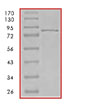
SDS-PAGE - Recombinant Human PI 3 Kinase catalytic subunit alpha/PIK3CA protein (GST tag N-Terminus) (AB159127)
ab159127 on a 12.5% SDS-PAGE stained with Coomassie Blue.
組合せ製品
Proteins & Peptides
AB84769
Recombinant Human PI 3 Kinase p85 alpha protein (His tag N-Terminus)
- 0
- 0
Primary Antibodies
AB191606
Anti-PI 3 Kinase p85 alpha antibody [EPR18702]
20ul selling size|RabMAb|Recombinant|KO Validated

- 5
- 2
Primary Antibodies
AB40776
Anti-PI 3 Kinase catalytic subunit alpha/PIK3CA antibody [EP383Y]
20ul selling size|RabMAb|Recombinant|KO Validated

- 0
- 1
Primary Antibodies
AB302958
Anti-PI 3 Kinase catalytic subunit gamma/PI3K-gamma antibody [EPR25156-60]
BOND RX™ Validated|20ul selling size|RabMAb|Recombinant

- 0
- 0
Reactivity data
配列情報
出荷温度及び保存条件
製品の状態
精製方法
出荷温度
短期保存温度
長期保存温度
分注に関する情報
保管に関する情報
補足情報
This supplementary information is collated from multiple sources and compiled automatically.
Biological function summary
The PIK3CA protein phosphorylates the inositol ring of phosphoinositides generating phosphatidylinositol (345)-trisphosphate (PIP3) a lipid second messenger involved in numerous signaling pathways. PIK3CA often acts within a complex interacting with regulatory subunits such as p85 to control its activity. The complex formation enhances its stability and localization to the cell membrane where it can exert its enzymatic actions effectively. In its biological capacity PIK3CA plays a role in cellular proliferation survival and metabolism.
Pathways
The PI3K/Akt signaling pathway involves PIK3CA as an important mediator. This pathway is integral to numerous cellular processes including metabolism growth and survival. PIK3CA links closely with Akt a downstream protein kinase that propagates the signal initiated by PIP3 generation. The mTOR pathway is another critical route involving PIK3CA where it regulates translation and cellular growth. These pathways emphasize the importance of PIK3CA in maintaining cellular homeostasis and responding to external growth signals.
一般的な情報
機能
Phosphoinositide-3-kinase (PI3K) phosphorylates phosphatidylinositol (PI) and its phosphorylated derivatives at position 3 of the inositol ring to produce 3-phosphoinositides (PubMed : 15135396, PubMed : 23936502, PubMed : 28676499). Uses ATP and PtdIns(4,5)P2 (phosphatidylinositol 4,5-bisphosphate) to generate phosphatidylinositol 3,4,5-trisphosphate (PIP3) (PubMed : 15135396, PubMed : 28676499). PIP3 plays a key role by recruiting PH domain-containing proteins to the membrane, including AKT1 and PDPK1, activating signaling cascades involved in cell growth, survival, proliferation, motility and morphology. Participates in cellular signaling in response to various growth factors. Involved in the activation of AKT1 upon stimulation by receptor tyrosine kinases ligands such as EGF, insulin, IGF1, VEGFA and PDGF. Involved in signaling via insulin-receptor substrate (IRS) proteins. Essential in endothelial cell migration during vascular development through VEGFA signaling, possibly by regulating RhoA activity. Required for lymphatic vasculature development, possibly by binding to RAS and by activation by EGF and FGF2, but not by PDGF. Regulates invadopodia formation through the PDPK1-AKT1 pathway. Participates in cardiomyogenesis in embryonic stem cells through a AKT1 pathway. Participates in vasculogenesis in embryonic stem cells through PDK1 and protein kinase C pathway. In addition to its lipid kinase activity, it displays a serine-protein kinase activity that results in the autophosphorylation of the p85alpha regulatory subunit as well as phosphorylation of other proteins such as 4EBP1, H-Ras, the IL-3 beta c receptor and possibly others (PubMed : 23936502, PubMed : 28676499). Plays a role in the positive regulation of phagocytosis and pinocytosis (By similarity).
配列の類似性
Belongs to the PI3/PI4-kinase family.
ターゲットの情報
Abcam product promise
Please note: All products are 'FOR RESEARCH USE ONLY. NOT FOR USE IN DIAGNOSTIC OR THERAPEUTIC PROCEDURES'.
For licensing inquiries, please contact partnerships@abcam.com