JavaScript is disabled in your browser. Please enable JavaScript to view this website.
AB93933

Recombinant Human NQO2 protein (His tag N-Terminus)

Recombinant Human NQO2 protein (His tag N-Terminus)

Be the first to review this product! Submit a review

|

(2 Publications)

Recombinant Human NQO2 protein (His tag N-Terminus) is a Human Full Length protein, in the 1 to 231 aa range, expressed in Escherichia coli, with >95%, suitable for SDS-PAGE, Mass Spec.

別名を表示する

NMOR2, NQO2, Ribosyldihydronicotinamide dehydrogenase [quinone], NRH dehydrogenase [quinone] 2, NRH:quinone oxidoreductase 2, Quinone reductase 2, QR2

1 Images
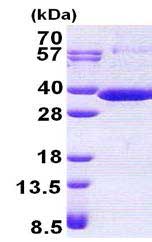
SDS-PAGE - Recombinant Human NQO2 protein (His tag N-Terminus) (AB93933)
  • SDS-PAGE

Unknown

SDS-PAGE - Recombinant Human NQO2 protein (His tag N-Terminus) (AB93933)

15% SDS-PAGE analysis of 3μg ab93933

Key facts

精製度

>95% SDS-PAGE

ab93933 was purified using conventional chromatography techniques.

発現系

Escherichia coli

タグ

His tag N-Terminus

アプリケーション

Mass Spec, SDS-PAGE

applications

生物活性

No

アクセッション番号

P16083

アニマルフリー

No

キャリアフリー

No

種

Human

バッファー組成

pH: 8 Constituents: 10% Glycerol (glycerin, glycerine), 0.316% Tris HCl, 0.0154% (R*,R*)-1,4-Dimercaptobutan-2,3-diol

storage-buffer

Reactivity data

{ "title": "Reactivity Data", "filters": { "stats": ["", "Reactivity", "Dilution Info", "Notes"] }, "values": { "SDS-PAGE": { "reactivity":"TESTED_AND_REACTS", "dilution-info":"", "notes":"<p></p>" }, "Mass Spec": { "reactivity":"TESTED_AND_REACTS", "dilution-info":"", "notes":"<p></p>" } } }

配列情報

[{"linker":null,"sequence":"MGSSHHHHHHSSGLVPRGSHMAGKKVLIVYAHQEPKSFNGSLKNVAVDELSRQGCTVTVSDLYAMNFEPRATDKDITGTLSNPEVFNYGVETHEAYKQRSLASDITDEQKKVREADLVIFQFPLYWFSVPAILKGWMDRVLCQGFAFDIPGFYDSGLLQGKLALLSVTTGGTAEMYTKTGVNGDSRYFLWPLQHGTLHFCGFKVLAPQISFAPEIASEEERKGMVAAWSQRLQTIWKEEPIPCTAHWHFGQ","proteinLength":"Full Length","predictedMolecularWeight":"28.1 kDa","actualMolecularWeight":null,"aminoAcidEnd":231,"aminoAcidStart":1,"nature":"Recombinant","expressionSystem":"Escherichia coli","accessionNumber":"P16083","tags":[{"tag":"His","terminus":"N-Terminus"}]}]

出荷温度及び保存条件

製品の状態
Liquid
出荷温度
Blue Ice
短期保存温度
-20°C
長期保存温度
-20°C
分注に関する情報
Upon delivery aliquot
保管に関する情報
Avoid freeze / thaw cycle
False

補足情報

This supplementary information is collated from multiple sources and compiled automatically.

NQO2 also known as NRH:quinone oxidoreductase 2 is a flavoprotein enzyme playing roles in cellular redox reactions. It has a molecular mass of approximately 25 kDa. NQO2 is expressed widely in human tissues such as liver colon and brain. It catalyzes the two-electron reduction of quinones to hydroquinones therefore helping prevent oxidative stress by converting reactive quinone species into less reactive and more stable molecules. The protein often interacts with other cellular components to perform its functions effectively.
Biological function summary

NQO2 participates in detoxification processes and acts as a dihydronicotinamide riboside:quinone oxidoreductase. Although it is not part of a large protein complex NQO2 may associate with other molecules or enzymes that modulate cellular antioxidant defense systems. It serves as a backup system when other primary antioxidant enzymes such as NQO1 are impaired. This function reflects the importance of NQO2 in maintaining cellular health and response to environmental stresses.

Pathways

NQO2 is involved in metabolism and oxidative stress response pathways. Its role in quinone detoxification connects it to the cellular defense mechanism against oxidative damage interacting with proteins like NQO1. NQO2's enzymatic activity goes hand-in-hand with the NAD(P)H dehydrogenase (quinone) pathway which collaborates with other proteins to maintain redox homeostasis and protect cells against electrophilic and oxidative stress.

Alterations in NQO2 expression or function are linked to cancer and neurodegenerative diseases. NQO2's involvement in detoxifying potent quinones links it to cancerous developments when these processes fail while its role against oxidative stress connects it to neurodegenerative conditions like Parkinson’s disease. During these conditions interactions with proteins such as NQO1 and p53 can be significant. The balance of NQO2 activity may contribute to disease progression or suppression highlighting its therapeutic potential in disease management.

一般的な情報

機能

The enzyme apparently serves as a quinone reductase in connection with conjugation reactions of hydroquinones involved in detoxification pathways as well as in biosynthetic processes such as the vitamin K-dependent gamma-carboxylation of glutamate residues in prothrombin synthesis.

配列の類似性

Belongs to the NAD(P)H dehydrogenase (quinone) family.

製品プロトコール

ターゲットの情報

The enzyme apparently serves as a quinone reductase in connection with conjugation reactions of hydroquinones involved in detoxification pathways as well as in biosynthetic processes such as the vitamin K-dependent gamma-carboxylation of glutamate residues in prothrombin synthesis.
See full target information NQO2

文献 (2)

Recent publications for all applications. Explore the full list and refine your search

Communications biology 8:1 PubMed39747445

2025

Fortilin binds CTNNA3 and protects it against phosphorylation, ubiquitination, and proteasomal degradation to guard cells against apoptosis.

Applications

Unspecified application

Species

Unspecified reactive species

Mari Nakashima,Decha Pinkaew,Uttariya Pal,Fei Miyao,Hanna Huynh,Lena Tanaka,Ken Fujise

Communications biology 5:157 PubMed35197550

2022

Fortilin interacts with TGF-β1 and prevents TGF-β receptor activation.

Applications

Unspecified application

Species

Unspecified reactive species

Decha Pinkaew,Erik Martinez-Hackert,Wei Jia,Matthew D King,Fei Miao,Nicole R Enger,Runglawan Silakit,Kota Ramana,Shi-You Chen,Ken Fujise
View all publications

Abcam product promise

当社は、高品質な試薬を通じてお客様の研究を力強くサポートすることをお約束いたします。ご使用いただく各段階で、常にお客様をサポートできる体制を整えております。万が一、製品が期待通りに機能しない場合は、「Abcam Product Promise」による当社保証制度に基づき、安心してご利用いただけます。
保証に関する詳細については利用規約をご確認ください。

Please note: All products are 'FOR RESEARCH USE ONLY. NOT FOR USE IN DIAGNOSTIC OR THERAPEUTIC PROCEDURES'.

For licensing inquiries, please contact partnerships@abcam.com