JavaScript is disabled in your browser. Please enable JavaScript to view this website.
AB126671

Recombinant human Glucose 6 Phosphate Dehydrogenase protein (His tag N-Terminus)

Recombinant human Glucose 6 Phosphate Dehydrogenase protein (His tag N-Terminus)

Be the first to review this product! Submit a review

|

(1 Publication)

Recombinant human Glucose 6 Phosphate Dehydrogenase protein (His tag N-Terminus) is a Human Full Length protein, in the 1 to 515 aa range, expressed in Baculovirus infected BTI-TN-5B1-4 cells, with >95%, suitable for SDS-PAGE, FuncS.

別名を表示する

Glucose-6-phosphate 1-dehydrogenase, G6PD

1 Images
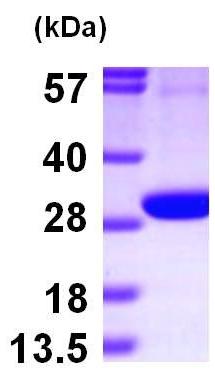
SDS-PAGE - Recombinant human Glucose 6 Phosphate Dehydrogenase protein (His tag N-Terminus) (AB126671)
  • SDS-PAGE

Unknown

SDS-PAGE - Recombinant human Glucose 6 Phosphate Dehydrogenase protein (His tag N-Terminus) (AB126671)

15% SDS-PAGE analysis of ab126671 (3μg)

Key facts

精製度

>95% SDS-PAGE

Affinity purified

発現系

Baculovirus infected BTI-TN-5B1-4 cells

タグ

His tag N-Terminus

アプリケーション

FuncS, SDS-PAGE

applications

生物活性

Yes

生物学的活性

Specific activity is > 7 units/ml obtained by measuring the increase of NADPH in absorbance at 340 nm resulting from the reduction of NAD or NADP. One unit oxidizes 1.0 umole D-glucose-6-phosphate to 6-phospho-D-gluconate per min in the presence of beta-NADP at pH 7.4 at 25°C

アクセッション番号

P11413

アニマルフリー

No

キャリアフリー

No

種

Human

バッファー組成

pH: 8 Constituents: 20% Glycerol (glycerin, glycerine), 1.17% Sodium chloride, 0.32% Tris HCl, 0.06% EDTA, 0.03% (R*,R*)-1,4-Dimercaptobutan-2,3-diol, 0.002% PMSF

storage-buffer

Reactivity data

{ "title": "Reactivity Data", "filters": { "stats": ["", "Reactivity", "Dilution Info", "Notes"] }, "values": { "SDS-PAGE": { "reactivity":"TESTED_AND_REACTS", "dilution-info":"", "notes":"<p></p>" }, "FuncS": { "reactivity":"TESTED_AND_REACTS", "dilution-info":"", "notes":"<p></p>" } } }

配列情報

[{"linker":null,"sequence":"MGSSHHHHHHSSGLVPRGSHMAEQVALSRTQVCGILREELFQGDAFHQSDTHIFIIMGASGDLAKKKIYPTIWWLFRDGLLPENTFIVGYARSRLTVADIRKQSEPFFKATPEEKLKLEDFFARNSYVAGQYDDAASYQRLNSHMNALHLGSQANRLFYLALPPTVYEAVTKNIHESCMSQIGWNRIIVEKPFGRDLQSSDRLSNHISSLFREDQIYRIDHYLGKEMVQNLMVLRFANRIFGPIWNRDNIACVILTFKEPFGTEGRGGYFDEFGIIRDVMQNHLLQMLCLVAMEKPASTNSDDVRDEKVKVLKCISEVQANNVVLGQYVGNPDGEGEATKGYLDDPTVPRGSTTATFAAVVLYVENERWDGVPFILRCGKALNERKAEVRLQFHDVAGDIFHQQCKRNELVIRVQPNEAVYTKMMTKKPGMFFNPEESELDLTYGNRYKNVKLPDAYERLILDVFCGSQMHFVRSDELREAWRIFTPLLHQIELEKPKPIPYIYGSRGPTEADELMKRVGFQYEGTYKWVNPHKL","proteinLength":"Full Length","predictedMolecularWeight":"61.4 kDa","actualMolecularWeight":null,"aminoAcidEnd":515,"aminoAcidStart":1,"nature":"Recombinant","expressionSystem":"Baculovirus infected BTI-TN-5B1-4 cells","accessionNumber":"P11413","tags":[{"tag":"His","terminus":"N-Terminus"}]}]

出荷温度及び保存条件

製品の状態
Liquid
精製方法
Affinity purification
出荷温度
Blue Ice
短期保存期間
1-2 weeks
短期保存温度
+4°C
長期保存温度
-20°C
分注に関する情報
Upon delivery aliquot
保管に関する情報
Avoid freeze / thaw cycle
True

補足情報

This supplementary information is collated from multiple sources and compiled automatically.

Glucose 6 Phosphate Dehydrogenase also known as G6PD or G6P dehydrogenase plays an important role in the pentose phosphate pathway catalyzing the conversion of glucose 6-phosphate to 6-phosphoglucono-δ-lactone while producing NADPH from NADP+. G6PD with a molecular mass of approximately 59 kDa is expressed in various tissues with high levels found in red blood cells liver and adrenal glands. This enzyme is vital for protecting cells from oxidative damage by supplying reductive capacity.
Biological function summary

Glucose 6-phosphate dehydrogenase is essential for maintaining cellular redox balance especially in cells lacking mitochondria like red blood cells. It functions as part of a monomer which can dimerize depending on the cellular needs and conditions. The activity of G6PD directly affects the production of NADPH which is necessary for the biosynthesis of nucleic acids and lipids and for maintaining reduced glutathione levels therefore sustaining the antioxidant capacity of the cell.

Pathways

Glucose 6-phosphate dehydrogenase is a pivotal enzyme in the oxidative phase of the pentose phosphate pathway which provides ribose 5-phosphate for nucleotide synthesis and NADPH for reductive biosynthetic reactions. G6PD connects with other enzymes in the pathway such as 6-phosphogluconate dehydrogenase contributing to the regulation of cellular metabolic needs. Its function is tightly linked to glucose metabolism and indirectly influences glycolytic processes.

Alterations in glucose 6-phosphate dehydrogenase activity lead to conditions such as G6PD deficiency which can cause hemolytic anemia when individuals are exposed to certain drugs infections or foods. This enzyme's deficiency is one of the most common enzymatic disorders in humans and is triggered by genetic mutations affecting G6PD function. Moreover G6PD has implications in cancer biology as its activity influences the proliferation and survival of cancer cells alongside other proteins like TP53 and NF-κB which are involved in cellular stress responses.

一般的な情報

機能

Catalyzes the rate-limiting step of the oxidative pentose-phosphate pathway, which represents a route for the dissimilation of carbohydrates besides glycolysis. The main function of this enzyme is to provide reducing power (NADPH) and pentose phosphates for fatty acid and nucleic acid synthesis.

配列の類似性

Belongs to the glucose-6-phosphate dehydrogenase family.

翻訳後修飾

Acetylated by ELP3 at Lys-403; acetylation inhibits its homodimerization and enzyme activity. Deacetylated by SIRT2 at Lys-403; deacetylation stimulates its enzyme activity.

製品プロトコール

ターゲットの情報

Catalyzes the rate-limiting step of the oxidative pentose-phosphate pathway, which represents a route for the dissimilation of carbohydrates besides glycolysis. The main function of this enzyme is to provide reducing power (NADPH) and pentose phosphates for fatty acid and nucleic acid synthesis.
See full target information Glucose-6-phosphate 1-dehydrogenase

文献 (1)

Recent publications for all applications. Explore the full list and refine your search

Science signaling 14:eabe3800 PubMed34784249

2021

Dual NADPH oxidases DUOX1 and DUOX2 synthesize NAADP and are necessary for Ca signaling during T cell activation.

Applications

Unspecified application

Species

Unspecified reactive species

Feng Gu,Aileen Krüger,Hannes G Roggenkamp,Rick Alpers,Dmitri Lodygin,Vincent Jaquet,Franziska Möckl,Lola C Hernandez C,Kai Winterberg,Andreas Bauche,Anette Rosche,Helmut Grasberger,John Y Kao,Daniel Schetelig,René Werner,Katrin Schröder,Michael Carty,Andrew G Bowie,Samuel Huber,Chris Meier,Hans-Willi Mittrücker,Joerg Heeren,Karl-Heinz Krause,Alexander Flügel,Björn-Philipp Diercks,Andreas H Guse
View all publications

Abcam product promise

当社は、高品質な試薬を通じてお客様の研究を力強くサポートすることをお約束いたします。ご使用いただく各段階で、常にお客様をサポートできる体制を整えております。万が一、製品が期待通りに機能しない場合は、「Abcam Product Promise」による当社保証制度に基づき、安心してご利用いただけます。
保証に関する詳細については利用規約をご確認ください。

Please note: All products are 'FOR RESEARCH USE ONLY. NOT FOR USE IN DIAGNOSTIC OR THERAPEUTIC PROCEDURES'.

For licensing inquiries, please contact partnerships@abcam.com