Recombinant Human CEBP Alpha/CEBPA protein (His tag N-Terminus)
Recombinant Human CEBP Alpha/CEBPA protein (His tag N-Terminus)
Be the first to review this product! Submit a review
|
(0 Publication)
Recombinant Human CEBP Alpha/CEBPA protein (His tag N-Terminus) is a Human Fragment protein, in the 270 to 358 aa range, expressed in Escherichia coli, with >95%, suitable for SDS-PAGE.
別名を表示する
CEBP, CEBPA, CCAAT/enhancer-binding protein alpha, C/EBP alpha

- SDS-PAGE
Supplier Data
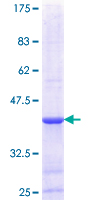
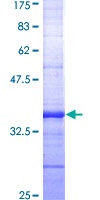
SDS-PAGE - Recombinant Human CEBP Alpha/CEBPA protein (His tag N-Terminus) (AB51301)
3ug by SDS-PAGE under reducing conditions and visualized by coomassie blue stain.
組合せ製品
Primary Antibodies
AB40761
Anti-CEBP Alpha/CEBPA antibody [EP708Y]
20ul selling size|RabMAb|Recombinant|Advanced Validation

- 4
- 2

Reactivity data
製品の詳細
配列情報
出荷温度及び保存条件
製品の状態
出荷温度
短期保存温度
長期保存温度
分注に関する情報
保管に関する情報
補足情報
This supplementary information is collated from multiple sources and compiled automatically.
Biological function summary
CEBP Alpha regulates important cellular processes by acting as a transcriptional regulator. It participates in the control of cellular differentiation proliferation and metabolism. CEBP Alpha forms homo- or heterodimers with other proteins of the CEBP family to exert its functions. It induces expression of genes involved in differentiation of myeloid progenitors into granulocytes and macrophages. The protein also promotes adipogenesis by activating genes responsible for the development and function of adipocytes.
Pathways
CEBP Alpha participates actively in signaling pathways that involve cell cycle control and hematopoiesis. In the hematopoietic pathway CEBP Alpha influences the differentiation of progenitor cells into mature blood cells. Additionally it interacts with other proteins such as PU.1 an important regulator in the myeloid lineage and through the MAPK pathway influences growth arrest and differentiation responses. These interactions highlight its essential role in maintaining the balance between cell proliferation and differentiation.
一般的な情報
機能
Transcription factor that coordinates proliferation arrest and the differentiation of myeloid progenitors, adipocytes, hepatocytes, and cells of the lung and the placenta. Binds directly to the consensus DNA sequence 5'-T[TG]NNGNAA[TG]-3' acting as an activator on distinct target genes (PubMed : 11242107). During early embryogenesis, plays essential and redundant functions with CEBPB. Essential for the transition from common myeloid progenitors (CMP) to granulocyte/monocyte progenitors (GMP). Critical for the proper development of the liver and the lung (By similarity). Necessary for terminal adipocyte differentiation, is required for postnatal maintenance of systemic energy homeostasis and lipid storage (By similarity). To regulate these different processes at the proper moment and tissue, interplays with other transcription factors and modulators. Down-regulates the expression of genes that maintain cells in an undifferentiated and proliferative state through E2F1 repression, which is critical for its ability to induce adipocyte and granulocyte terminal differentiation. Reciprocally E2F1 blocks adipocyte differentiation by binding to specific promoters and repressing CEBPA binding to its target gene promoters. Proliferation arrest also depends on a functional binding to SWI/SNF complex (PubMed : 14660596). In liver, regulates gluconeogenesis and lipogenesis through different mechanisms. To regulate gluconeogenesis, functionally cooperates with FOXO1 binding to IRE-controlled promoters and regulating the expression of target genes such as PCK1 or G6PC1. To modulate lipogenesis, interacts and transcriptionally synergizes with SREBF1 in promoter activation of specific lipogenic target genes such as ACAS2. In adipose tissue, seems to act as FOXO1 coactivator accessing to ADIPOQ promoter through FOXO1 binding sites (By similarity).. Isoform 3. Can act as dominant-negative. Binds DNA and have transctivation activity, even if much less efficiently than isoform 2. Does not inhibit cell proliferation (PubMed : 14660596).. Isoform 4. Directly and specifically enhances ribosomal DNA transcription interacting with RNA polymerase I-specific cofactors and inducing histone acetylation.
配列の類似性
Belongs to the bZIP family. C/EBP subfamily.
翻訳後修飾
Phosphorylation at Ser-190 is required for interaction with CDK2, CDK4 and SWI/SNF complex leading to cell cycle inhibition. Dephosphorylated at Ser-190 by protein phosphatase 2A (PP2A) through PI3K/AKT signaling pathway regulation (PubMed:15107404). Phosphorylation at Thr-226 and Thr-230 by GSK3 is constitutive in adipose tissue and lung. In liver, both Thr-226 and Thr-230 are phosphorylated only during feeding but not during fasting. Phosphorylation of the GSK3 consensus sites selectively decreases transactivation activity on IRE-controlled promoters.. Sumoylated, sumoylation blocks the inhibitory effect on cell proliferation by disrupting the interaction with SMARCA2.. Ubiquitinated by COP1 upon interaction with TRIB1.
細胞内局在性
Nucleus
ターゲットの情報
Abcam product promise
Please note: All products are 'FOR RESEARCH USE ONLY. NOT FOR USE IN DIAGNOSTIC OR THERAPEUTIC PROCEDURES'.
For licensing inquiries, please contact partnerships@abcam.com