Recombinant ヒト cAMP Protein Kinase Catalytic subunit (GST tag N-Terminus)
Recombinant human cAMP Protein Kinase Catalytic subunit (GST tag N-Terminus)
Be the first to review this product! Submit a review
|
(2 Publications)
Recombinant human cAMP Protein Kinase Catalytic subunit (GST tag N-Terminus) is a Human Full Length protein, expressed in Baculovirus infected Sf9 cells, with >90%, suitable for SDS-PAGE, FuncS.
別名を表示する
PKACA, PRKACA, cAMP-dependent protein kinase catalytic subunit alpha, PKA C-alpha
- FuncS
Unknown
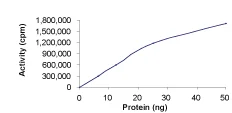
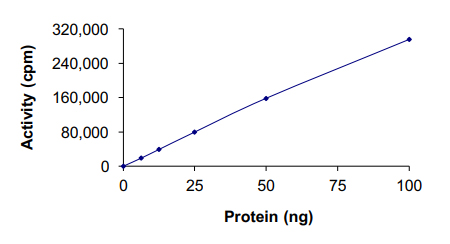
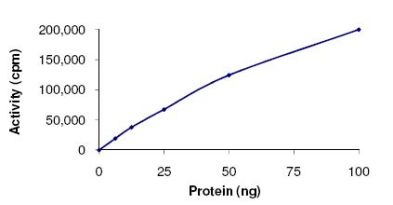
Functional Studies - Recombinant human cAMP Protein Kinase Catalytic subunit (GST tag N-Terminus) (AB56268)
Kinase assay with ab56268 at a 0.1μg/μl dilution, Specific Activity 1914 nmol/min/mg.
- FuncS
Unknown
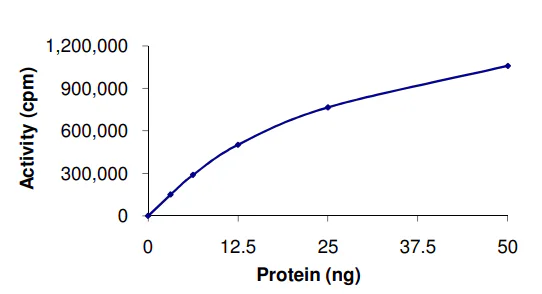
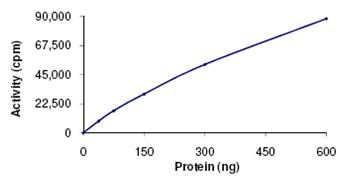
Functional Studies - Recombinant human cAMP Protein Kinase Catalytic subunit (GST tag N-Terminus) (AB56268)
The specific activity of cAMP Protein Kinase Catalytic subunit (ab56268) was determined to be 2100 nmol/min/mg as per activity assay protocol
- SDS-PAGE
Unknown
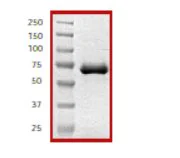
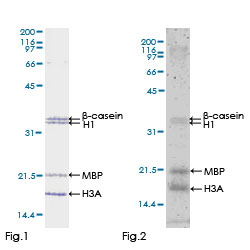
SDS-PAGE - Recombinant human cAMP Protein Kinase Catalytic subunit (GST tag N-Terminus) (AB56268)
ab56268 on SDS-PAGE.
- SDS-PAGE
Unknown
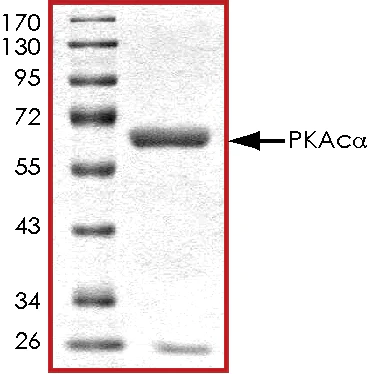
SDS-PAGE - Recombinant human cAMP Protein Kinase Catalytic subunit (GST tag N-Terminus) (AB56268)
SDS PAGE analysis of ab56268
組合せ製品
Reagents, Controls & Accessories
AB234617
Prestained Protein Ladder - Mid-range molecular weight (10 - 180 kDa)

- 0
- 0
Proteins & Peptides
AB60837
Recombinant human PKA beta (catalytic subunit) protein (GST tag N-Terminus)
- 0
- 0
Reactivity data
製品の詳細
it is recommended to store ab56268 in glycerol at -80C to preserve its activity.
ab204856 (CREB peptide) can be utilized as a substrate for assessing kinase activity
配列情報
出荷温度及び保存条件
製品の状態
精製方法
出荷温度
短期保存温度
長期保存温度
分注に関する情報
保管に関する情報
補足情報
This supplementary information is collated from multiple sources and compiled automatically.
Biological function summary
The catalytic subunit of protein kinase A modulates cellular processes by transferring a phosphate group from ATP to specific serine/threonine residues on substrates. It is part of a holoenzyme complex composed of two regulatory and two catalytic subunits; when cAMP binds to the regulatory subunits it releases the catalytic subunits allowing them to execute their activity. This release and activation result in the regulation of glycogen sugar and lipid metabolism among others.
Pathways
The cAMP Protein Kinase integrates deeply into the cAMP signaling and MAPK/ERK pathways. These pathways regulate various processes like cell growth differentiation and apoptosis. The catalytic subunit acts downstream of cAMP generation by adenylyl cyclase interacting with other proteins such as CREB (cAMP response element-binding protein) which directly affects transcription and gene expression.
一般的な情報
機能
Phosphorylates a large number of substrates in the cytoplasm and the nucleus (PubMed : 15642694, PubMed : 15905176, PubMed : 16387847, PubMed : 17333334, PubMed : 17565987, PubMed : 17693412, PubMed : 18836454, PubMed : 19949837, PubMed : 20356841, PubMed : 21085490, PubMed : 21514275, PubMed : 21812984, PubMed : 21852232, PubMed : 31112131). Phosphorylates CDC25B, ABL1, NFKB1, CLDN3, histone H1.4 (H1-4), PSMC5/RPT6, PJA2, RYR2, RORA, SOX9, UHRF1 and VASP (PubMed : 15178447, PubMed : 15642694, PubMed : 15905176, PubMed : 16387847, PubMed : 17333334, PubMed : 17565987, PubMed : 17693412, PubMed : 18836454, PubMed : 19949837, PubMed : 20356841, PubMed : 21085490, PubMed : 21514275, PubMed : 21812984). Regulates the abundance of compartmentalized pools of its regulatory subunits through phosphorylation of PJA2 which binds and ubiquitinates these subunits, leading to their subsequent proteolysis (PubMed : 21423175). RORA is activated by phosphorylation (PubMed : 21514275). Required for glucose-mediated adipogenic differentiation increase and osteogenic differentiation inhibition from osteoblasts (PubMed : 19949837). Involved in chondrogenesis by mediating phosphorylation of SOX9 (By similarity). Involved in the regulation of platelets in response to thrombin and collagen; maintains circulating platelets in a resting state by phosphorylating proteins in numerous platelet inhibitory pathways when in complex with NF-kappa-B (NFKB1 and NFKB2) and I-kappa-B-alpha (NFKBIA), but thrombin and collagen disrupt these complexes and free active PRKACA stimulates platelets and leads to platelet aggregation by phosphorylating VASP (PubMed : 15642694, PubMed : 20356841). Prevents the antiproliferative and anti-invasive effects of alpha-difluoromethylornithine in breast cancer cells when activated (PubMed : 17333334). RYR2 channel activity is potentiated by phosphorylation in presence of luminal Ca(2+), leading to reduced amplitude and increased frequency of store overload-induced Ca(2+) release (SOICR) characterized by an increased rate of Ca(2+) release and propagation velocity of spontaneous Ca(2+) waves, despite reduced wave amplitude and resting cytosolic Ca(2+) (PubMed : 17693412). PSMC5/RPT6 activation by phosphorylation stimulates proteasome (PubMed : 17565987). Negatively regulates tight junctions (TJs) in ovarian cancer cells via CLDN3 phosphorylation (PubMed : 15905176). NFKB1 phosphorylation promotes NF-kappa-B p50-p50 DNA binding (PubMed : 15642694). Required for phosphorylation of GLI transcription factors which inhibits them and prevents transcriptional activation of Hedgehog signaling pathway target genes (By similarity). GLI transcription factor phosphorylation is inhibited by interaction of PRKACA with SMO which sequesters PRKACA at the cell membrane (By similarity). Involved in embryonic development by down-regulating the Hedgehog (Hh) signaling pathway that determines embryo pattern formation and morphogenesis most probably through the regulation of OFD1 in ciliogenesis (PubMed : 33934390). Prevents meiosis resumption in prophase-arrested oocytes via CDC25B inactivation by phosphorylation (By similarity). May also regulate rapid eye movement (REM) sleep in the pedunculopontine tegmental (PPT) (By similarity). Phosphorylates APOBEC3G and AICDA (PubMed : 16387847, PubMed : 18836454). Phosphorylates HSF1; this phosphorylation promotes HSF1 nuclear localization and transcriptional activity upon heat shock (PubMed : 21085490). Acts as a negative regulator of mTORC1 by mediating phosphorylation of RPTOR (PubMed : 31112131). Phosphorylates AKAP19 (PubMed : 27028580).. Isoform 2. Phosphorylates and activates ABL1 in sperm flagellum to promote spermatozoa capacitation.
配列の類似性
Belongs to the protein kinase superfamily. AGC Ser/Thr protein kinase family. cAMP subfamily.
翻訳後修飾
Autophosphorylated. Phosphorylation is enhanced by vitamin K(2) (PubMed:12372837, PubMed:17909264). Phosphorylated on threonine and serine residues. Phosphorylation on Thr-198 is required for full activity (PubMed:16765046, PubMed:20137943, PubMed:20481595, PubMed:20732331, PubMed:21774789, Ref.46). Phosphorylated at Tyr-331 by activated receptor tyrosine kinases EGFR and PDGFR; this increases catalytic efficiency (By similarity).. Asn-3 is partially deaminated to Asp-3 giving rise to 2 major isoelectric variants, called CB and CA respectively.. When myristoylated, Ser-11 is autophosphorylated probably in conjunction with deamidation of Asn-3.
ターゲットの情報
文献 (2)
Recent publications for all applications. Explore the full list and refine your search
Developmental cell 55:544-557.e6 PubMed33120014
2020
Applications
Unspecified application
Species
Unspecified reactive species
Antioxidants & redox signaling 15:2395-406 PubMed21529143
2011
Applications
Unspecified application
Species
Unspecified reactive species
Abcam product promise
Please note: All products are 'FOR RESEARCH USE ONLY. NOT FOR USE IN DIAGNOSTIC OR THERAPEUTIC PROCEDURES'.
For licensing inquiries, please contact partnerships@abcam.com