JavaScript is disabled in your browser. Please enable JavaScript to view this website.
AB114337

Recombinant Human Bak protein (GST tag N-Terminus)

Recombinant Human Bak protein (GST tag N-Terminus)

Be the first to review this product! Submit a review

|

(0 Publication)

Recombinant Human Bak protein (GST tag N-Terminus) is a Human Full Length protein, in the 1 to 211 aa range, expressed in Wheat germ, suitable for SDS-PAGE, ELISA, WB.

別名を表示する

BAK, BCL2L7, CDN1, BAK1, Bcl-2 homologous antagonist/killer, Apoptosis regulator BAK, Bcl-2-like protein 7, Bcl2-L-7

1 Images
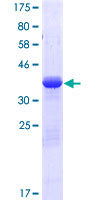
SDS-PAGE - Recombinant Human Bak protein (GST tag N-Terminus) (AB114337)
  • SDS-PAGE

Unknown

SDS-PAGE - Recombinant Human Bak protein (GST tag N-Terminus) (AB114337)

ab114337 analysed on a 12.5% SDS-PAGE gel stained with Coomassie Blue

Key facts

発現系

Wheat germ

タグ

GST tag N-Terminus

アプリケーション

WB, ELISA, SDS-PAGE

applications

生物活性

No

アクセッション番号

Q16611

アニマルフリー

No

キャリアフリー

No

種

Human

バッファー組成

pH: 8 Constituents: 0.79% Tris HCl, 0.3% Glutathione

storage-buffer

Reactivity data

{ "title": "Reactivity Data", "filters": { "stats": ["", "Reactivity", "Dilution Info", "Notes"] }, "values": { "SDS-PAGE": { "reactivity":"TESTED_AND_REACTS", "dilution-info":"", "notes":"<p></p>" }, "ELISA": { "reactivity":"TESTED_AND_REACTS", "dilution-info":"", "notes":"<p></p>" }, "WB": { "reactivity":"TESTED_AND_REACTS", "dilution-info":"", "notes":"<p></p>" } } }

配列情報

[{"linker":null,"sequence":"MASGQGPGPPRQECGEPALPSASEEQVAQDTEEVFRSYVFYRHQQEQEAEGVAAPADPEMVTLPLQPSSTMGQVGRQLAIIGDDINRRYDSEFQTMLQHLQPTAENAYEYFTKIATSLFESGINWGRVVALLGFGYRLALHVYQHGLTGFLGQVTRFVVDFMLHHCIARWIAQRGGWVAALNLGNGPILNVLVVLGVVLLGQFVVRRFFKS","proteinLength":"Full Length","predictedMolecularWeight":"49.28 kDa","actualMolecularWeight":null,"aminoAcidEnd":211,"aminoAcidStart":1,"nature":"Recombinant","expressionSystem":"Wheat germ","accessionNumber":"Q16611","tags":[{"tag":"GST","terminus":"N-Terminus"}]}]

出荷温度及び保存条件

製品の状態
Liquid
精製方法
Proprietary technique
出荷温度
Dry Ice
短期保存温度
-80°C
長期保存温度
-80°C
分注に関する情報
Upon delivery aliquot
保管に関する情報
Avoid freeze / thaw cycle
False

補足情報

This supplementary information is collated from multiple sources and compiled automatically.

The Bak protein also known as Bcl-2 homologous antagonist killer plays a mechanical role in the mitochondrial apoptosis pathway. It often functions as a pro-apoptotic member of the Bcl-2 protein family. Bak is expressed widely in the body being present in tissues such as the brain and heart. The molecular weight of Bak is approximately 23 kilodaltons. Bak interacts with other mitochondrial proteins to trigger cell death processes.
Biological function summary

Bak engages in promoting apoptosis by disrupting the mitochondrial outer membrane potential. It is part of the Bcl-2 family complex which balances cell survival and cell death. Bak collaborates with Bax protein to form pores in the mitochondrial membrane releasing cytochrome c and other apoptotic factors. This process initiates the cascade of caspases leading to programmed cell death.

Pathways

Bak is a critical component of the intrinsic apoptotic pathway. It directly interacts with pro-apoptotic proteins like Bax and anti-apoptotic proteins such as Bcl-2 and Bcl-xL. Bak's action in the apoptotic pathway involves a delicate balance between survival and death signals affecting cellular homeostasis. In addition Bak's interaction with the p53 pathway emphasizes its role in response to DNA damage ensuring damaged cells do not proliferate uncontrollably.

Malfunction or dysregulation of Bak can lead to cancer and neurodegenerative disorders. In cancer reduced Bak activity may allow cells to evade apoptosis promoting tumor survival and growth. Conversely in diseases like Parkinson's excessive Bak activity may result in enhanced neuronal apoptosis. Bak's interaction with proteins such as Bcl-2 also makes it a potential target for therapies aimed at restoring apoptotic balance in affected cells.

一般的な情報

機能

Plays a role in the mitochondrial apoptotic process. Upon arrival of cell death signals, promotes mitochondrial outer membrane (MOM) permeabilization by oligomerizing to form pores within the MOM. This releases apoptogenic factors into the cytosol, including cytochrome c, promoting the activation of caspase 9 which in turn processes and activates the effector caspases.

配列の類似性

Belongs to the Bcl-2 family.

製品プロトコール

ターゲットの情報

Plays a role in the mitochondrial apoptotic process. Upon arrival of cell death signals, promotes mitochondrial outer membrane (MOM) permeabilization by oligomerizing to form pores within the MOM. This releases apoptogenic factors into the cytosol, including cytochrome c, promoting the activation of caspase 9 which in turn processes and activates the effector caspases.
See full target information BAK1

Abcam product promise

当社は、高品質な試薬を通じてお客様の研究を力強くサポートすることをお約束いたします。ご使用いただく各段階で、常にお客様をサポートできる体制を整えております。万が一、製品が期待通りに機能しない場合は、「Abcam Product Promise」による当社保証制度に基づき、安心してご利用いただけます。
保証に関する詳細については利用規約をご確認ください。

Please note: All products are 'FOR RESEARCH USE ONLY. NOT FOR USE IN DIAGNOSTIC OR THERAPEUTIC PROCEDURES'.

For licensing inquiries, please contact partnerships@abcam.com