Recombinant EN-TEV Protease protein
Recombinant EN-TEV Protease protein
- Bioactive
- 詳細を見る
Be the first to review this product! Submit a review
|
(0 Publication)
Recombinant EN-TEV Protease protein is a Tobacco etch virus Fragment protein, in the 2038 to 2279 aa range, expressed in Escherichia coli, with >95%, suitable for SDS-PAGE, Size Exclusion Chromatography, FuncS.
別名を表示する
Genome polyprotein
- FuncS
Supplier Data
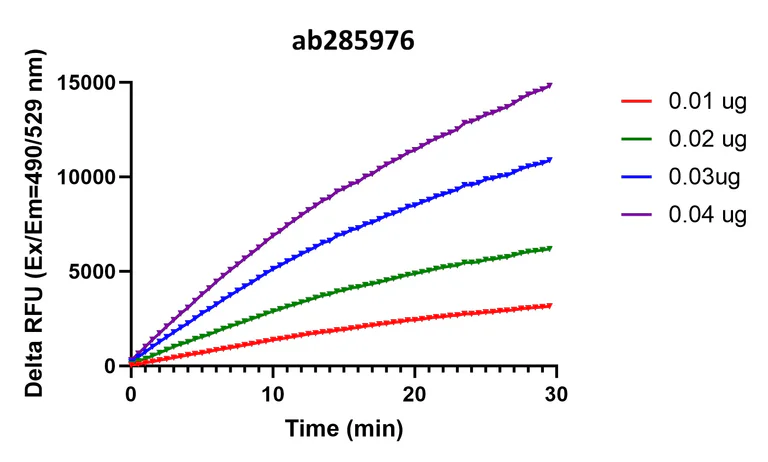
Functional Studies - Recombinant EN-TEV Protease protein (AB285976)
TEV activity graph using ab285976
- SDS-PAGE
Supplier Data
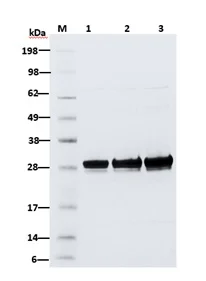
SDS-PAGE - Recombinant EN-TEV Protease protein (AB285976)
4–12% SDS-PAGE : 1, 2 and 3 ug of TEV Protease loaded in each lane under reducing conditions and stained with Coomassie Blue. TEV Protease has a predicted MW of ~31 kDa
組合せ製品

Reactivity data
配列情報
出荷温度及び保存条件
製品の状態
精製方法
出荷温度
短期保存温度
長期保存温度
補足情報
This supplementary information is collated from multiple sources and compiled automatically.
Biological function summary
The action of TEV protease involves recognizing and cleaving a specific sequence in fusion proteins allowing for the removal of affinity tags. Though not generally part of a complex its activity is often important for modifying proteins without interfering with their structure or function beyond the cleaved site. By providing a method to separate desired parts of proteins TEV protease enhances the study of protein functions and structures. It also assists in generating authentic recombinant proteins critical for various research applications.
Pathways
TEV protease's role mainly revolves around its function in post-translational modification processes rather than classical signaling pathways. It facilitates pathways where the removal of fusion tags is necessary for studying protein interactions and conformations. This function does not directly involve TEV protease in cellular metabolic pathways but its activity complements the activity of other proteases like Actev protease and protease assay protocol tools by providing a precise cleavage mechanism necessary for subsequent biochemical analysis and studies.
一般的な情報
機能
Helper component proteinase. Required for aphid transmission and also has proteolytic activity. Only cleaves a Gly-Gly dipeptide at its own C-terminus (PubMed : 2656254). Interacts with virions and aphid stylets (PubMed : 9880030). Acts as a suppressor of RNA-mediated gene silencing, also known as post-transcriptional gene silencing (PTGS), a mechanism of plant viral defense that limits the accumulation of viral RNAs (PubMed : 11414807). May have RNA-binding activity.. Cytoplasmic inclusion protein. Has helicase activity. It may be involved in replication.. 6 kDa protein 1. Indispensable for virus replication (By similarity). Reduces the abundance of host transcripts related to jasmonic acid biosynthesis therefore altering the host defenses (By similarity). In order to increase its own stability, decreases host protein degradation pathways (By similarity).. 6 kDa protein 2. Indispensable for virus replication.. Viral genome-linked protein. Mediates the cap-independent, EIF4E-dependent translation of viral genomic RNAs (Probable). Binds to the cap-binding site of host EIF4E and thus interferes with the host EIF4E-dependent mRNA export and translation (By similarity). VPg-RNA directly binds EIF4E and is a template for transcription (By similarity). Also forms trimeric complexes with EIF4E-EIF4G, which are templates for translation (By similarity).. Nuclear inclusion protein A. Has RNA-binding and proteolytic activities.. Nuclear inclusion protein B. An RNA-dependent RNA polymerase that plays an essential role in the virus replication.. Capsid protein. Involved in aphid transmission, cell-to-cell and systemis movement, encapsidation of the viral RNA and in the regulation of viral RNA amplification.
配列の類似性
Belongs to the potyviridae genome polyprotein family.
翻訳後修飾
Viral genome-linked protein. VPg is uridylylated by the polymerase and is covalently attached to the 5'-end of the genomic RNA. This uridylylated form acts as a nucleotide-peptide primer for the polymerase (By similarity).. Genome polyprotein. Potyviral RNA is expressed as two polyproteins which undergo post-translational proteolytic processing. Genome polyprotein is processed by NIa-pro, P1 and HC-pro proteinases resulting in the production of at least ten individual proteins. P3N-PIPO polyprotein is cleaved by P1 and HC-pro proteinases resulting in the production of three individual proteins. The P1 proteinase and the HC-pro cleave only their respective C-termini autocatalytically. 6K1 is essential for proper proteolytic separation of P3 from CI (By similarity).
ターゲットの情報
Abcam product promise
Please note: All products are 'FOR RESEARCH USE ONLY. NOT FOR USE IN DIAGNOSTIC OR THERAPEUTIC PROCEDURES'.
For licensing inquiries, please contact partnerships@abcam.com