Native Human IgE protein (Azide free)
Human IgE protein (Azide free)
4
(2 Reviews)
|
(12 Publications)
Human IgE protein (Azide free) is a Human Full Length IgE protein with >90% purity, < 25 EU/mg endotoxin level and suitable for western blot, ELISA, IHC, and SDS-PAGE. The predicted molecular weight of ab65866 protein is 185 kDa.
- Save time and ensure accurate results - use ab65866 as an IgE isotype control
- Optimal bioactivity, stability and reproducibility
- No contamination from other immunoglobulin isotypes
- Available in different sizes to fit your experimental needs
別名を表示する
Immunoglobulin epsilon heavy chain, Immunoglobulin epsilon heavy chain ND, Immunoglobulin kappa light chain, Immunoglobulin kappa light chain EU

- SDS-PAGE
Supplier Data
SDS-PAGE - Human IgE protein (Azide free) (AB65866)
SDS-PAGE analysis of ab65866.
Lane 1 : Molecular weight markers.
Lane 2 : ab65866 at molecular weight 185 kDa.
Lane 3 : IgE purified from serum from a myeloma patient.

- sELISA
Unknown
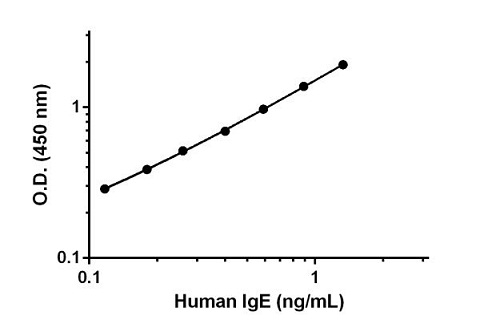
Sandwich ELISA - Human IgE protein (Azide free) (AB65866)
Background-subtracted data values (mean +/- SD) are graphed.
組合せ製品

Reagents, Controls & Accessories
AB234617
Prestained Protein Ladder - Mid-range molecular weight (10 - 180 kDa)

- 0
- 0


Primary Antibodies
AB16667
BOND RX™ Validated|KO Validated|RabMAb|Advanced Validation|Recombinant|20ul selling size

- 5
- 133
Reactivity data
製品の詳細
Analyze your ELISA data using the IgE ab65866 protein to generate and plot the standard curve.
Check out our ELISA protocol for more information here.
This product is purified Human IgE with kappa light chains produced in vitro from a monoclonal hybridoma.
This antigen is quite unique, because it is the only available IgE product, which originates from a human monoclonal cell line.
Our IgE product shows superior advantage when compared to the traditionally purified polyclonal IgE from myeloma patients.
A comparison which is highly superior on the following key parameters:
- Low batch-to-batch variation
- Higher degree of purity (>90%)
- A more uniform product (monoclonal and not polyclonal)
Low endotoxin levels below < 25 EU/mg allow use of IgE protein in cellular immunology and in cell proliferation studies.
配列情報
出荷温度及び保存条件
製品の状態
出荷温度
短期保存期間
短期保存温度
長期保存温度
分注に関する情報
保管に関する情報
補足情報
This supplementary information is collated from multiple sources and compiled automatically.
Biological function summary
The IgE protein functions as a mediator in allergic reactions. It does not operate as part of a complex but directly interacts with allergens and the IgE-specific receptors on immune cells. IgE's role is important in defense against parasitic infections where it performs a protective function by promoting eosinophil activation and degranulation. This action helps the body to expel the parasites. In the absence of parasitic infection IgE's function translates into its role in allergic responses where it becomes responsible for the symptoms associated with allergic diseases.
Pathways
IgE is an important player in the immune response pathway. The protein interacts with allergy-related pathways such as the T helper 2 (Th2) pathway. IgE's role in this pathway involves cooperation with cytokines notably IL-4 and IL-13 which are produced by Th2 cells and promote IgE synthesis in B cells. Also IgE is linked to the FcεRI receptor signaling pathway that initiates the release of histamines and other mediators when IgE binds to an allergen leading to an allergic response.
一般的な情報
機能
Immunoglobulins, also known as antibodies, are membrane-bound or secreted glycoproteins produced by B lymphocytes. In the recognition phase of humoral immunity, the membrane-bound immunoglobulins serve as receptors which, upon binding of a specific antigen, trigger the clonal expansion and differentiation of B lymphocytes into immunoglobulins-secreting plasma cells. Secreted immunoglobulins mediate the effector phase of humoral immunity, which results in the elimination of bound antigens (PubMed : 20176268, PubMed : 22158414). The antigen binding site is formed by the variable domain of one heavy chain, together with that of its associated light chain. Thus, each immunoglobulin has two antigen binding sites with remarkable affinity for a particular antigen. The variable domains are assembled by a process called V-(D)-J rearrangement and can then be subjected to somatic hypermutations which, after exposure to antigen and selection, allow affinity maturation for a particular antigen (PubMed : 17576170, PubMed : 20176268).
ターゲットの情報
文献 (12)
Recent publications for all applications. Explore the full list and refine your search
BMC biotechnology 24:72 PubMed39367362
2024
Applications
Unspecified application
Species
Unspecified reactive species
The Journal of allergy and clinical immunology 152:711-724.e14 PubMed37100120
2023
Applications
Unspecified application
Species
Unspecified reactive species
International journal of molecular medicine 46:1367-1376 PubMed32945368
2020
Applications
Unspecified application
Species
Unspecified reactive species
Journal of immunotoxicology 17:110-121 PubMed32525431
2020
Applications
Unspecified application
Species
Unspecified reactive species
Nucleic acids research 48:e63 PubMed32383757
2020
Applications
Unspecified application
Species
Unspecified reactive species
Langmuir : the ACS journal of surfaces and colloids 34:10321-10332 PubMed30089209
2018
Applications
Unspecified application
Species
Unspecified reactive species
PloS one 13:e0191987 PubMed29389948
2018
Applications
Unspecified application
Species
Unspecified reactive species
Journal of immunological methods 455:41-54 PubMed29397157
2018
Applications
Unspecified application
Species
Unspecified reactive species
Biochemical and biophysical research communications 483:669-673 PubMed27988336
2016
Applications
Unspecified application
Species
Unspecified reactive species
JAMA dermatology 153:30-38 PubMed27829102
2016
Applications
Unspecified application
Species
Unspecified reactive species
Abcam product promise
Please note: All products are 'FOR RESEARCH USE ONLY. NOT FOR USE IN DIAGNOSTIC OR THERAPEUTIC PROCEDURES'.
For licensing inquiries, please contact partnerships@abcam.com