Anti-ZEB1 抗体 [2A8A6]
Anti-ZEB1 antibody [2A8A6]
- KO Validated
- 詳細を見る
Be the first to review this product! Submit a review
|
(25 Publications)
Mouse Monoclonal ZEB1 antibody. Suitable for Flow Cyt, WB, IHC-P, ICC/IF and reacts with Human, Recombinant fragment - Human samples. Cited in 25 publications. Immunogen corresponding to Recombinant Fragment Protein within Human ZEB1 aa 950 to C-terminus.
別名を表示する
AREB6, TCF8, ZEB1, Zinc finger E-box-binding homeobox 1, NIL-2-A zinc finger protein, Negative regulator of IL2, Transcription factor 8, TCF-8
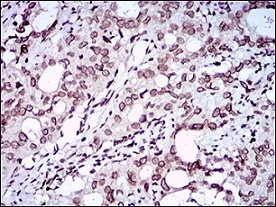
- IHC-P
Supplier Data
Immunohistochemistry (Formalin/PFA-fixed paraffin-embedded sections) - Anti-ZEB1 antibody [2A8A6] (AB181451)
Immunohistochemical analysis of paraffin-embedded Human cervical cancer tissue labeling ZEB1 with ab181451 at 1/200 dilution.
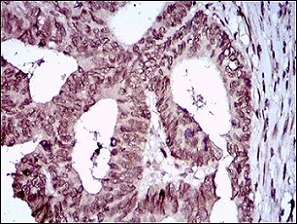
- IHC-P
Supplier Data
Immunohistochemistry (Formalin/PFA-fixed paraffin-embedded sections) - Anti-ZEB1 antibody [2A8A6] (AB181451)
Immunohistochemical analysis of paraffin-embedded Human rectum cancer tissue labeling ZEB1 with ab181451 at 1/200 dilution.
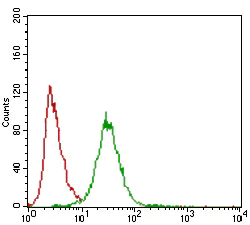
- Flow Cyt
Supplier Data
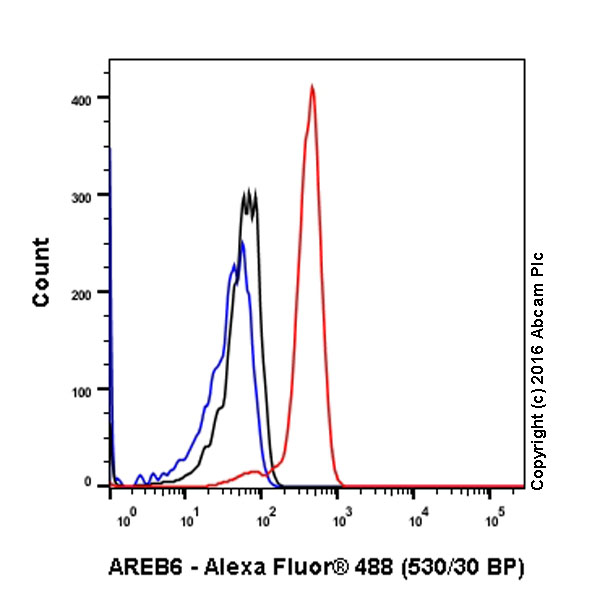
Flow Cytometry - Anti-ZEB1 antibody [2A8A6] (AB181451)
Flow cytometric analysis of HeLa cells labeling ZEB1 (green) with ab181451 at 1/200 dilution. Negative control (red).
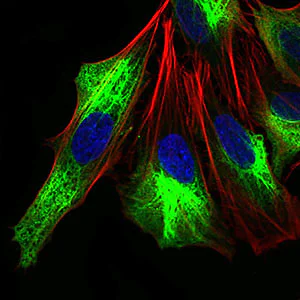
- ICC/IF
Supplier Data
Immunocytochemistry/ Immunofluorescence - Anti-ZEB1 antibody [2A8A6] (AB181451)
Immunofluorescence analysis of HeLa cells labeling ZEB1 (green) with ab181451 at 1/200 dilution. Blue : DRAQ5 fluorescent DNA dye. Red : Actin filaments have been labeled with Alexa Fluor-555 phalloidin.
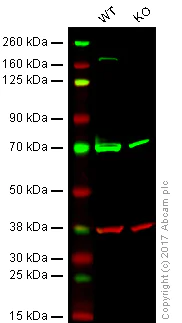
- WB
Lab
Western blot - Anti-ZEB1 antibody [2A8A6] (AB181451)
Lane 1 : Wild-type HAP1 whole cell lysate (20 μg)
Lane 2 : ZEB1 knockout HAP1 whole cell lysate (20 μg)
Lanes 1 - 2 : Merged signal (red and green). Green - ab181451 observed at 200 kDa. Red - loading control, ab181602, observed at 37 kDa.
ab181451 was shown to recognize ZEB1 in wild-type HAP1 cells as signal was lost at the expected MW in ZEB1 knockout cells. Additional cross-reactive bands were observed in the wild-type and knockout cells. Wild-type and ZEB1 knockout samples were subjected to SDS-PAGE. ab181451 and ab181602 (Rabbit anti-GAPDH loading control) were incubated overnight at 4°C at 1/500 dilution and 1/20000 dilution respectively. Blots were developed with Goat anti-Mouse IgG H&L (IRDye® 800CW) preabsorbed ab216772 and Goat anti-Rabbit IgG H&L (IRDye® 680RD) preabsorbed ab216777 secondary antibodies at 1/20000 dilution for 1 hour at room temperature before imaging.
All lanes:
Western blot - Anti-ZEB1 antibody [2A8A6] (ab181451)
Predicted band size: 124 kDa
false
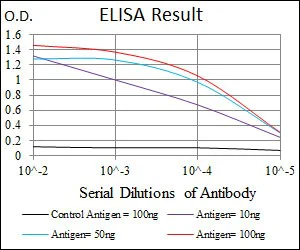
- ELISA
Unknown
ELISA - Anti-ZEB1 antibody [2A8A6] (AB181451)
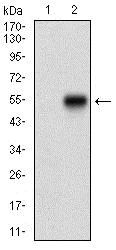
- WB
Supplier Data
Western blot - Anti-ZEB1 antibody [2A8A6] (AB181451)
All lanes:
Western blot - Anti-ZEB1 antibody [2A8A6] (ab181451) at 1/500 dilution
Lane 1:
HEK293 cell lysate
Lane 2:
KEB1 (AA: 967-1108)-hIgGFc transfected HEK293 cell lysate
Predicted band size: 124 kDa
false
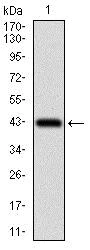
- WB
Supplier Data
Western blot - Anti-ZEB1 antibody [2A8A6] (AB181451)
All lanes:
Western blot - Anti-ZEB1 antibody [2A8A6] (ab181451) at 1/500 dilution
All lanes:
ZEB1 recombinant protein fragment (Expected MW is 41.7 kDa)
Predicted band size: 124 kDa
false
- WB
CiteAb
Western blot - Anti-ZEB1 antibody [2A8A6] (AB181451)
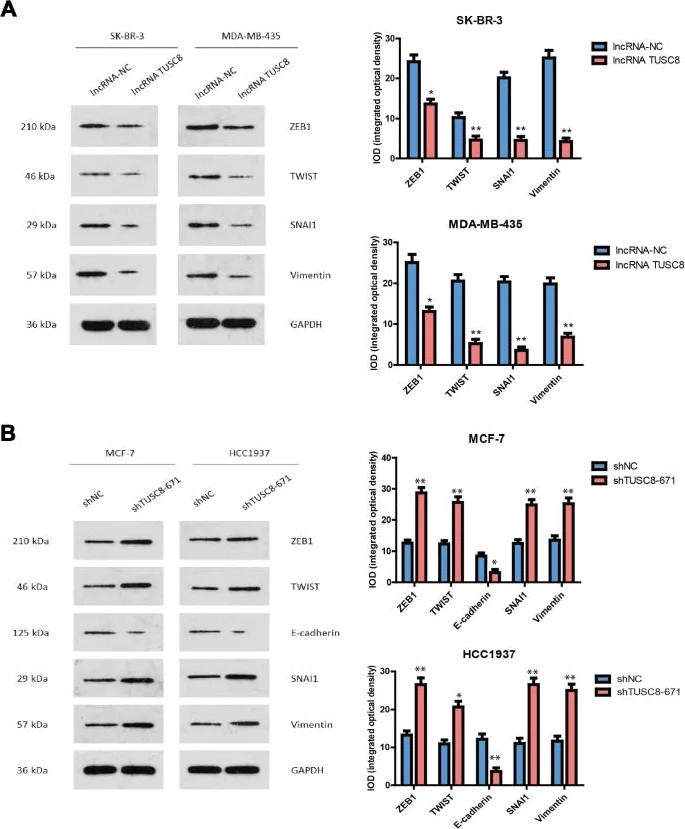
ZEB1 western blot using anti-ZEB1 antibody [2A8A6] ab181451. Publication image and figure legend from Zhao, L., Zhou, Y., et al., 2020, Aging (Albany NY), PubMed 32039833.
ab181451 was used in this publication in western blot. This may not be the same as the application(s) guaranteed by Abcam. For a full list of applications guaranteed by Abcam for ab181451 please see the product overview.
TUSC8 affects breast cancer cell metastasis through regulating the expression of epithelial–mesenchymal transition (EMT) related markers. (A) Over-expression of TUSC8 down-regulated the expression of mesenchymal related markers (ZEB1, TWIST, SNAI1 and Vimentin) in breast cancer cell lines SK-BR-3 and MDA-MB-435 by western blot. (B) Knock-down of TUSC8 up-regulated the expression of mesenchymal related markers (ZEB1, TWIST, SNAI1 and Vimentin), while down-regulated the expression of epithelial related marker (E-cadherin) in breast cancer cell lines MCF-7 and HCC1937 by western blot. The asterisks (*, **) indicate a significant difference (p < 0.05, p < 0.01) respectively.
false
代替製品
Primary Antibodies
AB203829
20ul selling size|RabMAb|Recombinant|KO Validated

- 3
- 3
Primary Antibodies
AB228986
Anti-ZEB1 antibody [EPR17375] - BSA and Azide free
RabMAb|Recombinant|KO Validated
- 0
- 0
組合せ製品
Primary Antibodies
AB40772
Anti-E Cadherin antibody [EP700Y] - Intercellular Junction Marker
BOND RX™ Validated|KO Validated|RabMAb|Recombinant|Lab Essentials|20ul selling size|Advanced Validation

- 4
- 23
Primary Antibodies
AB92547
Anti-Vimentin antibody [EPR3776] - Cytoskeleton Marker
BOND RX™ Validated|KO Validated|RabMAb|Recombinant|Lab Essentials|20ul selling size|Advanced Validation

- 5
- 92
Primary Antibodies
AB76011
Anti-N Cadherin antibody [EPR1791-4]
20ul selling size|RabMAb|Recombinant|KO Validated

- 4
- 14
Primary Antibodies
AB216347
Anti-SNAIL antibody [EPR21043]
20ul selling size|KO Validated|RabMAb|Recombinant
- 1
- 1
Reactivity data
製品の詳細
出荷温度及び保存条件
製品の状態
精製方法
精製に関する特記事項
バッファー組成
出荷温度
短期保存期間
短期保存温度
長期保存温度
分注に関する情報
保管に関する情報
補足情報
This supplementary information is collated from multiple sources and compiled automatically.
Biological function summary
ZEB1 modulates cellular differentiation and identity by repressing and activating target genes. This protein is particularly notable for its involvement in the epithelial-to-mesenchymal transition (EMT) an important biological process for development and wound healing. ZEB1 doesn't act alone; it forms complexes with other transcription factors and co-repressors such as SMAD and CtBP enhancing its regulatory reach. Through these interactions ZEB1 influences cell adhesion molecules and cytoskeletal components facilitating cell motility and invasion.
Pathways
ZEB1 is integral to the TGF-β signaling pathway influencing cellular responses to growth factors. It also intersects with the Wnt signaling pathway linking it to cellular proliferation and differentiation. Through these pathways ZEB1 interacts with other significant proteins including β-catenin and SMAD proteins which collaboratively regulate gene expression that affects cell phenotype and behavior.
製品プロトコール
- Visit the General protocols
- Visit the Troubleshooting
ターゲットの情報
文献 (25)
Recent publications for all applications. Explore the full list and refine your search
Journal of extracellular vesicles 14:e70160 PubMed40955457
2025
Applications
Unspecified application
Species
Unspecified reactive species
Open life sciences 20:20251109 PubMed40771411
2025
Applications
Unspecified application
Species
Unspecified reactive species
Journal of translational medicine 23:265 PubMed40038747
2025
Applications
Unspecified application
Species
Unspecified reactive species
Cell death discovery 10:377 PubMed39181873
2024
Applications
Unspecified application
Species
Unspecified reactive species
Journal of translational medicine 20:58 PubMed35101080
2022
Applications
Unspecified application
Species
Unspecified reactive species
Cancer research communications 1:106-114 PubMed36860286
2021
Applications
Unspecified application
Species
Unspecified reactive species
Journal of Cancer 12:4626-4637 PubMed34149926
2021
Applications
Unspecified application
Species
Unspecified reactive species
Translational andrology and urology 10:643-653 PubMed33718067
2021
Applications
Unspecified application
Species
Unspecified reactive species
Frontiers in oncology 10:583682 PubMed33363013
2020
Applications
Unspecified application
Species
Unspecified reactive species
Aging 12:2974-2991 PubMed32039833
2020
Applications
Unspecified application
Species
Unspecified reactive species
Abcam product promise
Please note: All products are 'FOR RESEARCH USE ONLY. NOT FOR USE IN DIAGNOSTIC OR THERAPEUTIC PROCEDURES'.
For licensing inquiries, please contact partnerships@abcam.com