Anti-XPF 抗体 [EPR25350-148] - BSA and Azide free
Anti-XPF antibody [EPR25350-148] - BSA and Azide free
- RabMAb
- Recombinant
- KO Validated
- 詳細を見る
Be the first to review this product! Submit a review
|
(0 Publication)
Rabbit Recombinant Monoclonal XPF antibody. Carrier free. Suitable for IP, WB and reacts with Human samples.
別名を表示する
ERCC11, XPF, ERCC4, DNA repair endonuclease XPF, DNA excision repair protein ERCC-4, DNA repair protein complementing XP-F cells, Xeroderma pigmentosum group F-complementing protein
- IP
Supplier Data
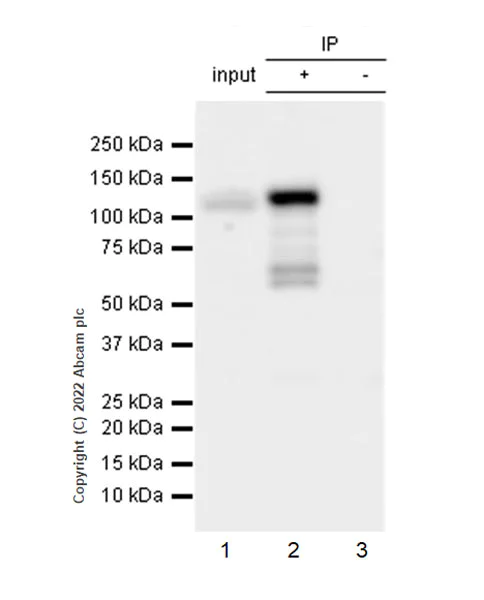
Immunoprecipitation - Anti-XPF antibody [EPR25350-148] - BSA and Azide free (AB290740)
This data was developed using ab290725, the same antibody clone in a different buffer formulation.
XPF was immunoprecipitated from 0.35 mg 293T (human embryonic kidney epithelial cell) whole cell lysate 10 ug with ab290725 at 1/30 dilution (2ug in 0.35mg lysates). Western blot was performed on the immunoprecipitate using ab290725 at 1/1000 dilution. VeriBlot for IP secondary antibody(HRP)(ab131366) was used at 1/5000 dilution.
Lane 1 : 293T (human embryonic kidney epithelial cell) whole cell lysate 10 ug
Lane 2 : ab290725 IP in 293T whole cell lysate
Lane 3 : Rabbit monoclonal IgG (ab172730) instead of ab290725 in 293T whole cell lysate
Blocking and dilution buffer and concentration : 5% NFDM/TBST.
Exposure time : 15 seconds
All lanes:
Immunoprecipitation - Anti-XPF antibody [EPR25350-148] (<a href='/products/primary-antibodies/xpf-antibody-epr25350-148-ab290725'>ab290725</a>)
Predicted band size: 104 kDa
false
- WB
Lab
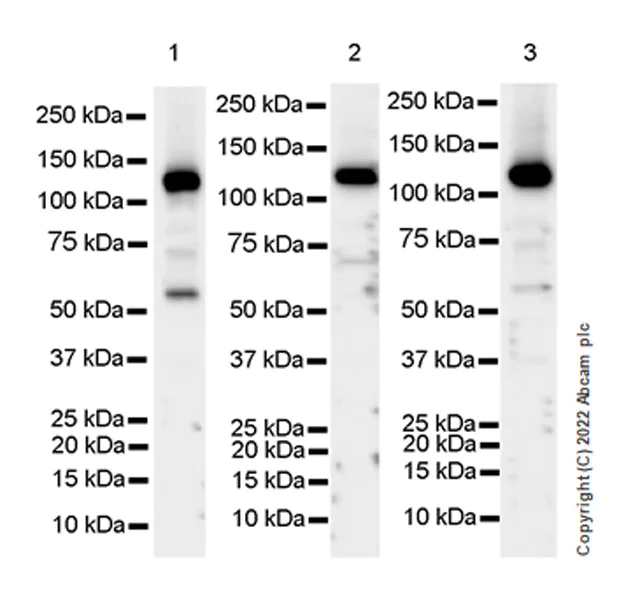
Western blot - Anti-XPF antibody [EPR25350-148] - BSA and Azide free (AB290740)
This data was developed using ab290725, the same antibody clone in a different buffer formulation.
Blocking / Dilution buffer and concentration : 5% NFDM/TBST
Lysates should be made freshly and used in WB immediately to minimize protein degradation.
All lanes:
Western blot - Anti-XPF antibody [EPR25350-148] (<a href='/products/primary-antibodies/xpf-antibody-epr25350-148-ab290725'>ab290725</a>) at 1/1000 dilution
Lane 1:
MCF7 (human breast adenocarcinoma epithelial cell) whole cell lysate. at 20 µg
Lane 2:
K-562 (human chronic myelogenous leukemia lymphoblast) whole cell lysate. at 20 µg
Lane 3:
293T (human embryonic kidney epithelial cell) whole cell lysate. at 20 µg
Secondary
All lanes:
Western blot - Goat Anti-Rabbit IgG H&L (HRP) (<a href='/products/secondary-antibodies/goat-rabbit-igg-h-l-hrp-ab97051'>ab97051</a>) at 1/20000 dilution
Predicted band size: 104 kDa
Observed band size: 104 kDa
false
Exposure time: 15s
- WB
Lab
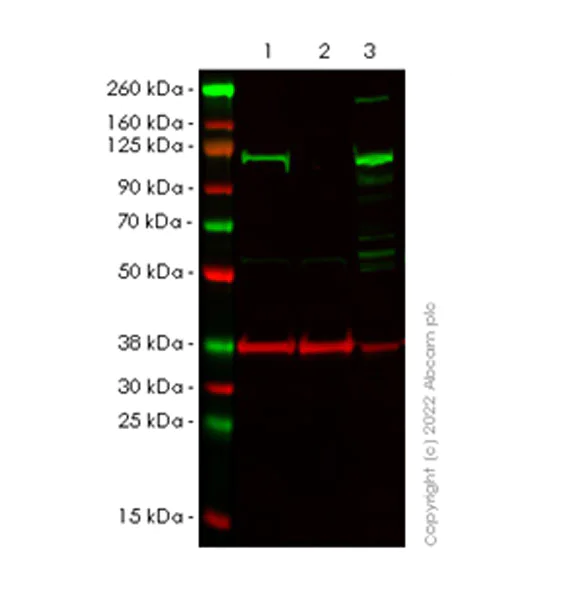
Western blot - Anti-XPF antibody [EPR25350-148] - BSA and Azide free (AB290740)
This data was developed using ab290725, the same antibody clone in a different buffer formulation.
Blocking / Diluent buffer and concentration : Intercept® (TBS) Blocking Buffer diluted with an equal volume of 0.1% TBS.
Lanes 1-3 : Merged signal (red and green). Green - ab290725 observed at 104 kDa. Red - loading control ab8245 observed at 36 kDa.
ab290725 Anti-ERCC4 antibody [EPR25350-148] was shown to specifically react with ERCC4 in wild-type HeLa cells. Loss of signal was observed when knockout cell line was used. Wild-type and ERCC4 knockout samples were subjected to SDS-PAGE. ab290725 and Anti-GAPDH antibody [6C5] - Loading Control (ab8245) were incubated at 4℃ overnight at 1 in 1000 dilution and 1 in 20000 dilution respectively. Blots were developed with Goat anti-Rabbit IgG H&L (IRDye® 800CW) preadsorbed (ab216773) and Goat anti-Mouse IgG H&L (IRDye® 680RD) preadsorbed (ab216776) secondary antibodies at 1 in 10000 dilution for 1 hour at room temperature before imaging.
All lanes:
Western blot - Anti-XPF antibody [EPR25350-148] (<a href='/products/primary-antibodies/xpf-antibody-epr25350-148-ab290725'>ab290725</a>) at 1/1000 dilution
Lane 1:
Wild-type HeLa (human cervix adenocarcinoma epithelial cell) whole cell lysate. at 20 µg
Lane 2:
ERCC4 knockout HeLa whole cell lysate. at 20 µg
Lane 3:
293T (human embryonic kidney epithelial cell) whole cell lysate. at 20 µg
Secondary
All lanes:
Goat Anti-Rabbit IgG H&L (IRDye® 800CW) (<a href='/products/secondary-antibodies/goat-rabbit-igg-h-l-irdye-800cw-preadsorbed-ab216773'>ab216773</a>) and Goat Anti-Mouse IgG H&L (IRDye® 680RD) (<a href='/products/secondary-antibodies/goat-mouse-igg-h-l-irdye-680rd-preadsorbed-ab216776'>ab216776</a>) at 1/10000 dilution
Predicted band size: 104 kDa
Observed band size: 104 kDa
false
関連する標識済み抗体及び組成の異なる製品 (1)
-
Anti-XPF antibody [EPR25350-148]
組合せ製品

Primary Antibodies
AB27156
Anti-ds DNA antibody [35I9 DNA] - BSA and Azide free
BOND RX™ Validated

- 4
- 11
Reactivity data
製品の詳細
Patented technology
Our RabMAb® technology is a patented hybridoma-based technology for making rabbit monoclonal antibodies. For details on our patents, please refer to RabMAb® patents.
What are the advantages of a recombinant monoclonal antibody?
This product is a recombinant monoclonal antibody, which offers several advantages including:
- - High batch-to-batch consistency and reproducibility
- - Improved sensitivity and specificity
- - Long-term security of supply
- - Animal-free batch production
For more information, read more on recombinant antibodies.
Conjugation ready
Our carrier-free antibodies are typically supplied in a PBS-only formulation, purified and free of BSA, sodium azide and glycerol. This conjugation-ready format is designed for use with fluorochromes, metal isotopes, oligonucleotides, and enzymes, which makes them ideal for antibody labelling, functional and cell-based assays, flow-based assays (e.g. mass cytometry) and Multiplex Imaging applications.
Use our conjugation kits for antibody conjugates that are ready-to-use in as little as 20 minutes with 1 minute hands-on-time and 100% antibody recovery: available for fluorescent dyes, HRP, biotin and gold.
Compatibility
This product is compatible with the Maxpar® Antibody Labeling Kit from Fluidigm, without the need for antibody preparation. Maxpar® is a trademark of Fluidigm Canada Inc.
出荷温度及び保存条件
製品の状態
精製方法
バッファー組成
出荷温度
短期保存温度
長期保存温度
補足情報
This supplementary information is collated from multiple sources and compiled automatically.
Biological function summary
The XPF protein collaborates with ERCC1 to form a heterodimeric complex important for nucleotide excision repair (NER). This complex is essential in recognizing and repairing bulky DNA adducts therefore maintaining DNA integrity. The complex performs specific incisions near DNA damage sites removing lesions that frequently occur due to environmental factors like UV radiation and chemical pollutants.
Pathways
XPF functions within the NER and interstrand crosslink repair pathways. In these pathways the XPF-ERCC1 complex coordinates with other proteins like XPA and RPA to accurately excise damaged DNA segments and facilitate repair synthesis. These interactions are important for restoring normal DNA configuration and function after damage thereby preventing mutations and genomic instability.
製品プロトコール
- Visit the General protocols
- Visit the Troubleshooting
ターゲットの情報
Abcam product promise
Please note: All products are 'FOR RESEARCH USE ONLY. NOT FOR USE IN DIAGNOSTIC OR THERAPEUTIC PROCEDURES'.
For licensing inquiries, please contact partnerships@abcam.com