Anti-Ubiquitin 抗体 [EPR8589]
Anti-Ubiquitin antibody [EPR8589]
- 20ul selling size
- RabMAb
- Recombinant
- 詳細を見る
Be the first to review this product! Submit a review
|
(4 Publications)
Rabbit Recombinant Monoclonal UBC antibody. Suitable for WB, ICC/IF, Flow Cyt (Intra) and reacts with Mouse, Human samples. Cited in 4 publications.
別名を表示する
Polyubiquitin-C, UBC, UBCEP2, UBA52, Ubiquitin-ribosomal protein eL40 fusion protein, CEP52, Ubiquitin A-52 residue ribosomal protein fusion product 1, UBA80, UBCEP1, RPS27A, Ubiquitin-ribosomal protein eS31 fusion protein, Ubiquitin carboxyl extension protein 80
- ICC/IF
Unknown
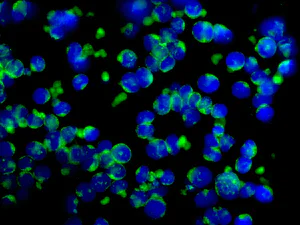
Immunocytochemistry/ Immunofluorescence - Anti-Ubiquitin antibody [EPR8589] (AB137031)
Immunofluorescence analysis of Jurkat cells labelling Ubiquitin with ab137031 at 1/250 dilution.
- Flow Cyt (Intra)
Unknown
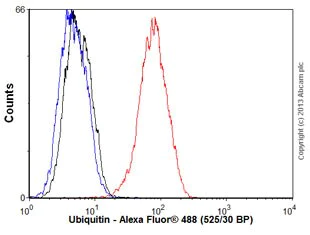
Flow Cytometry (Intracellular) - Anti-Ubiquitin antibody [EPR8589] (AB137031)
Overlay histogram showing HepG2 cells stained with ab137031 (red line). The cells were fixed with 4% paraformaldehyde (10 min) and then permeabilized with 0.1% PBS-Tween for 20 min. The cells were then incubated in 1x PBS / 10% normal goat serum / 0.3M glycine to block non-specific protein-protein interactions followed by the antibody (ab137031 1/1000 dilution) for 30 min at 22°C. The secondary antibody used was Alexa Fluor® 488 goat anti-rabbit IgG (H&L) (ab150077) at 1/2000 dilution for 30 min at 22°C. Isotype control antibody (black line) was rabbit IgG (monoclonal) (0.1μg/1x106 cells) used under the same conditions. Unlabelled sample (blue line) was also used as a control. Acquisition of >5000 events were collected using a 20mW Argon ion laser (488nm) and 525/30 bandpass filter. This antibody gave a positive signal in HepG2 cells fixed with 80% methanol (5 min)/permeabilized with 0.1% PBS-Tween for 20 min used under the same conditions.
- WB
Unknown
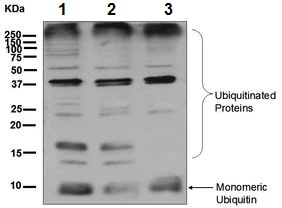
Western blot - Anti-Ubiquitin antibody [EPR8589] (AB137031)
All lanes:
Western blot - Anti-Ubiquitin antibody [EPR8589] (ab137031) at 1/1000 dilution
Lane 1:
Hela cell lysate at 10 µg
Lane 2:
Jurkat cell lysate at 10 µg
Lane 3:
293T (Human embryonic kidney epithelial cell) cell lysate at 10 µg
Secondary
All lanes:
HRP conjugated Goat anti Rabbit IgG at 1/2000 dilution
Predicted band size: 26 kDa
false
- WB
Lab
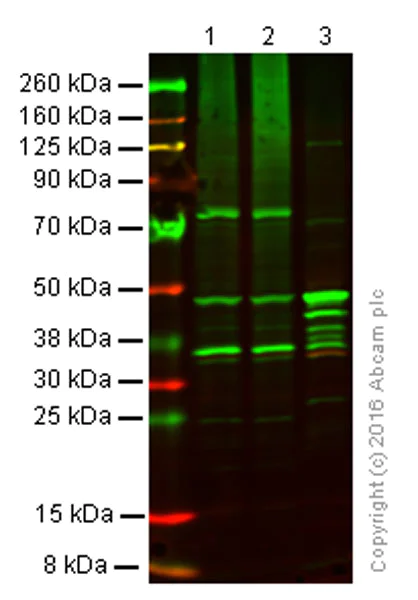
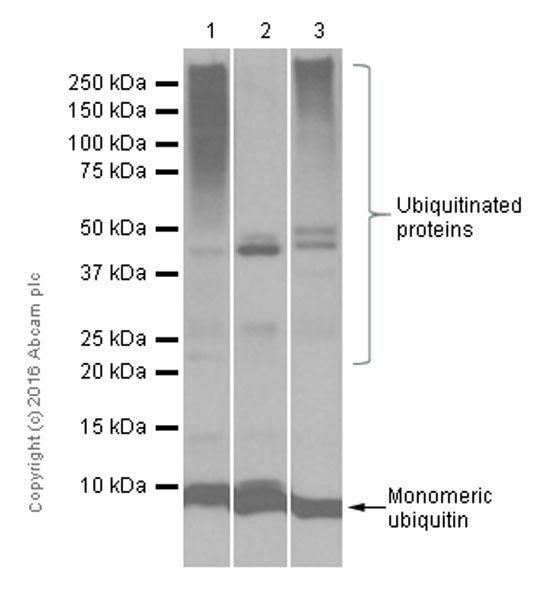
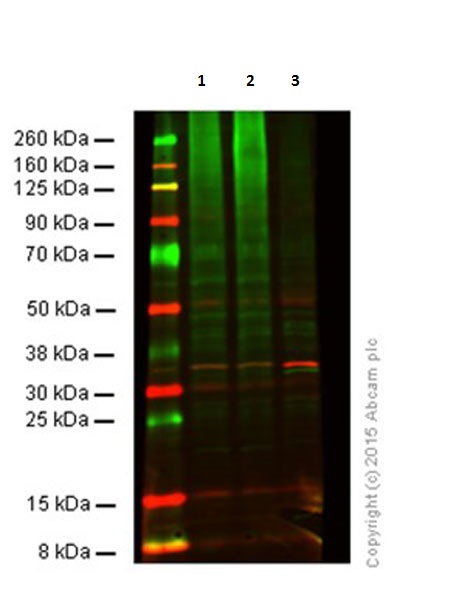
Western blot - Anti-Ubiquitin antibody [EPR8589] (AB137031)
This blot was produced using a 4-12% Bis-tris gel under the MES buffer system. The gel was run at 200V for 35 minutes before being transferred onto a nitrocellulose membrane at 30V for 70 minutes. ab137031 and ab8245 (loading control to GAPDH) were diluted 1/200 and 1/10 000 respectively and incubated overnight at 4°C. Blots were developed with goat anti-rabbit IgG (H + L) and goat anti-mouse IgG (H + L) secondary antibodies at 1/10 000 dilution for 1 h at room temperature before imaging using the Licor Odyssey CLx.
All lanes:
Western blot - Anti-Ubiquitin antibody [EPR8589] (ab137031) at 1/200 dilution
Lane 1:
MCF-7 Whole Cell Lysate at 20 µg
Lane 2:
MCF-7 Whole Cell Lysate + M132 (50 uM 90 min) at 20 µg
Lane 3:
Mouse brain tissue lysate at 20 µg
Predicted band size: 26 kDa
false
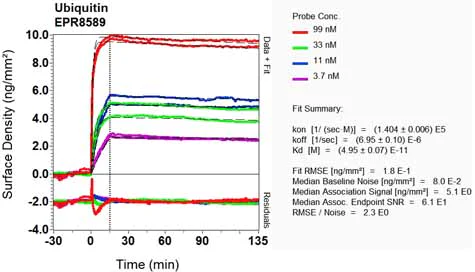
- OI-RD Scanning
Unknown
OI-RD Scanning - Anti-Ubiquitin antibody [EPR8589] (AB137031)
We have systematically measured KD (the equilibrium dissociation constant between the antibody and its antigen), of more than 840 recombinant antibodies to assess not only their individual KD values but also to see the average affinity of antibody. Based on the comparison with published literature values for mouse monoclonal antibodies, Recombinant antibodies appear to be on average 1-2 order of magnitude higher affinity.
関連する標識済み抗体及び組成の異なる製品 (7)
-
Anti-Ubiquitin antibody [EPR8589] - BSA and Azide free
-
660 APC
APC Anti-Ubiquitin antibody [EPR8589]
-
519 Alexa Fluor® 488
Alexa Fluor® 488 Anti-Ubiquitin antibody [EPR8589]
-
565 Alexa Fluor® 555
Alexa Fluor® 555 Anti-Ubiquitin antibody [EPR8589]
-
617 Alexa Fluor® 594
Alexa Fluor® 594 Anti-Ubiquitin antibody [EPR8589]
-
665 Alexa Fluor® 647
Alexa Fluor® 647 Anti-Ubiquitin antibody [EPR8589]
-
578 PE
PE Anti-Ubiquitin antibody [EPR8589]
代替製品
Primary Antibodies
AB204274
Alexa Fluor® 488 Anti-Ubiquitin (linkage-specific K48) antibody [EP8589]
RabMAb|Recombinant
- 0
- 0
Primary Antibodies
AB192489
Alexa Fluor® 647 Anti-Ubiquitin (linkage-specific K63) antibody [EPR8590-448]
RabMAb|Recombinant

- 0
- 0
Primary Antibodies
AB137025
Anti-Ubiquitin antibody [EPR8590]
20ul selling size|RabMAb|Recombinant
- 0
- 0
Primary Antibodies
AB134953
Anti-Ubiquitin antibody [EPR8830]
20ul selling size|RabMAb|Recombinant
- 4
- 3
Primary Antibodies
AB140601
Anti-Ubiquitin (linkage-specific K48) antibody [EP8589]
20ul selling size|RabMAb|Recombinant

- 5
- 10
Primary Antibodies
AB181537
Anti-Ubiquitin (linkage-specific K27) antibody [EPR17034]
20ul selling size|RabMAb|Recombinant
- 4
- 1
Primary Antibodies
AB179434
Anti-Ubiquitin (linkage-specific K63) antibody [EPR8590-448]
20ul selling size|RabMAb|Recombinant

- 5
- 6
組合せ製品
Primary Antibodies
AB134953
Anti-Ubiquitin antibody [EPR8830]
20ul selling size|RabMAb|Recombinant
- 4
- 3

Primary Antibodies
AB140601
Anti-Ubiquitin (linkage-specific K48) antibody [EP8589]
20ul selling size|RabMAb|Recombinant
- 5
- 10
Reactivity data
製品の詳細
Patented technology
Our RabMAb® technology is a patented hybridoma-based technology for making rabbit monoclonal antibodies. For details on our patents, please refer to RabMAb® patents.
What are the advantages of a recombinant monoclonal antibody?
This product is a recombinant monoclonal antibody, which offers several advantages including:
- - High batch-to-batch consistency and reproducibility
- - Improved sensitivity and specificity
- - Long-term security of supply
- - Animal-free batch production
For more information, read more on recombinant antibodies.
出荷温度及び保存条件
製品の状態
精製方法
バッファー組成
出荷温度
短期保存温度
長期保存温度
分注に関する情報
保管に関する情報
補足情報
This supplementary information is collated from multiple sources and compiled automatically.
Biological function summary
The ubiquitin system plays a critical role in regulating protein turnover and quality control within cells. It is part of a larger complex known as the ubiquitin-proteasome system (UPS) which is responsible for degrading proteins that need to be turned over. This process is essential for cell cycle control response to oxidative stress and DNA repair. Ubiquitin's role in tagging proteins for degradation or signaling allows cells to respond quickly to changes in their environment and maintain balance.
Pathways
Ubiquitin functions in several important biological pathways including the Wnt and NF-kB pathways. In the Wnt signaling pathway ubiquitination modulates the stability of key components thereby affecting the pathway's overall activity. In the NF-kB signaling pathway ubiquitin labels inhibitor proteins for degradation which releases and activates NF-kB. These pathways highlight ubiquitin's interaction with proteins such as beta-catenin in Wnt and IkB in NF-kB illustrating how it regulates diverse cellular processes.
製品プロトコール
- Visit the General protocols
- Visit the Troubleshooting
ターゲットの情報
追加のターゲット
文献 (4)
Recent publications for all applications. Explore the full list and refine your search
Biology direct 19:35 PubMed38715121
2024
Applications
Unspecified application
Species
Unspecified reactive species
International journal of molecular sciences 25: PubMed38474102
2024
Applications
Unspecified application
Species
Unspecified reactive species
Nucleic acids research 49:11728-11745 PubMed34718776
2021
Applications
Unspecified application
Species
Unspecified reactive species
Nature communications 11:6409 PubMed33335104
2020
Applications
Unspecified application
Species
Unspecified reactive species
Abcam product promise
Please note: All products are 'FOR RESEARCH USE ONLY. NOT FOR USE IN DIAGNOSTIC OR THERAPEUTIC PROCEDURES'.
For licensing inquiries, please contact partnerships@abcam.com