Anti-Ubiquitin 抗体 [5B9-B3]
Anti-Ubiquitin antibody [5B9-B3]
Be the first to review this product! Submit a review
|
(3 Publications)
Mouse Monoclonal UBB antibody. Suitable for WB, ICC/IF and reacts with Human samples. Cited in 3 publications. Immunogen corresponding to Native Full Length Protein corresponding to Cow UBB conjugated to Keyhole Limpet Haemocyanin.
別名を表示する
Polyubiquitin-B, UBB
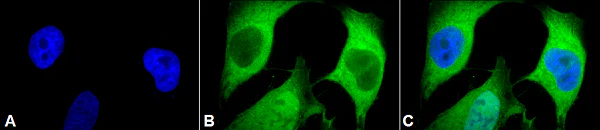
- ICC/IF
Supplier Data
Immunocytochemistry/ Immunofluorescence - Anti-Ubiquitin antibody [5B9-B3] (AB223378)
2% formaldehyde-fixed HeLa (human epithelial cell line from cervix adenocarcinoma) cells stained for Ubiquitin (green) using ab223378 at 1/100 dilution in ICC/IF. Secondary : Goat Anti-Mouse FITC at 1/200 dilution for 2 hours at RT. Counterstain : DAPI (blue) nuclear stain at 1/40000 for 2 hours RT.
(A) DAPI nuclear stain (B) ab223378 (C) Merge.
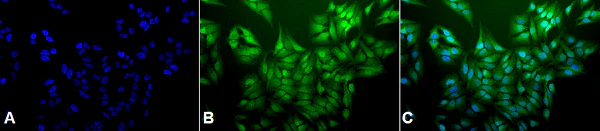
- ICC/IF
Supplier Data
Immunocytochemistry/ Immunofluorescence - Anti-Ubiquitin antibody [5B9-B3] (AB223378)
2% formaldehyde-fixed HeLa (human epithelial cell line from cervix adenocarcinoma) cells stained for Ubiquitin (green) using ab223378 at 1/100 dilution in ICC/IF. Secondary : Goat Anti-Mouse FITC at 1/200 dilution for 2 hours at RT. Counterstain : DAPI (blue) nuclear stain at 1/40000 for 2 hours RT.
(A) DAPI nuclear stain (B) ab223378 (C) Merge.
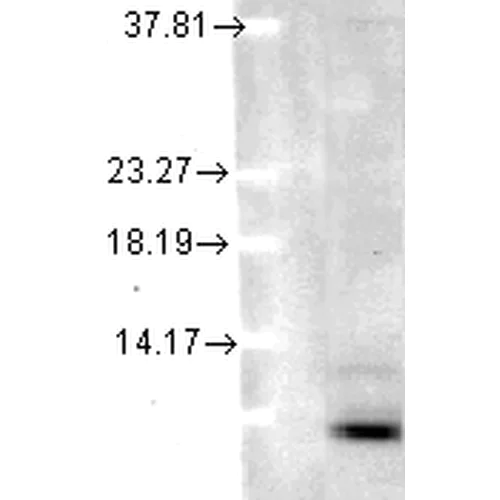
- WB
Supplier Data
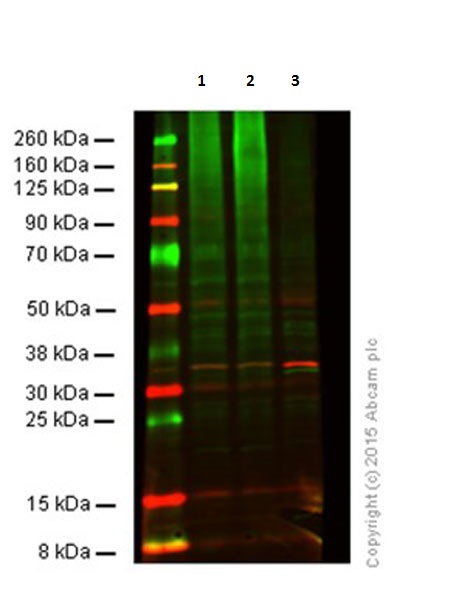
Western blot - Anti-Ubiquitin antibody [5B9-B3] (AB223378)
Blocking buffer : 1.5% BSA.
Primary antibody was incubated for 2 hours, the secondary for 1 hour at RT.
Mix of human cell line lysates : epidermoid carcinoma (A431), adenocarcinomic alveolar basal epithelial cells (A549), colon cancer (HCT116), cervical cancer (HeLa), embryonic kidney (HEK293), liver cancer (HepG2), promyelocytic leukemia (HL-60), umbilical vein endothelial cells (HUVEC), T lymphocytes (Jurkat), breast cancer (MCF7), prostate cancer (PC3), brain glioblastom (T98G).
All lanes:
Western blot - Anti-Ubiquitin antibody [5B9-B3] (ab223378) at 1/1000 dilution
All lanes:
Mix of human cell lysates at 15 µg
Secondary
All lanes:
Sheep Anti-Mouse IgG HRP
Predicted band size: 26 kDa
Observed band size: 10 kDa
false
代替製品
Primary Antibodies
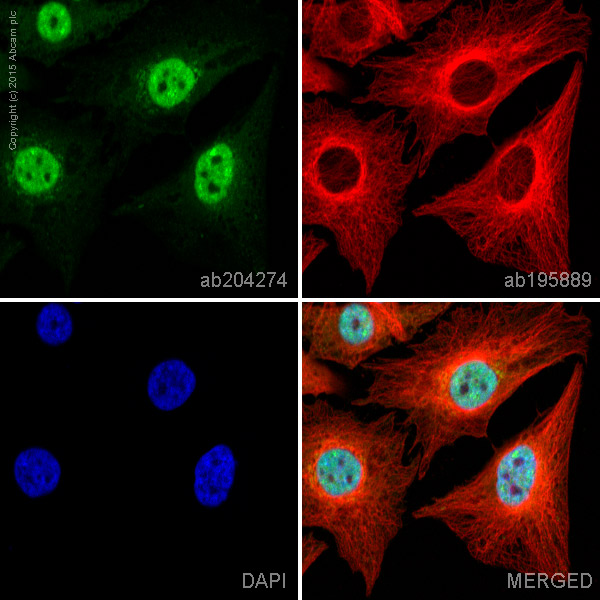
AB204274
Alexa Fluor® 488 Anti-Ubiquitin (linkage-specific K48) antibody [EP8589]
RabMAb|Recombinant
- 0
- 0
Primary Antibodies
AB192489
Alexa Fluor® 647 Anti-Ubiquitin (linkage-specific K63) antibody [EPR8590-448]
RabMAb|Recombinant

- 0
- 0
Primary Antibodies
AB137025
Anti-Ubiquitin antibody [EPR8590]
20ul selling size|RabMAb|Recombinant
- 0
- 0
Primary Antibodies
AB134953
Anti-Ubiquitin antibody [EPR8830]
20ul selling size|RabMAb|Recombinant
- 4
- 3
Primary Antibodies
AB140601
Anti-Ubiquitin (linkage-specific K48) antibody [EP8589]
20ul selling size|RabMAb|Recombinant

- 5
- 10
Primary Antibodies
AB181537
Anti-Ubiquitin (linkage-specific K27) antibody [EPR17034]
20ul selling size|RabMAb|Recombinant
- 4
- 1
Primary Antibodies
AB179434
Anti-Ubiquitin (linkage-specific K63) antibody [EPR8590-448]
20ul selling size|RabMAb|Recombinant

- 5
- 6
組合せ製品

Primary Antibodies
AB140601
Anti-Ubiquitin (linkage-specific K48) antibody [EP8589]
20ul selling size|RabMAb|Recombinant
- 5
- 10
Primary Antibodies
AB179434
Anti-Ubiquitin (linkage-specific K63) antibody [EPR8590-448]
20ul selling size|RabMAb|Recombinant
- 5
- 6
Primary Antibodies
AB109535
20ul selling size|BOND RX™ Validated|KO Validated|RabMAb|Recombinant
- 5
- 1
Reactivity data
出荷温度及び保存条件
製品の状態
精製方法
バッファー組成
出荷温度
短期保存期間
短期保存温度
長期保存温度
分注に関する情報
保管に関する情報
補足情報
This supplementary information is collated from multiple sources and compiled automatically.
Biological function summary
The ubiquitin system plays a critical role in regulating protein turnover and quality control within cells. It is part of a larger complex known as the ubiquitin-proteasome system (UPS) which is responsible for degrading proteins that need to be turned over. This process is essential for cell cycle control response to oxidative stress and DNA repair. Ubiquitin's role in tagging proteins for degradation or signaling allows cells to respond quickly to changes in their environment and maintain balance.
Pathways
Ubiquitin functions in several important biological pathways including the Wnt and NF-kB pathways. In the Wnt signaling pathway ubiquitination modulates the stability of key components thereby affecting the pathway's overall activity. In the NF-kB signaling pathway ubiquitin labels inhibitor proteins for degradation which releases and activates NF-kB. These pathways highlight ubiquitin's interaction with proteins such as beta-catenin in Wnt and IkB in NF-kB illustrating how it regulates diverse cellular processes.
製品プロトコール
- Visit the General protocols
- Visit the Troubleshooting
ターゲットの情報
文献 (3)
Recent publications for all applications. Explore the full list and refine your search
Molecular cell 82:2858-2870.e8 PubMed35732190
2022
Applications
Unspecified application
Species
Unspecified reactive species
Frontiers in neuroscience 16:907155 PubMed35769705
2022
Applications
Unspecified application
Species
Unspecified reactive species
Microbiology spectrum 10:e0071822 PubMed35768946
2022
Applications
Unspecified application
Species
Unspecified reactive species
Abcam product promise
Please note: All products are 'FOR RESEARCH USE ONLY. NOT FOR USE IN DIAGNOSTIC OR THERAPEUTIC PROCEDURES'.
For licensing inquiries, please contact partnerships@abcam.com