JavaScript is disabled in your browser. Please enable JavaScript to view this website.
AB229329

Anti-TIPIN 抗体

Anti-TIPIN antibody

Be the first to review this product! Submit a review

|

(3 Publications)

Rabbit Polyclonal TIPIN antibody. Suitable for WB and reacts with Human samples. Cited in 3 publications. Immunogen corresponding to Recombinant Fragment Protein within Human TIMELESS-interacting protein.

別名を表示する

TIMELESS-interacting protein, TIPIN
1 Images
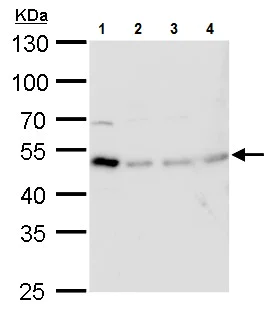
Western blot - Anti-TIPIN antibody (AB229329)
  • WB

Supplier Data

Western blot - Anti-TIPIN antibody (AB229329)

10 % SDS-PAGE gel.

All lanes:

Western blot - Anti-TIPIN antibody (ab229329) at 1/1000 dilution

Lane 1:

HEK-293T (human epithelial cell line from embryonic kidney transformed with large T antigen) whole cell lysate at 30 µg

Lane 2:

A431 (human epidermoid carcinoma cell line) whole cell lysate at 30 µg

Lane 3:

HeLa (human epithelial cell line from cervix adenocarcinoma) whole cell lysate at 30 µg

Lane 4:

HepG2 (human liver hepatocellular carcinoma cell line) whole cell lysate at 30 µg

Predicted band size: 35 kDa

false

Key facts

宿主種

Rabbit

クローン性

Polyclonal

アイソタイプ

IgG

キャリアフリー

No

交差種

Human

アプリケーション

WB

applications

免疫原

Recombinant Fragment Protein within Human TIMELESS-interacting protein. The exact immunogen used to generate this antibody is proprietary information.

Q9BVW5

Reactivity data

{ "title": "Reactivity Data", "filters": { "stats": ["", "Species", "Dilution Info", "Notes"], "tabs": { "all-applications": {"fullname" : "All Applications", "shortname": "All Applications"}, "WB" : {"fullname" : "Western blot", "shortname":"WB"} }, "product-promise": { "all": "all", "testedAndGuaranteed": "tested", "guaranteed": "expected", "predicted": "predicted", "notRecommended": "not-recommended" } }, "values": { "Human": { "WB-species-checked": "testedAndGuaranteed", "WB-species-dilution-info": "1/1000 - 1/10000", "WB-species-notes": "<p></p>" }, "Cow": { "WB-species-checked": "predicted", "WB-species-dilution-info": "", "WB-species-notes": "" } } }

出荷温度及び保存条件

製品の状態
Liquid
精製方法
Affinity purification Immunogen
バッファー組成
pH: 7 Preservative: 0.025% Proclin 300 Constituents: PBS, 20% Glycerol (glycerin, glycerine)
出荷温度
Blue Ice
短期保存期間
1-2 weeks
短期保存温度
+4°C
長期保存温度
-20°C
分注に関する情報
Upon delivery aliquot
保管に関する情報
Avoid freeze / thaw cycle

補足情報

This supplementary information is collated from multiple sources and compiled automatically.

The TIPIN protein also known as Timekeeper Homolog is a 29 kDa protein involved in the regulation of DNA replication and genome stability. It interacts with other proteins to form a complex that plays a role in stabilizing the replication machinery. TIPIN expresses in various tissues including those with high proliferation rates. Researchers study its mechanical role because of its involvement in maintaining the proper functioning of the replication fork a critical part of DNA synthesis.
Biological function summary

The interaction of TIPIN in the replication fork protection complex is important for preventing genomic instability. TIPIN associates with the Timeless protein to form an important complex that maintains the integrity of DNA replication under stress conditions. This complex stabilizes replication forks and prevents DNA breakage allowing smooth progression of DNA synthesis. Without its function cells might encounter failed replication processes and increased mutations.

Pathways

TIPIN integrates into the DNA damage response pathway which maintains genome integrity by activating repair processes. It interacts with the ATR-Chk1 signaling pathway an important mediator of replication stress response. This pathway triggers cell cycle arrest to give cells time to repair damaged DNA. TIPIN collaborates with Timeless and other proteins like MCM helicase preventing replication collapse and maintaining genomic stall points.

TIPIN's role in maintaining genomic stability connects it with cancer development where DNA replication errors can promote tumorigenesis. Changes or mutations affecting TIPIN expression can contribute to breast cancer. Additionally TIPIN is linked to ATR mutations in rare genetic disorders like Seckel syndrome where defective DNA repair causes developmental problems. The relationship between TIPIN and these proteins highlights its possible impact on such diseases serving as a target for therapeutic interventions.

製品プロトコール

For this product, it's our understanding that no specific protocols are required. You can visit:

ターゲットの情報

Plays an important role in the control of DNA replication and the maintenance of replication fork stability (PubMed : 17102137, PubMed : 23359676, PubMed : 35585232). Important for cell survival after DNA damage or replication stress (PubMed : 17116885). May be specifically required for the ATR-CHEK1 pathway in the replication checkpoint induced by hydroxyurea or ultraviolet light (PubMed : 17296725). Forms a complex with TIMELESS and this complex regulates DNA replication processes under both normal and stress conditions, stabilizes replication forks and influences both CHEK1 phosphorylation and the intra-S phase checkpoint in response to genotoxic stress (PubMed : 17102137, PubMed : 17116885, PubMed : 17296725, PubMed : 23359676, PubMed : 35585232).
See full target information TIMELESS-interacting protein

文献 (3)

Recent publications for all applications. Explore the full list and refine your search

Nutrition & metabolism 22:109 PubMed41029463

2025

mTOR-autophagy axis regulation by intermittent fasting promotes skeletal muscle growth and differentiation.

Applications

Unspecified application

Species

Unspecified reactive species

Chen Xinyan,Wu Yajie,He Shangfan,Yang Yuefei,Li Junwei,Zhu Jiaqiao,Ju Huiming

Molecular cancer therapeutics 23:911-923 PubMed38466804

2024

The Novel ATR Inhibitor M1774 Induces Replication Protein Overexpression and Broad Synergy with DNA-targeted Anticancer Drugs.

Applications

Unspecified application

Species

Unspecified reactive species

Ukhyun Jo,Yasuhiro Arakawa,Astrid Zimmermann,Daiki Taniyama,Makito Mizunuma,Lisa M Jenkins,Tapan Maity,Suresh Kumar,Frank T Zenke,Naoko Takebe,Yves Pommier

eLife 10: PubMed34608864

2021

DDK/Hsk1 phosphorylates and targets fission yeast histone deacetylase Hst4 for degradation to stabilize stalled DNA replication forks.

Applications

Unspecified application

Species

Unspecified reactive species

Shalini Aricthota,Devyani Haldar
View all publications

Abcam product promise

当社は、高品質な試薬を通じてお客様の研究を力強くサポートすることをお約束いたします。ご使用いただく各段階で、常にお客様をサポートできる体制を整えております。万が一、製品が期待通りに機能しない場合は、「Abcam Product Promise」による当社保証制度に基づき、安心してご利用いただけます。
保証に関する詳細については利用規約をご確認ください。

Please note: All products are 'FOR RESEARCH USE ONLY. NOT FOR USE IN DIAGNOSTIC OR THERAPEUTIC PROCEDURES'.

For licensing inquiries, please contact partnerships@abcam.com