JavaScript is disabled in your browser. Please enable JavaScript to view this website.
AB54374

Anti-TEA domain family member 2/ETF 抗体 [404C5a]

Anti-TEA domain family member 2/ETF antibody [404C5a]

4

(1 Review)

|

(1 Publication)

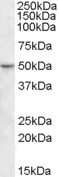
Mouse Monoclonal TEA domain family member 2/ETF antibody. Suitable for WB and reacts with Recombinant fragment - Human samples. Cited in 1 publication. Immunogen corresponding to Recombinant Fragment Protein within Human TEAD2.

別名を表示する

TEF4, TEAD2, Transcriptional enhancer factor TEF-4, TEA domain family member 2, TEAD-2

Key facts

宿主種

Mouse

クローン性

Monoclonal

クローン番号

404C5a

アイソタイプ

IgG1

キャリアフリー

No

アプリケーション

WB

applications

免疫原

Recombinant Fragment Protein within Human TEAD2. The exact immunogen used to generate this antibody is proprietary information.

Q15562

Reactivity data

{ "title": "Reactivity Data", "filters": { "stats": ["", "Species", "Dilution Info", "Notes"], "tabs": { "all-applications": {"fullname" : "All Applications", "shortname": "All Applications"}, "WB" : {"fullname" : "Western blot", "shortname":"WB"} }, "product-promise": { "all": "all", "testedAndGuaranteed": "tested", "guaranteed": "expected", "predicted": "predicted", "notRecommended": "not-recommended" } }, "values": { "Recombinant fragment - Human": { "WB-species-checked": "testedAndGuaranteed", "WB-species-dilution-info": "", "WB-species-notes": "<p></p>" } } }

出荷温度及び保存条件

製品の状態
Liquid
精製方法
Affinity purification Protein G
精製に関する特記事項
ab54374 was purified using protein G column chromatography from culture supernatant of hybridoma cultured in a medium containing bovine IgG depleted (approximately 95%) fetal bovine serum and filtered through a 0.22µm membrane.
バッファー組成
pH: 7.4 Preservative: 0.05% Sodium azide Constituents: PBS, 1% BSA
出荷温度
Blue Ice
短期保存期間
1-2 weeks
短期保存温度
+4°C
長期保存温度
-20°C
分注に関する情報
Upon delivery aliquot

補足情報

This supplementary information is collated from multiple sources and compiled automatically.

TEA domain family member 2 (also known as ETF or TEAD2) is a transcription factor belonging to the TEAD protein family with a molecular mass around 47 kDa. TEAD2 plays an important mechanical role in regulating gene expression by binding to enhancer regions within the DNA. You will find TEAD2 predominantly expressed in tissues such as the brain heart and skeletal muscle. This expression pattern indicates its involvement in critical cellular activities.
Biological function summary

TEAD2 functions as a participant in the transcriptional activation of target genes by forming complexes with other cofactors such as YAP and TAZ. This complex formation facilitates the modulation of cell proliferation differentiation and apoptosis. TEAD2 activation leads to transcriptional regulation of genes promoting these cellular processes signifying its importance in maintaining tissue homeostasis and development.

Pathways

TEAD2 participates importantly in the Hippo signaling pathway which plays a role in organ size determination and tumor suppression. The TEAD2 pathway interaction occurs via its association with YAP and TAZ proteins which transmit signals from cell surface receptors to the nucleus. Additionally involvement in Wnt signaling connects TEAD2 to a network of proteins regulating embryonic development and adult tissue homeostasis further highlighting its pathway integration.

Dysregulation of TEAD2 activity has implications in oncological processes especially concerning tumor growth and metastasis. TEAD2's association with YAP and TAZ is significant in cancer biology due to their role in constitutive pathway activation which can lead to uncontrolled cell growth. Abnormal TEAD2 signaling may also influence diseases linked to developmental malformations because of its regulatory activity in important developmental pathways.

製品プロトコール

For this product, it's our understanding that no specific protocols are required. You can visit:

ターゲットの情報

Transcription factor which plays a key role in the Hippo signaling pathway, a pathway involved in organ size control and tumor suppression by restricting proliferation and promoting apoptosis. The core of this pathway is composed of a kinase cascade wherein MST1/MST2, in complex with its regulatory protein SAV1, phosphorylates and activates LATS1/2 in complex with its regulatory protein MOB1, which in turn phosphorylates and inactivates YAP1 oncoprotein and WWTR1/TAZ. Acts by mediating gene expression of YAP1 and WWTR1/TAZ, thereby regulating cell proliferation, migration and epithelial mesenchymal transition (EMT) induction. Binds to the SPH and GT-IIC 'enhansons' (5'-GTGGAATGT-3'). May be involved in the gene regulation of neural development. Binds to the M-CAT motif.
See full target information TEAD2

文献 (1)

Recent publications for all applications. Explore the full list and refine your search

Oncotarget 7:49042-49064 PubMed27119498

2016

Vitamin D3 suppresses morphological evolution of the cribriform cancerous phenotype.

Applications

Unspecified application

Species

Unspecified reactive species

Ravi K Deevi,Jane McClements,Karen D McCloskey,Aliya Fatehullah,Dorota Tkocz,Arman Javadi,Robyn Higginson,Victoria Marsh Durban,Marnix Jansen,Alan Clarke,Maurice B Loughrey,Frederick C Campbell
View all publications

Abcam product promise

当社は、高品質な試薬を通じてお客様の研究を力強くサポートすることをお約束いたします。ご使用いただく各段階で、常にお客様をサポートできる体制を整えております。万が一、製品が期待通りに機能しない場合は、「Abcam Product Promise」による当社保証制度に基づき、安心してご利用いただけます。
保証に関する詳細については利用規約をご確認ください。

Please note: All products are 'FOR RESEARCH USE ONLY. NOT FOR USE IN DIAGNOSTIC OR THERAPEUTIC PROCEDURES'.

For licensing inquiries, please contact partnerships@abcam.com