JavaScript is disabled in your browser. Please enable JavaScript to view this website.
AB75603

Anti-Tau (phospho Ser673) 抗体

Anti-Tau (Phospho Ser673) antibody

Be the first to review this product! Submit a review

|

(17 Publications)

Rabbit Polyclonal TAU phospho S673 antibody. Suitable for WB, ICC/IF and reacts with Mouse, Human, Rat samples. Cited in 17 publications. Immunogen corresponding to Synthetic Peptide within Human MAPT phospho S673.

別名を表示する

MAPTL, MTBT1, TAU, MAPT, Microtubule-associated protein tau, Neurofibrillary tangle protein, Paired helical filament-tau, PHF-tau, ptau, p tau, phospho tau, MAPTL, MTBT1, TAU, Microtubule-associated protein tau, Neurofibrillary tangle protein, Paired helical filament-tau, PHF-tau
2 Images
Immunocytochemistry/ Immunofluorescence - Anti-Tau (Phospho Ser673) Antibody (AB75603)
  • ICC/IF

Unknown

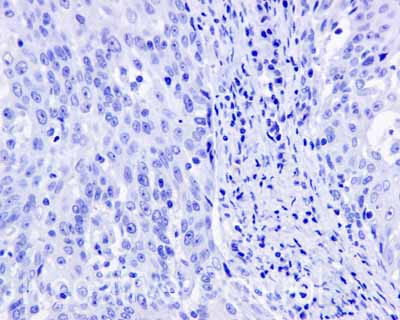
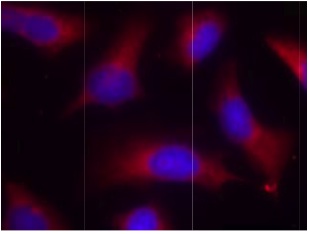
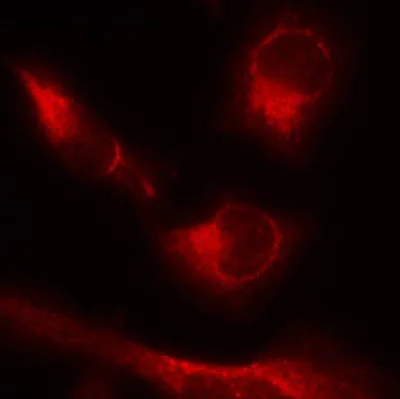
Immunocytochemistry/ Immunofluorescence - Anti-Tau (Phospho Ser673) Antibody (AB75603)

ab75603 at 1/100 dilution staining Tau (phospho S356) in human Hela cells by ICC/IF.
Western blot - Anti-Tau (Phospho Ser673) Antibody (AB75603)
  • WB

Supplier Data

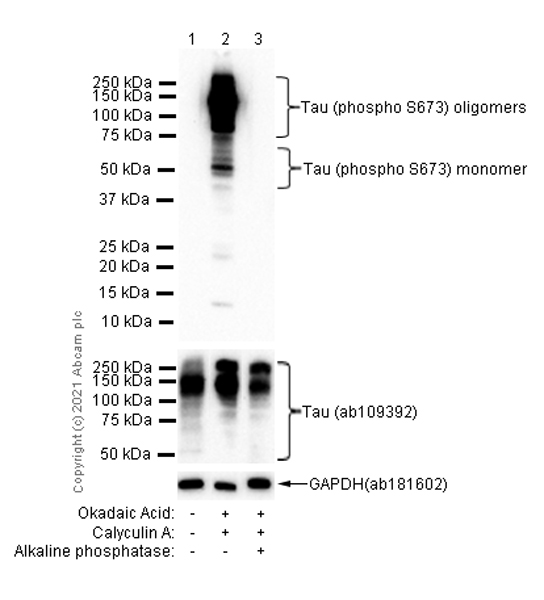
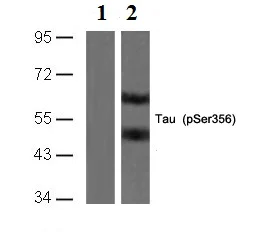
Western blot - Anti-Tau (Phospho Ser673) Antibody (AB75603)

All lanes:

Western blot - Anti-Tau (Phospho Ser673) Antibody (ab75603) at 1/500 dilution

Lane 1:

Mouse brain tissue with Blocking peptide

Lane 2:

Mouse brain tissue

Predicted band size: 78 kDa

false

Key facts

宿主種

Rabbit

クローン性

Polyclonal

アイソタイプ

IgG

キャリアフリー

No

交差種

Mouse, Human, Rat

アプリケーション

WB, ICC/IF

applications

免疫原

Synthetic Peptide within Human MAPT pS673. The exact immunogen used to generate this antibody is proprietary information.

P10636

特異性

<p>Tau S673 was historically referred as Tau S356 in some Tau isoforms such as tau-4&#46;</p>

Reactivity data

{ "title": "Reactivity Data", "filters": { "stats": ["", "Species", "Dilution Info", "Notes"], "tabs": { "all-applications": {"fullname" : "All Applications", "shortname": "All Applications"}, "WB" : {"fullname" : "Western blot", "shortname":"WB"}, "ICCIF" : {"fullname" : "Immunocytochemistry/ Immunofluorescence", "shortname":"ICC/IF"} }, "product-promise": { "all": "all", "testedAndGuaranteed": "tested", "guaranteed": "expected", "predicted": "predicted", "notRecommended": "not-recommended" } }, "values": { "Human": { "WB-species-checked": "guaranteed", "WB-species-dilution-info": "", "WB-species-notes": "", "ICCIF-species-checked": "testedAndGuaranteed", "ICCIF-species-dilution-info": "1/100 - 1/200", "ICCIF-species-notes": "<p></p>" }, "Mouse": { "WB-species-checked": "testedAndGuaranteed", "WB-species-dilution-info": "1/500 - 1/1000", "WB-species-notes": "<p></p>", "ICCIF-species-checked": "guaranteed", "ICCIF-species-dilution-info": "", "ICCIF-species-notes": "" }, "Rat": { "WB-species-checked": "guaranteed", "WB-species-dilution-info": "1/500 - 1/1000", "WB-species-notes": "<p></p>", "ICCIF-species-checked": "guaranteed", "ICCIF-species-dilution-info": "1/100 - 1/200", "ICCIF-species-notes": "<p></p>" } } }

出荷温度及び保存条件

製品の状態
Liquid
精製方法
Affinity purification Immunogen
精製に関する特記事項
ab75603 was affinity-purified from rabbit antiserum by affinity chromatography using epitope-specific phosphopeptide. The antibody against non-phosphopeptide was removed by chromatogramphy using non-phosphopeptide corresponding to the phosphorylation site.
バッファー組成
pH: 7.4 Preservative: 0.02% Sodium azide Constituents: PBS, 50% Glycerol (glycerin, glycerine), 0.87% Sodium chloride
出荷温度
Blue Ice
短期保存温度
+4°C
長期保存温度
-20°C
保管に関する情報
Stable for 12 months at -20°C

補足情報

This supplementary information is collated from multiple sources and compiled automatically.

Tau also known as microtubule-associated protein Tau (MAPT) plays an important role in stabilizing microtubules in neuronal cells. Tau is primarily found in the central nervous system but also exists in peripheral neurons. Human Tau protein comes in six isoforms due to alternative splicing with molecular weights ranging from 48 kDa to 67 kDa. This protein predominantly locates in the axons of neurons where it maintains the stability of microtubule tracks necessary for axonal transport.
Biological function summary

Tau is involved in the assembly and stabilization of microtubules essential for maintaining neuronal structure. It interacts with microtubule-binding domains (MBD) to bind and bundle microtubules facilitating intracellular transport. Tau forms a part of the neuronal cytoskeleton complex working closely with other cytoskeletal proteins to preserve the proper axonal transport and function. Abnormally phosphorylated Tau often termed phospho-Tau disrupts this complex affecting microtubule stability.

Pathways

Tau has critical involvement in several signaling cascades such as the microtubule-binding and transport pathways. Glycogen synthase kinase 3 beta (GSK3β) and cyclin-dependent kinase 5 (CDK5) frequently phosphorylate Tau controlling its interaction with microtubules. Phosphorylated Tau accumulates leading to the formation of neurofibrillary tangles often observed in neurodegenerative conditions. Additionally Tau interacts with GAPDH impacting cellular energy regulation through potential pathway cross-talk involving oxidative stress responses.

Tau is closely associated with Alzheimer's disease and frontotemporal dementia. In Alzheimer's disease hyperphosphorylated Tau aggregates into paired helical filaments forming neurofibrillary tangles while similar aggregates are observed in frontotemporal dementia. In these conditions Tau links to amyloid precursor protein (APP) where misregulated phosphorylation-driven interactions contribute to neurodegeneration. Identifying phospho-Tau and its altered interactions with related proteins aids in understanding and potentially treating these disorders.

製品プロトコール

For this product, it's our understanding that no specific protocols are required. You can visit:

ターゲットの情報

Promotes microtubule assembly and stability, and might be involved in the establishment and maintenance of neuronal polarity (PubMed : 21985311). The C-terminus binds axonal microtubules while the N-terminus binds neural plasma membrane components, suggesting that tau functions as a linker protein between both (PubMed : 21985311, PubMed : 32961270). Axonal polarity is predetermined by TAU/MAPT localization (in the neuronal cell) in the domain of the cell body defined by the centrosome. The short isoforms allow plasticity of the cytoskeleton whereas the longer isoforms may preferentially play a role in its stabilization.
See full target information MAPT pS673

文献 (17)

Recent publications for all applications. Explore the full list and refine your search

Alzheimer's research & therapy 17:24 PubMed39827356

2025

Targeting early tau pathology: probiotic diet enhances cognitive function and reduces inflammation in a preclinical Alzheimer's model.

Applications

Unspecified application

Species

Unspecified reactive species

Cassandra M Flynn,Tamunotonye Omoluabi,Alyssa M Janes,Emma J Rodgers,Sarah E Torraville,Brenda L Negandhi,Timothy E Nobel,Shyamchand Mayengbam,Qi Yuan

Aging cell 24:e14405 PubMed39520141

2024

Locus coeruleus vulnerability to tau hyperphosphorylation in a rat model.

Applications

Unspecified application

Species

Unspecified reactive species

Tamunotonye Omoluabi,Zia Hasan,Jessie E Piche,Abeni R S Flynn,Jules J E Doré,Susan G Walling,Andrew C W Weeks,Touati Benoukraf,Qi Yuan

Brain communications 6:fcae136 PubMed38712317

2024

ablation attenuates pathological phenotypes in a mouse model of tauopathy.

Applications

Unspecified application

Species

Unspecified reactive species

Grigorii Sultanakhmetov,Sophia Jobien M Limlingan,Aoi Fukuchi,Keisuke Tsuda,Hirokazu Suzuki,Iori Kato,Taro Saito,Adam Z Weitemier,Kanae Ando

Brain communications 6:fcae096 PubMed38562310

2024

Hippocampal hyperphosphorylated tau-induced deficiency is rescued by L-type calcium channel blockade.

Applications

Unspecified application

Species

Unspecified reactive species

Chelsea A Crossley,Tamunotonye Omoluabi,Sarah E Torraville,Sarah Duraid,Aida Maziar,Zia Hasan,Vishaal Rajani,Kanae Ando,Johannes W Hell,Qi Yuan

Acta neuropathologica 147:7 PubMed38175261

2024

p-tau Ser356 is associated with Alzheimer's disease pathology and is lowered in brain slice cultures using the NUAK inhibitor WZ4003.

Applications

Unspecified application

Species

Unspecified reactive species

Lewis W Taylor,Elizabeth M Simzer,Claire Pimblett,Oscar T T Lacey-Solymar,Robert I McGeachan,Soraya Meftah,Jamie L Rose,Maxwell P Spires-Jones,Kristján Holt,James H Catterson,Henner Koch,Imran Liaquat,Jonathan H Clarke,John Skidmore,Colin Smith,Sam A Booker,Paul M Brennan,Tara L Spires-Jones,Claire S Durrant

Scientific reports 13:16770 PubMed37798424

2023

Long term administration of loquat leaves and their major component, ursolic acid, attenuated endogenous amyloid-β burden and memory impairment.

Applications

Unspecified application

Species

Unspecified reactive species

Kensuke Iwasa,Sosuke Yagishita,Nan Yagishita-Kyo,Anzu Yamagishi,Shinji Yamamoto,Kota Yamashina,Chikara Haruta,Masashi Asai,Kei Maruyama,Kuniyoshi Shimizu,Keisuke Yoshikawa

Advanced science (Weinheim, Baden-Wurttemberg, Germany) 10:e2302035 PubMed37594721

2023

Self-Aggregating Tau Fragments Recapitulate Pathologic Phenotypes and Neurotoxicity of Alzheimer's Disease in Mice.

Applications

Unspecified application

Species

Unspecified reactive species

Ly Thi Huong Luu Le,Jeeyoung Lee,Dongjoon Im,Sunha Park,Kyoung-Doo Hwang,Jung Hoon Lee,Yanxialei Jiang,Yong-Seok Lee,Young Ho Suh,Hugh I Kim,Min Jae Lee

Cell reports 40:111249 PubMed36001963

2022

Disruption of nuclear envelope integrity as a possible initiating event in tauopathies.

Applications

Unspecified application

Species

Unspecified reactive species

Marine Prissette,Wen Fury,Matthew Koss,Claudia Racioppi,Daria Fedorova,Ella Dragileva,Georgia Clarke,Taylor Pohl,John Dugan,Diana Ahrens,Joyce Chiu,Charleen Hunt,Chia-Jen Siao,Tara Young,Arijit Bhowmick,Vitaliy Rogulin,Mathieu Desclaux,Eric Y Hayden,Michael Podgorski,Min Gao,Lynn E Macdonald,David Frendewey,George D Yancopoulos,Brian Zambrowicz

ACS chemical neuroscience 13:1296-1314 PubMed35357812

2022

O-GlcNAcase Inhibitor ASN90 is a Multimodal Drug Candidate for Tau and α-Synuclein Proteinopathies.

Applications

Unspecified application

Species

Unspecified reactive species

Bruno Permanne,Astrid Sand,Solenne Ousson,Maud Nény,Jennifer Hantson,Ryan Schubert,Christoph Wiessner,Anna Quattropani,Dirk Beher

Frontiers in cell and developmental biology 8:565020 PubMed33015060

2020

Upregulation of Prickle2 Ameliorates Alzheimer's Disease-Like Pathology in a Transgenic Mouse Model of Alzheimer's Disease.

Applications

Unspecified application

Species

Unspecified reactive species

Fengxian Sun,Fang Jiang,Na Zhang,Hua Li,Weiping Tian,Weiying Liu
View all publications

Abcam product promise

当社は、高品質な試薬を通じてお客様の研究を力強くサポートすることをお約束いたします。ご使用いただく各段階で、常にお客様をサポートできる体制を整えております。万が一、製品が期待通りに機能しない場合は、「Abcam Product Promise」による当社保証制度に基づき、安心してご利用いただけます。
保証に関する詳細については利用規約をご確認ください。

Please note: All products are 'FOR RESEARCH USE ONLY. NOT FOR USE IN DIAGNOSTIC OR THERAPEUTIC PROCEDURES'.

For licensing inquiries, please contact partnerships@abcam.com