Anti-Tau (phospho S324) 抗体 [EPR2457(2)]
Anti-Tau (phospho S324) antibody [EPR2457(2)]
- 20ul selling size
- RabMAb
- Recombinant
- 詳細を見る
Be the first to review this product! Submit a review
|
(7 Publications)
Rabbit Recombinant Monoclonal TAU phospho S324 antibody. Suitable for WB, ICC/IF, I-ELISA and reacts with Human, Mouse, Rat samples. Cited in 7 publications.
別名を表示する
MAPTL, MTBT1, TAU, MAPT, Microtubule-associated protein tau, Neurofibrillary tangle protein, Paired helical filament-tau, PHF-tau, ptau, p tau, phospho tau, MAPTL, MTBT1, TAU, MAPT, Microtubule-associated protein tau, Neurofibrillary tangle protein, Paired helical filament-tau, PHF-tau

- ICC/IF
Unknown
Immunocytochemistry/ Immunofluorescence - Anti-Tau (phospho S324) antibody [EPR2457(2)] (AB109401)
Immunofluorescent staining of Tau in SH-SY5Y cells using ab109401 at 1/100.

- I-ELISA
Lab
Indirect ELISA - Anti-Tau (phospho S324) antibody [EPR2457(2)] (AB109401)
Indirect ELISA analysis of ab109401 at 1000-0 ng/ml. The Secondary antibody used was Alkaline Phosphatase-conjugated AffiniPure Goat Anti-Rabbit IgG (H+L) at 1 : 2500 dilution dilution.
Antigen : Human Tau (phospho S324) peptide, Human Tau non-phospho peptide.
Antigen concentration : 100 ng/ml

- WB
Lab
Western blot - Anti-Tau (phospho S324) antibody [EPR2457(2)] (AB109401)
Blocking and diluting buffer and concentration : 5% NFDM/TBST.
In Western blot, Anti-GAPDH antibody [EPR16891] - Loading Control (ab181602) staining at 1/200000 dilution.
In Western blot, Anti-Tau antibody [EP2456Y] (ab76128) Total Protein Control at 1/1000 dilution.
All lanes:
Western blot - Anti-Tau (phospho S324) antibody [EPR2457(2)] (ab109401) at 1/1000 dilution
Lane 1:
Untreated mouse brain tissue lysate (untreated membrane) at 20 µg
Lane 2:
Mouse brain treated with 1μM Okadaic Acid and 200nM Calyculin A for 1 hour, tissue lysate (untreated membrane) at 20 µg
Lane 3:
Untreated mouse brain tissue lysate (alkaline phosphatase treated membrane) at 20 µg
Lane 4:
Mouse brain treated with 1μM Okadaic Acid and 200nM Calyculin A for 1 hour, tissue lysate (alkaline phosphatase treated membrane) at 20 µg
Secondary
All lanes:
Western blot - Goat Anti-Rabbit IgG H&L (HRP) (<a href='/products/secondary-antibodies/goat-rabbit-igg-h-l-hrp-ab97051'>ab97051</a>) at 1/20000 dilution
Observed band size: 48-60 kDa
false
Exposure time: 136s

- WB
Lab
Western blot - Anti-Tau (phospho S324) antibody [EPR2457(2)] (AB109401)
Blocking and diluting buffer and concentration : 5% NFDM/TBST.
In Western blot, Anti-GAPDH antibody [EPR16891] - Loading Control (ab181602) staining at 1/200000 dilution.
In Western blot, Anti-Tau antibody [EP2456Y] (ab76128) Total Protein Control at 1/1000 dilution.
All lanes:
Western blot - Anti-Tau (phospho S324) antibody [EPR2457(2)] (ab109401) at 1/1000 dilution
Lane 1:
Untreated rat brain tissue lysate (untreated membrane) at 20 µg
Lane 2:
Rat brain treated with 1μM Okadaic Acid and 200nM Calyculin A for 1 hour, tissue lysate (untreated membrane) at 20 µg
Lane 3:
Untreated rat brain tissue lysate (alkaline phosphatase treated membrane) at 20 µg
Lane 4:
Rat brain treated with 1μM Okadaic Acid and 200nM Calyculin A for 1 hour, tissue lysate (alkaline phosphatase treated membrane) at 20 µg
Secondary
All lanes:
Western blot - Goat Anti-Rabbit IgG H&L (HRP) (<a href='/products/secondary-antibodies/goat-rabbit-igg-h-l-hrp-ab97051'>ab97051</a>) at 1/20000 dilution
Observed band size: 48-60 kDa
false
Exposure time: 70s

- WB
Unknown
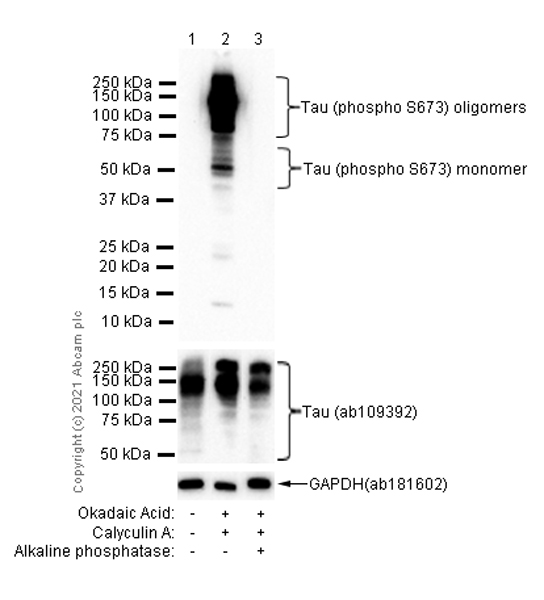
Western blot - Anti-Tau (phospho S324) antibody [EPR2457(2)] (AB109401)
All lanes:
Western blot - Anti-Tau (phospho S324) antibody [EPR2457(2)] (ab109401) at 1/10000 dilution
Lane 1:
SH-SY5Y cell lysate untreated at 10 µg
Lane 2:
SH-SY5Y cell lysate treated with Okadaic acid and Calyculin A at 10 µg
Predicted band size: 78 kDa
false
関連する標識済み抗体及び組成の異なる製品 (1)
-
Anti-Tau (phospho S324) antibody [EPR2457(2)] - BSA and Azide free
代替製品
Primary Antibodies
AB92682
Anti-Tau (phospho Ser356) antibody [EPR2603]
20ul selling size|RabMAb|Recombinant
- 0
- 0
Primary Antibodies
AB109390
Anti-Tau (phospho S396) antibody [EPR2731]
BOND RX™ Validated|20ul selling size|RabMAb|Recombinant

- 4
- 14
Primary Antibodies
AB151559
Anti-Tau (phospho T231) antibody [EPR2488]
BOND RX™ Validated|20ul selling size|RabMAb|Recombinant

- 5
- 6
Primary Antibodies
AB32057
Anti-Tau (phospho S396) antibody [E178]
BOND RX™ Validated|20ul selling size|RabMAb|Recombinant

- 5
- 5
Primary Antibodies
AB170892
Anti-Tau (phospho S214) antibody [EPR1884(2)]
BOND RX™ Validated|20ul selling size|RabMAb|Recombinant|Trial Size|Trial Size

- 5
- 1
Primary Antibodies
AB92676
Anti-Tau (phospho S404) antibody [EPR2605]
BOND RX™ Validated|20ul selling size|RabMAb|Recombinant

- 5
- 4
Primary Antibodies
AB93726
BOND RX™ Validated|20ul selling size|RabMAb|Recombinant

- 5
- 4
組合せ製品

Primary Antibodies
AB76128
BOND RX™ Validated|20ul selling size|RabMAb|Recombinant

- 5
- 1
Primary Antibodies
AB170892
Anti-Tau (phospho S214) antibody [EPR1884(2)]
BOND RX™ Validated|20ul selling size|RabMAb|Recombinant|Trial Size
- 5
- 1

Reactivity data
製品の詳細
Patented technology
Our RabMAb® technology is a patented hybridoma-based technology for making rabbit monoclonal antibodies. For details on our patents, please refer to RabMAb® patents.
What are the advantages of a recombinant monoclonal antibody?
This product is a recombinant monoclonal antibody, which offers several advantages including:
- - High batch-to-batch consistency and reproducibility
- - Improved sensitivity and specificity
- - Long-term security of supply
- - Animal-free batch production
For more information, read more on recombinant antibodies.
出荷温度及び保存条件
製品の状態
精製度
バッファー組成
出荷温度
短期保存温度
長期保存温度
保管に関する情報
補足情報
This supplementary information is collated from multiple sources and compiled automatically.
Biological function summary
Tau is involved in the assembly and stabilization of microtubules essential for maintaining neuronal structure. It interacts with microtubule-binding domains (MBD) to bind and bundle microtubules facilitating intracellular transport. Tau forms a part of the neuronal cytoskeleton complex working closely with other cytoskeletal proteins to preserve the proper axonal transport and function. Abnormally phosphorylated Tau often termed phospho-Tau disrupts this complex affecting microtubule stability.
Pathways
Tau has critical involvement in several signaling cascades such as the microtubule-binding and transport pathways. Glycogen synthase kinase 3 beta (GSK3β) and cyclin-dependent kinase 5 (CDK5) frequently phosphorylate Tau controlling its interaction with microtubules. Phosphorylated Tau accumulates leading to the formation of neurofibrillary tangles often observed in neurodegenerative conditions. Additionally Tau interacts with GAPDH impacting cellular energy regulation through potential pathway cross-talk involving oxidative stress responses.
製品プロトコール
- Visit the General protocols
- Visit the Troubleshooting
ターゲットの情報
文献 (7)
Recent publications for all applications. Explore the full list and refine your search
Communications biology 8:1139 PubMed40745206
2025
Applications
Unspecified application
Species
Unspecified reactive species
Advanced science (Weinheim, Baden-Wurttemberg, Germany) 11:e2310134 PubMed38634567
2024
Applications
Unspecified application
Species
Unspecified reactive species
Journal of neuroscience research 101:1900-1913 PubMed37787045
2023
Applications
Unspecified application
Species
Unspecified reactive species
Molecular metabolism 73:101731 PubMed37121509
2023
Applications
Unspecified application
Species
Unspecified reactive species
The EMBO journal 41:e108882 PubMed35298090
2022
Applications
Unspecified application
Species
Unspecified reactive species
The Journal of biological chemistry 296:100760 PubMed33965374
2021
Applications
Unspecified application
Species
Unspecified reactive species
PloS one 14:e0225727 PubMed31794565
2019
Applications
Unspecified application
Species
Unspecified reactive species
Abcam product promise
Please note: All products are 'FOR RESEARCH USE ONLY. NOT FOR USE IN DIAGNOSTIC OR THERAPEUTIC PROCEDURES'.
For licensing inquiries, please contact partnerships@abcam.com