JavaScript is disabled in your browser. Please enable JavaScript to view this website.
AB3344

Anti-SynGAP 抗体

Anti-SynGAP antibody

0

(1 Review)

|

(7 Publications)

Rabbit Polyclonal SynGAP antibody. Suitable for IHC-P, ICC/IF and reacts with Human, Rat samples. Cited in 7 publications. Immunogen corresponding to Recombinant Fragment Protein within Rat Syngap1 aa 900 to C-terminus.

別名を表示する

KIAA1938, SYNGAP1, Ras/Rap GTPase-activating protein SynGAP, Neuronal RasGAP, Synaptic Ras GTPase-activating protein 1, Synaptic Ras-GAP 1

4 Images
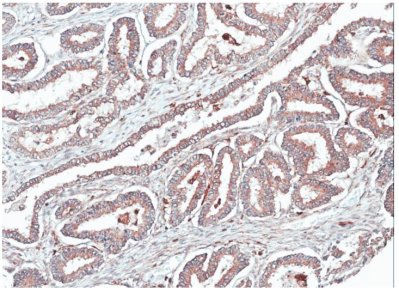
Immunohistochemistry (Formalin/PFA-fixed paraffin-embedded sections) - Anti-SynGAP antibody (AB3344)
  • IHC-P

Supplier Data

Immunohistochemistry (Formalin/PFA-fixed paraffin-embedded sections) - Anti-SynGAP antibody (AB3344)

Immunohistochemical anysis of paraffin-embedded human hear tissue staining synGAP with ab3344 at 1/100 dilution counterstained with hematoxylin and detected using HRP-conjugated secondary antibody. Negative control (left) has no primary antibody.

Immunocytochemistry/ Immunofluorescence - Anti-SynGAP antibody (AB3344)
  • ICC/IF

Supplier Data

Immunocytochemistry/ Immunofluorescence - Anti-SynGAP antibody (AB3344)

Immunolocalization of SynGAP in rat hippocampal neurons using ab3344.

Immunocytochemistry/ Immunofluorescence - Anti-SynGAP antibody (AB3344)
  • ICC/IF

Supplier Data

Immunocytochemistry/ Immunofluorescence - Anti-SynGAP antibody (AB3344)

Immunocytochemistry analysis of 4% paraformaldehyde-fixed 0.1% Triton™ X-100 permeabilized PC-12 cells staining synGAP with ab3344 at 2 μg/ml concentration and Goat anti-Rabbit IgG (H+L) Superclonal™ Secondary Antibody Alexa Fluor® 488 conjugate at 1 : 2000. Nuclei were stained with SlowFade® Gold Antifade Mountant with DAPI (blue), and F-actin stained with Alexa Fluor® 555 Rhodamine Phalloidin (red). Negative control is using no primary antibody control.

Immunocytochemistry/ Immunofluorescence - Anti-SynGAP antibody (AB3344)
  • ICC/IF

Supplier Data

Immunocytochemistry/ Immunofluorescence - Anti-SynGAP antibody (AB3344)

Immunolocalization of SynGAP in rat hippocampal neurons using ab3344.

Key facts

宿主種

Rabbit

クローン性

Polyclonal

アイソタイプ

IgG

キャリアフリー

No

交差種

Rat, Human

アプリケーション

IHC-P, ICC/IF

applications

免疫原

Recombinant Fragment Protein within Rat Syngap1 aa 900 to C-terminus. The exact immunogen used to generate this antibody is proprietary information.

Q9QUH6

Reactivity data

{ "title": "Reactivity Data", "filters": { "stats": ["", "Species", "Dilution Info", "Notes"], "tabs": { "all-applications": {"fullname" : "All Applications", "shortname": "All Applications"}, "IHCP" : {"fullname" : "Immunohistochemistry (Formalin/PFA-fixed paraffin-embedded sections)", "shortname":"IHC-P"}, "ICCIF" : {"fullname" : "Immunocytochemistry/ Immunofluorescence", "shortname":"ICC/IF"} }, "product-promise": { "all": "all", "testedAndGuaranteed": "tested", "guaranteed": "expected", "predicted": "predicted", "notRecommended": "not-recommended" } }, "values": { "Human": { "IHCP-species-checked": "testedAndGuaranteed", "IHCP-species-dilution-info": "2 µg/mL", "IHCP-species-notes": "<p></p>", "ICCIF-species-checked": "guaranteed", "ICCIF-species-dilution-info": "", "ICCIF-species-notes": "" }, "Rat": { "IHCP-species-checked": "guaranteed", "IHCP-species-dilution-info": "", "IHCP-species-notes": "", "ICCIF-species-checked": "testedAndGuaranteed", "ICCIF-species-dilution-info": "2 µg/mL", "ICCIF-species-notes": "<p></p>" } } }

出荷温度及び保存条件

製品の状態
Liquid
精製方法
Affinity purification Immunogen
バッファー組成
Constituents: PBS, 0.1% BSA
出荷温度
Blue Ice
短期保存期間
1-2 weeks
短期保存温度
+4°C
長期保存温度
-20°C
分注に関する情報
Upon delivery aliquot
保管に関する情報
Avoid freeze / thaw cycle

補足情報

This supplementary information is collated from multiple sources and compiled automatically.

SynGAP also known as Synaptic Ras GTPase-activating protein 1 has a molecular weight of about 138 kDa. It predominantly expresses in the brain especially in the post-synaptic density of neurons. SynGAP acts mechanically by regulating Ras and Rap GTPase signaling through its GTPase-activating protein (GAP) domain. This protein modulates synaptic strength and plasticity by influencing the activity of these GTPases which are pivotal for intracellular signaling.
Biological function summary

SynGAP influences synaptic function and plasticity. It forms part of the NMDA receptor complex linking it to various synaptic signaling pathways. SynGAP modulates excitatory synaptic transmission by controlling the levels of Ras and Rap GTPases which impact the phosphorylation of AMPA receptors. Through these activities it maintains proper synaptic strength and structural integrity essential for learning and memory processes.

Pathways

SynGAP interfaces with signaling networks critical for neuronal function such as the MAPK/ERK and PI3K/Akt pathways. In these pathways SynGAP regulates Ras-related protein kinase activity influencing downstream effects on gene expression and cellular survival. The protein's interaction with other partners like the PSD-95 and other MAGUK family proteins highlights its central role in controlling synaptic signaling cascades.

Researchers link SynGAP to neurodevelopmental disorders like intellectual disability and autism spectrum disorders. Mutations or disruptions in SynGAP levels correlate with altered synaptic function and contribute to these conditions. SynGAP also interacts with proteins such as SHANK3 which connects to synaptic abnormalities observed in these disorders. Understanding its role in such conditions can provide insights into potential therapeutic targets.

製品プロトコール

For this product, it's our understanding that no specific protocols are required. You can visit:

ターゲットの情報

Major constituent of the PSD essential for postsynaptic signaling. Inhibitory regulator of the Ras-cAMP pathway. Member of the NMDAR signaling complex in excitatory synapses, it may play a role in NMDAR-dependent control of AMPAR potentiation, AMPAR membrane trafficking and synaptic plasticity. Regulates AMPAR-mediated miniature excitatory postsynaptic currents. Exhibits dual GTPase-activating specificity for Ras and Rap. May be involved in certain forms of brain injury, leading to long-term learning and memory deficits (By similarity).
See full target information SYNGAP1

文献 (7)

Recent publications for all applications. Explore the full list and refine your search

Frontiers in molecular neuroscience 17:1401746 PubMed39050824

2024

Context-dependent hyperactivity in and zebrafish models of SYNGAP1-related disorder.

Applications

Unspecified application

Species

Unspecified reactive species

Sureni H Sumathipala,Suha Khan,Robert A Kozol,Yoichi Araki,Sheyum Syed,Richard L Huganir,Julia E Dallman

Science (New York, N.Y.) 383:eadk1291 PubMed38422154

2024

SynGAP regulates synaptic plasticity and cognition independently of its catalytic activity.

Applications

Unspecified application

Species

Unspecified reactive species

Yoichi Araki,Kacey E Rajkovich,Elizabeth E Gerber,Timothy R Gamache,Richard C Johnson,Thanh Hai N Tran,Bian Liu,Qianwen Zhu,Ingie Hong,Alfredo Kirkwood,Richard Huganir

International journal of molecular sciences 22: PubMed33802775

2021

Early and Delayed Impact of Nanosilver on the Glutamatergic NMDA Receptor Complex in Immature Rat Brain.

Applications

Unspecified application

Species

Unspecified reactive species

Beata Dąbrowska-Bouta,Grzegorz Sulkowski,Mikołaj Sałek,Małgorzata Frontczak-Baniewicz,Lidia Strużyńska

Scientific reports 10:15983 PubMed32994440

2020

Quantitative analysis of global protein stability rates in tissues.

Applications

Unspecified application

Species

Unspecified reactive species

Daniel B McClatchy,Salvador Martínez-Bartolomé,Yu Gao,Mathieu Lavallée-Adam,John R Yates

Science signaling 12: PubMed31387938

2019

Disruption of SynGAP-dopamine D1 receptor complexes alters actin and microtubule dynamics and impairs GABAergic interneuron migration.

Applications

Unspecified application

Species

Unspecified reactive species

Ping Su,Terence K Y Lai,Frankie H F Lee,Andrew R Abela,Paul J Fletcher,Fang Liu

PloS one 7:e46683 PubMed23071613

2012

Comparative study of human and mouse postsynaptic proteomes finds high compositional conservation and abundance differences for key synaptic proteins.

Applications

Unspecified application

Species

Unspecified reactive species

Alex Bayés,Mark O Collins,Mike D R Croning,Louie N van de Lagemaat,Jyoti S Choudhary,Seth G N Grant

Neuroscience 192:132-9 PubMed21736925

2011

SynGAP moves out of the core of the postsynaptic density upon depolarization.

Applications

EM, WB

Species

Rat, Rat

Y Yang,J-H Tao-Cheng,T S Reese,A Dosemeci
View all publications

Abcam product promise

当社は、高品質な試薬を通じてお客様の研究を力強くサポートすることをお約束いたします。ご使用いただく各段階で、常にお客様をサポートできる体制を整えております。万が一、製品が期待通りに機能しない場合は、「Abcam Product Promise」による当社保証制度に基づき、安心してご利用いただけます。
保証に関する詳細については利用規約をご確認ください。

Please note: All products are 'FOR RESEARCH USE ONLY. NOT FOR USE IN DIAGNOSTIC OR THERAPEUTIC PROCEDURES'.

For licensing inquiries, please contact partnerships@abcam.com