Anti-Sumo 2 + Sumo 3 + Sumo 4 抗体 [EPR300(2)]
Anti-Sumo 2 + Sumo 3 + Sumo 4 antibody [EPR300(2)]
- RabMAb
- Recombinant
- 詳細を見る
4
(3 Reviews)
|
(2 Publications)
Rabbit Recombinant Monoclonal Sumo 4 antibody. Suitable for IHC-P, WB and reacts with Human samples. Cited in 2 publications.
別名を表示する
SMT3H4, SUMO4, Small ubiquitin-related modifier 4, SUMO-4, Small ubiquitin-like protein 4, SMT3A, SMT3H1, SUMO3, Small ubiquitin-related modifier 3, SUMO-3, SMT3 homolog 1, SUMO-2, Ubiquitin-like protein SMT3A, Smt3A, SMT3B, SMT3H2, SUMO2, Small ubiquitin-related modifier 2, SUMO-2, HSMT3, SMT3 homolog 2, SUMO-3, Sentrin-2, Ubiquitin-like protein SMT3B, Smt3B
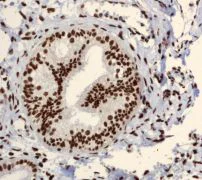
- IHC-P
Unknown
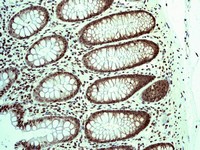
Immunohistochemistry (Formalin/PFA-fixed paraffin-embedded sections) - Anti-Sumo 2 + Sumo 3 + Sumo 4 antibody [EPR300(2)] (AB109196)
ab109196, at 1/100, staining Sumo 2 + Sumo 3 + Sumo 4 in paraffin-embedded Human ovarian tissue by Immunohistochemistry.
Perform heat mediated antigen retrieval with citrate buffer pH 6 before commencing with IHC staining protocol.
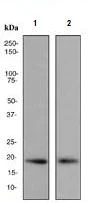
- WB
Unknown
Western blot - Anti-Sumo 2 + Sumo 3 + Sumo 4 antibody [EPR300(2)] (AB109196)
All lanes:
Western blot - Anti-Sumo 2 + Sumo 3 + Sumo 4 antibody [EPR300(2)] (ab109196) at 1/1000 dilution
Lane 1:
HeLa cell lysate at 10 µg
Lane 2:
Jurkat cell lysate at 10 µg
Predicted band size: 12 kDa
false
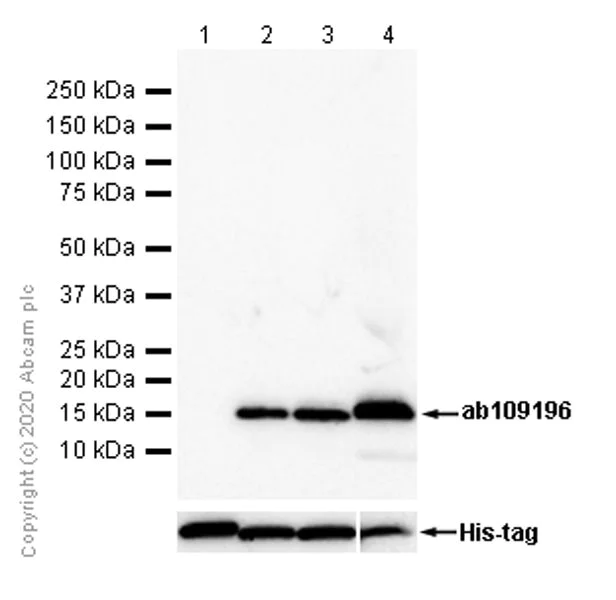
- WB
Lab
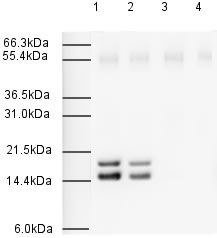
Western blot - Anti-Sumo 2 + Sumo 3 + Sumo 4 antibody [EPR300(2)] (AB109196)
Blocking buffer : 5% NFDM/TBST
All lanes:
Western blot - Anti-Sumo 2 + Sumo 3 + Sumo 4 antibody [EPR300(2)] (ab109196) at 1/200 dilution
Lane 1:
Western blot - Recombinant Human Sumo 1 protein (His tag N-Terminus) (<a href='/products/proteins-peptides/recombinant-human-sumo-1-protein-ab140417'>ab140417</a>) at 0.01 µg
Lane 2:
Western blot - Recombinant Human Sumo 2 protein (<a href='/products/proteins-peptides/recombinant-human-sumo-2-protein-ab140420'>ab140420</a>) at 0.01 µg
Lane 3:
Recombinant Human Sumo 3 protein (<a href='/products/unavailable/recombinant-human-sumo-3-protein-ab140414'>ab140414</a>) at 0.01 µg
Lane 4:
Western blot - Recombinant Human Sumo 4 protein (<a href='/products/proteins-peptides/recombinant-human-sumo-4-protein-ab157025'>ab157025</a>) at 0.1 µg
Secondary
All lanes:
Western blot - Goat Anti-Rabbit IgG H&L (HRP) (<a href='/products/secondary-antibodies/goat-rabbit-igg-h-l-hrp-ab97051'>ab97051</a>) at 1/20000 dilution
Predicted band size: 12 kDa
Observed band size: 16 kDa
true
Exposure time: 20s
関連する標識済み抗体及び組成の異なる製品 (1)
-
Anti-Sumo 2 + Sumo 3 + Sumo 4 antibody [EPR300(2)] - BSA and Azide free
代替製品
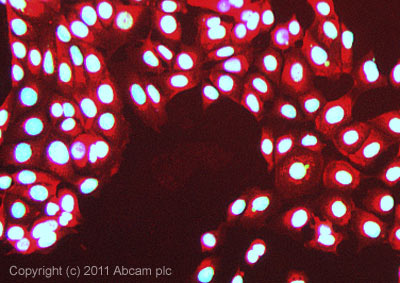

Primary Antibodies
AB196330
Alexa Fluor® 488 Anti-Sumo 2 + Sumo 3 antibody [EPR4602]
RabMAb|Recombinant
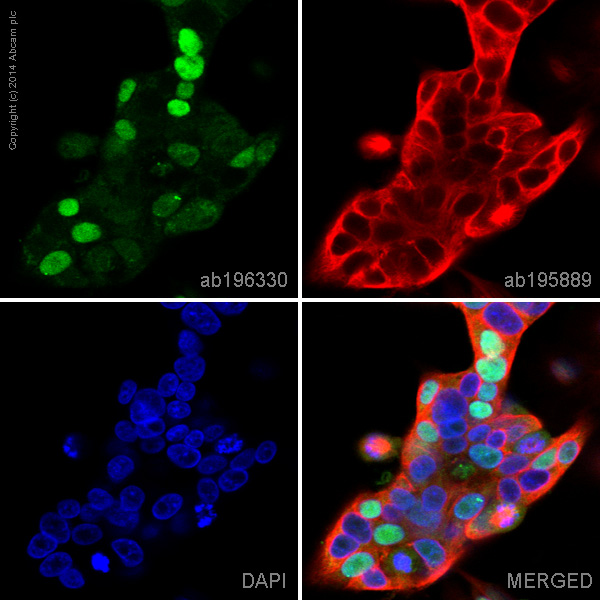
- 0
- 0
Primary Antibodies
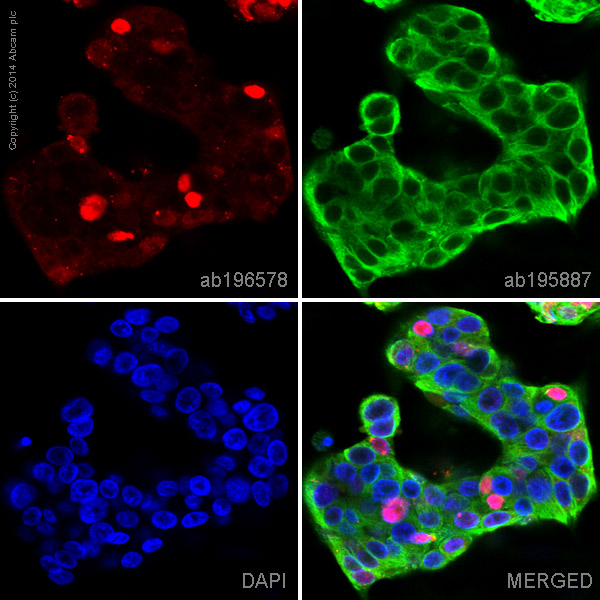
AB196578
Alexa Fluor® 647 Anti-Sumo 2 + Sumo 3 antibody [EPR4602]
RabMAb|Recombinant
- 0
- 0
組合せ製品
Primary Antibodies
AB16669
Anti-CD3 epsilon antibody [SP7]
BOND RX™ Validated|RabMAb|Advanced Validation|Recombinant|Lab Essentials|20ul selling size

- 4
- 80
Primary Antibodies
AB183685
RabMAb|Recombinant|Lab Essentials|20ul selling size

- 5
- 21
Primary Antibodies
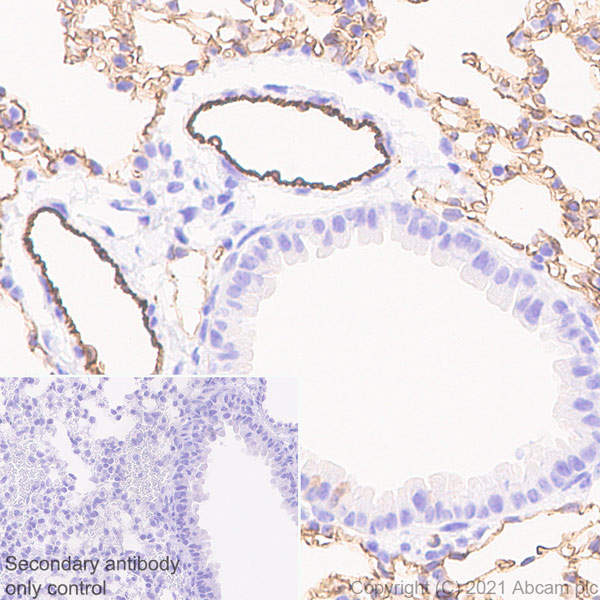
AB281583
BOND RX™ Validated|RabMAb|Recombinant|Lab Essentials|20ul selling size
- 5
- 5
Primary Antibodies
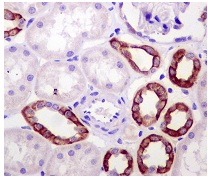
AB124773
Anti-Mitofusin 2 antibody [NIAR164]
20ul selling size|KO Validated|RabMAb|Recombinant
- 4
- 6
Reactivity data
製品の詳細
Species reactivity
Mouse, Rat: We have preliminary internal testing data to indicate this antibody may not react with these species.
Please contact us for more information.
Patented technology
Our RabMAb® technology is a patented hybridoma-based technology for making rabbit monoclonal antibodies. For details on our patents, please refer to RabMAb® patents.
What are the advantages of a recombinant monoclonal antibody?
This product is a recombinant monoclonal antibody, which offers several advantages including:
- - High batch-to-batch consistency and reproducibility
- - Improved sensitivity and specificity
- - Long-term security of supply
- - Animal-free batch production
For more information, read more on recombinant antibodies.
出荷温度及び保存条件
製品の状態
精製方法
バッファー組成
出荷温度
短期保存温度
長期保存温度
保管に関する情報
補足情報
This supplementary information is collated from multiple sources and compiled automatically.
Biological function summary
SUMO protein family modifies target proteins and influences important cellular processes like transcriptional regulation DNA repair and cell cycle progression. SUMO2 and SUMO3 unlike SUMO1 often form poly-SUMO chains which interact with other ubiquitin-like modifiers and create multi-protein complexes. SUMO4 lacks the processing enzymes necessary for maturation suggesting a different role or regulation. These processes facilitate the dynamic response of the cell to various physiological and stress signals which is critical to maintaining normal cellular functions.
Pathways
SUMO conjugation regulates numerous signaling pathways including the p53 and NF-kB pathways. In the p53 pathway SUMO modification helps control the stability and activity of the p53 protein a major tumor suppressor that monitors DNA damage and apoptosis. In the NF-kB pathway SUMOylation impacts the transcriptional activity of NF-kB subunits by modifying proteins like IκBα and influencing the inflammatory response. The interaction with existing molecular players in these pathways enables precise control of gene expression and cellular responses to internal and external stimuli.
製品プロトコール
- Visit the General protocols
- Visit the Troubleshooting
ターゲットの情報
追加のターゲット
文献 (2)
Recent publications for all applications. Explore the full list and refine your search
Molecular cancer therapeutics 23:1597-1612 PubMed39150446
2024
Applications
Unspecified application
Species
Unspecified reactive species
Nature 626:881-890 PubMed38297124
2024
Applications
Unspecified application
Species
Unspecified reactive species
Abcam product promise
Please note: All products are 'FOR RESEARCH USE ONLY. NOT FOR USE IN DIAGNOSTIC OR THERAPEUTIC PROCEDURES'.
For licensing inquiries, please contact partnerships@abcam.com