Anti-STIP1/STI1 抗体 [EPR6606]
Anti-STIP1/STI1 antibody [EPR6606]
- RabMAb
- Recombinant
- KO Validated
- 詳細を見る
Be the first to review this product! Submit a review
|
(5 Publications)
Rabbit Recombinant Monoclonal STIP1/STI1 antibody. Suitable for IHC-P, IP, WB and reacts with Human samples. Cited in 5 publications.
別名を表示する
Stress-induced-phosphoprotein 1, STI1, Hsc70/Hsp90-organizing protein, Renal carcinoma antigen NY-REN-11, Transformation-sensitive protein IEF SSP 3521, Hop, STIP1
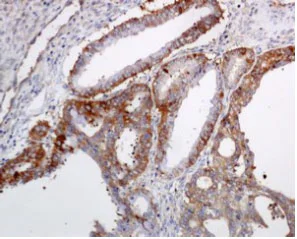
- IHC-P
Unknown
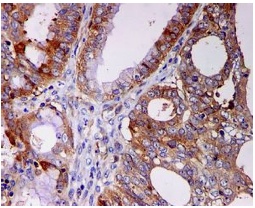
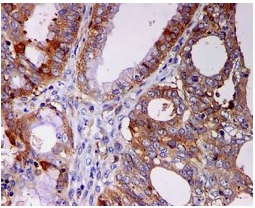
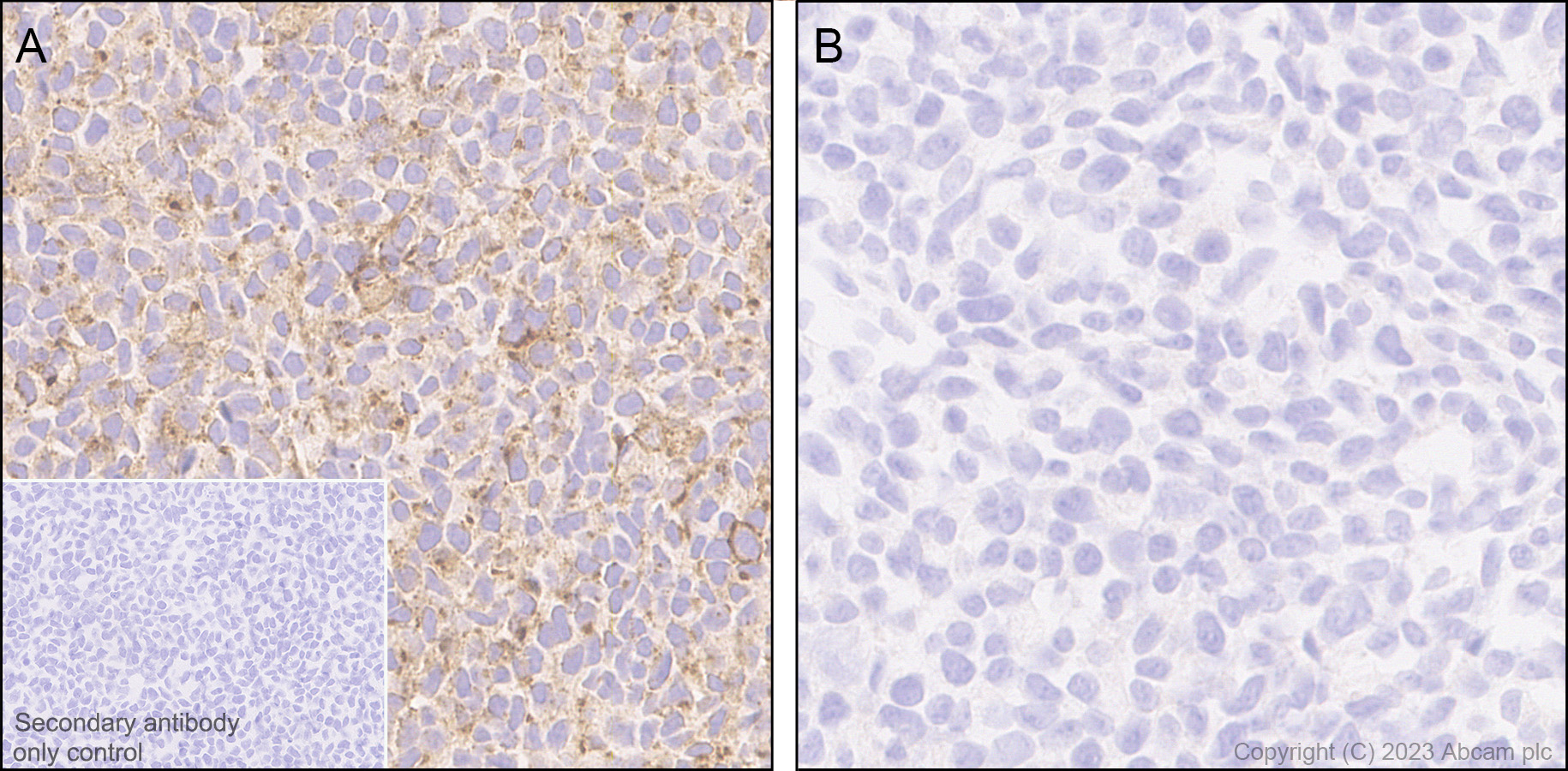
Immunohistochemistry (Formalin/PFA-fixed paraffin-embedded sections) - Anti-STIP1/STI1 antibody [EPR6606] (AB126753)
ab126753, at 1/50 dilution, staining STIP1/STI1 in paraffin-embedded Human ovarian carcinoma tissue by Immunohistochemistry.
Perform heat mediated antigen retrieval before commencing with IHC staining protocol.
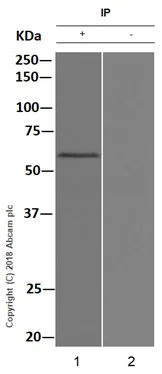
- IP
Lab
Immunoprecipitation - Anti-STIP1/STI1 antibody [EPR6606] (AB126753)
ab126753 immunoprecipitating STIP1/STI1 in Jurkat (Human T cell leukemia T lymphocyte) whole cell lysate at a dilution of 1/30.
Blocking and diution buffer : 5% NFDM/TBST.
All lanes:
Immunoprecipitation - Anti-STIP1/STI1 antibody [EPR6606] (ab126753) at 1/1000 dilution
Lane 1:
IP using ab126753 in Jurkat (Human T cell leukemia T lymphocyte) whole cell lysate
Lane 2:
Jurkat (Human T cell leukemia T lymphocyte) whole cell lysate
Secondary
All lanes:
Anti-Rabbit IgG (HRP), specific to the non-reduced form of IgG at 1/1500 dilution
Predicted band size: 63 kDa
Observed band size: 63 kDa
false
Exposure time: 2min
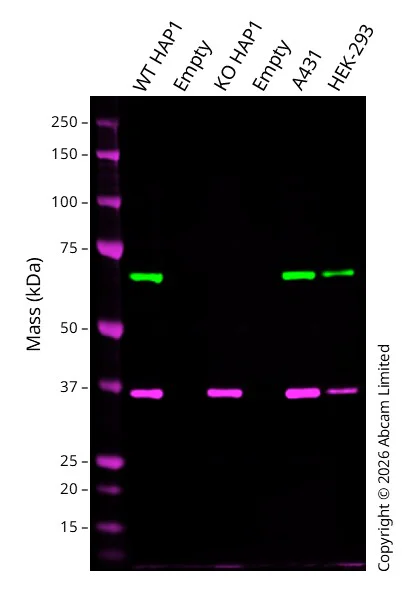
- WB
Lab
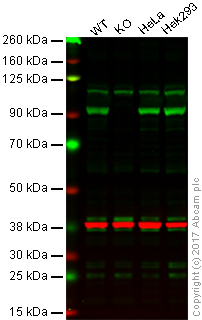
Western blot - Anti-STIP1/STI1 antibody [EPR6606] (AB126753)
Western blot : Anti-STIP1/STI1 antibody [EPR6606] ab126753 staining at 1/1000 dilution, shown in green; Mouse anti GAPDH ab8245 loading control staining at 1/20000 dilution, shown in magenta. A band was observed at 63 kDa in Wild-type HAP1 cell line with no signal observed at this size in STIP1 knockout HAP1 cell line. To generate this image, samples were run on an SDS-PAGE gel then transferred onto a nitrocellulose membrane. Membranes were blocked in 5% Milk in TBS-0.1 % Tween® 20 (TBS-T) before incubation with primary antibodies overnight at 4 °C. Blots were washed four times in TBS-T, incubated with secondary antibodies for 1 h at room temperature, washed again four times then imaged. Secondary antibodies used were Goat anti-Rabbit 800CW and Goat anti-Mouse 680RD at 1/20,000 dilution.
All lanes:
Western blot - Anti-STIP1/STI1 antibody [EPR6606] (ab126753) at 1/1000 dilution
Lane 1:
Wild-type HAP1 cell lysates at 20 µg
Lanes 2 and 4:
Empty
Lane 3:
STIP1 knockout HAP1 cell lysates at 20 µg
Lane 5:
A431 cell lysates at 20 µg
Lane 6:
HEK-293 cell lysates at 20 µg
Secondary
All lanes:
Goat anti-Rabbit 800CW & Goat anti-Mouse 680RD at 1/20000 dilution
Predicted band size: 63 kDa
Observed band size: 63 kDa
false
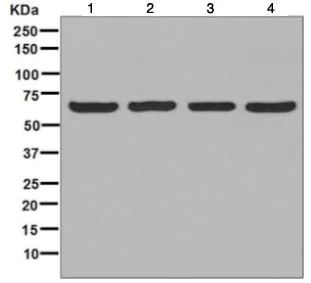
- WB
Unknown
Western blot - Anti-STIP1/STI1 antibody [EPR6606] (AB126753)
All lanes:
Western blot - Anti-STIP1/STI1 antibody [EPR6606] (ab126753) at 1/1000 dilution
Lane 1:
Jurkat cell lysate at 10 µg
Lane 2:
HeLa cell lysate at 10 µg
Lane 3:
BxPC-3 cell lysate at 10 µg
Lane 4:
HepG2 cell lysate at 10 µg
Secondary
All lanes:
HRP-conjugated goat anti-rabbit at 1/2000 dilution
Predicted band size: 63 kDa
false
関連する標識済み抗体及び組成の異なる製品 (1)
-
Anti-STIP1/STI1 antibody [EPR6606] - BSA and Azide free
代替製品
Primary Antibodies
AB238963
Anti-STIP1/STI1 antibody [EPR6605] - BSA and Azide free
RabMAb|Recombinant|KO Validated
- 0
- 0
組合せ製品
Primary Antibodies
AB115777
Anti-beta Actin antibody [SP124] - Cytoskeleton Marker
20ul selling size|RabMAb|Lab Essentials|Recombinant
- 4
- 1
Primary Antibodies
AB314908
Anti-Connexin 43 / GJA1 antibody [RM1071] - Intercellular Junction Marker
BOND RX™ Validated|20ul selling size|KO Validated|RabMAb|Recombinant
- 0
- 0
Reactivity data
製品の詳細
Patented technology
Our RabMAb® technology is a patented hybridoma-based technology for making rabbit monoclonal antibodies. For details on our patents, please refer to RabMAb® patents.
What are the advantages of a recombinant monoclonal antibody?
This product is a recombinant monoclonal antibody, which offers several advantages including:
- - High batch-to-batch consistency and reproducibility
- - Improved sensitivity and specificity
- - Long-term security of supply
- - Animal-free batch production
For more information, read more on recombinant antibodies.
出荷温度及び保存条件
製品の状態
精製方法
バッファー組成
出荷温度
短期保存温度
長期保存温度
保管に関する情報
補足情報
This supplementary information is collated from multiple sources and compiled automatically.
Biological function summary
The stress-induced phosphoprotein STIP1 functions within cytoplasm and is pivotal for cellular integrity. It forms a complex with HSP70 and HSP90 that regulates the folding and activation of a range of client proteins including steroid hormone receptors and kinases. This modulation influences protein activity stability and degradation. STIP1 impacts signal transduction pathways cellular growth and stress responses by influencing how effectively client proteins perform their biological roles within cells.
Pathways
The protein STIP1 plays a significant part in the steroid hormone signaling pathway and the protein folding network. It helps facilitate the proper folding and function of steroid hormone receptors through its interaction with major chaperone proteins HSP70 and HSP90. Both these pathways are important for cell survival and proper cell regulation. By helping with the maturation and activation of client proteins STIP1 ensures that cellular responses to various internal and external signals proceed efficiently.
製品プロトコール
- Visit the General protocols
- Visit the Troubleshooting
ターゲットの情報
文献 (5)
Recent publications for all applications. Explore the full list and refine your search
Immunity, inflammation and disease 11:e852 PubMed37904692
2023
Applications
Unspecified application
Species
Unspecified reactive species
Chemico-biological interactions 341:109446 PubMed33766539
2021
Applications
Unspecified application
Species
Unspecified reactive species
Frontiers in oncology 10:575358 PubMed33134174
2020
Applications
Unspecified application
Species
Unspecified reactive species
Pathology oncology research : POR 26:1243-1249 PubMed31250373
2019
Applications
Unspecified application
Species
Unspecified reactive species
Iranian journal of pathology 13:256-271 PubMed30697297
2018
Applications
Unspecified application
Species
Unspecified reactive species
Abcam product promise
Please note: All products are 'FOR RESEARCH USE ONLY. NOT FOR USE IN DIAGNOSTIC OR THERAPEUTIC PROCEDURES'.
For licensing inquiries, please contact partnerships@abcam.com