Anti-SQSTM1 / p62 (phospho S349) 抗体 [EPR20451] - BSA and Azide free
Anti-SQSTM1 / p62 (phospho S349) antibody [EPR20451] - BSA and Azide free
- RabMAb
- Recombinant
- KO Validated
- 詳細を見る
4
(2 Reviews)
|
(1 Publication)
Rabbit Recombinant Monoclonal SQSTM1 / p62 phospho S349 antibody. Carrier free. Suitable for IP, WB, ICC/IF, Flow Cyt (Intra) and reacts with Human, Mouse, Rat samples. Cited in 1 publication.
別名を表示する
ORCA, OSIL, SQSTM1, Sequestosome-1, EBI3-associated protein of 60 kDa, Phosphotyrosine-independent ligand for the Lck SH2 domain of 62 kDa, Ubiquitin-binding protein p62, EBIAP, p60, p62
- ICC/IF
Lab
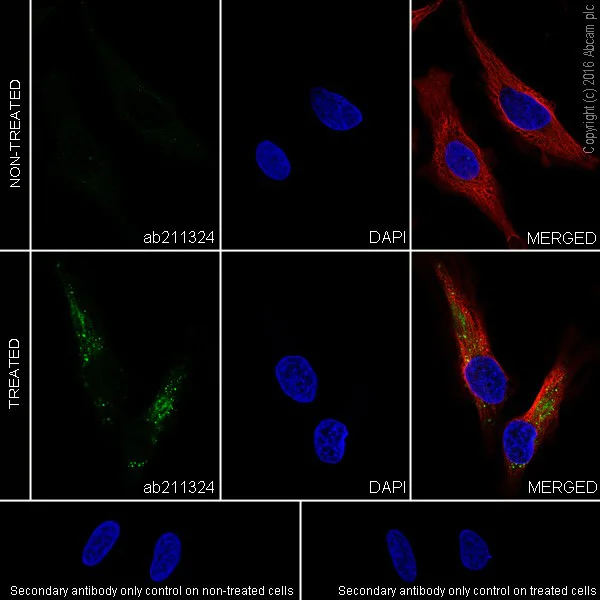
Immunocytochemistry/ Immunofluorescence - Anti-SQSTM1 / p62 (phospho S349) antibody [EPR20451] - BSA and Azide free (AB238445)
Immunofluorescent analysis of 4% paraformaldehyde-fixed, 0.1% Triton X-100 permeabilized HeLa (Human epithelial cell line from cervix adenocarcinoma) cells, treated with 2μM MG-132 for 18 hours or untreated, labeling SQSTM1 / p62 (phospho S349) with ab211324 at 1/100 dilution, followed by Anti-alpha Tubulin antibody [DM1A] - Microtubule Marker (Alexa Fluor® 594) (ab195889) secondary antibody at 1/200 dilution (green).
Confocal image showing cytoplasmic staining on HeLa cell line. The expression increased after treatment with 2μM MG-132 for 18 hours.
This data was developed using the same antibody clone in a different buffer formulation containing PBS, BSA, glycerol, and sodium azide (ab211324).
- Flow Cyt (Intra)
Lab
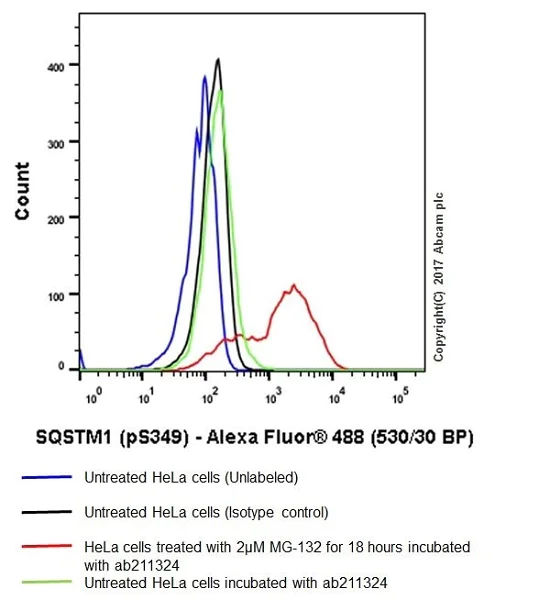
Flow Cytometry (Intracellular) - Anti-SQSTM1 / p62 (phospho S349) antibody [EPR20451] - BSA and Azide free (AB238445)
Intracellular flow cytometric analysis of 4% paraformaldehyde-fixed HeLa (Human epithelial cell line from cervix adenocarcinoma) cells, treated with 2μM MG-132 for 18 hours (red) or untreated (green), labeling SQSTM1 / p62 (phospho S349) with ab211324 at 1/500 dilution compared with a rabbit monoclonal IgG isotype control (ab172730; black) and an unlabeled control (cells without incubation with primary antibody and secondary antibody; blue). Goat anti rabbit IgG (Alexa Fluor® 488) at 1/2000 dilution was used as the secondary antibody.
This data was developed using the same antibody clone in a different buffer formulation containing PBS, BSA, glycerol, and sodium azide (ab211324).
- IP
Lab
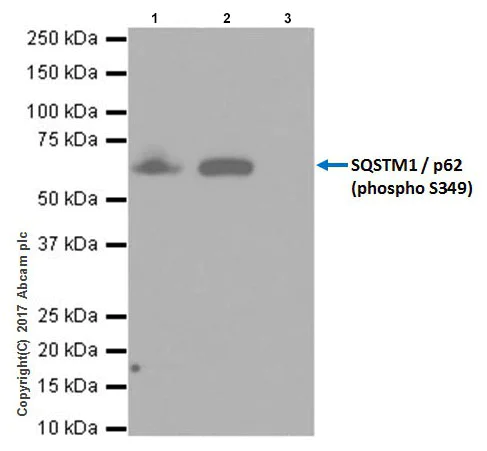
Immunoprecipitation - Anti-SQSTM1 / p62 (phospho S349) antibody [EPR20451] - BSA and Azide free (AB238445)
SQSTM1 / p62 (phospho S349) was immunoprecipitated from 0.35 mg of HeLa (Human epithelial cell line from cervix adenocarcinoma) whole cell lysate treated with 2μM MG-132 for 18h with ab211324 at 1/30 dilution.
Western blot was performed from the immunoprecipitate using ab211324 at 1/1000 dilution.
VeriBlot for IP Detection Reagent (HRP) (ab131366), was used for detection at 1/10000 dilution.
Lane 1 : HeLa treated with 2μM MG-132 for 18h whole cell lysate, 10 μg (Input).
Lane 2 : ab211324 IP in HeLa treated with 2μM MG-132 for 18h whole cell lysate.
Lane 3 : Rabbit monoclonal IgG (ab172730) instead of ab211324 in HeLa treated with 2μM MG-132 for 18h whole cell lysate.
Blocking and dilution buffer and concentration : 5% NFDM/TBST.
Exposure time : 10 seconds.
This data was developed using the same antibody clone in a different buffer formulation containing PBS, BSA, glycerol, and sodium azide (ab211324).
All lanes:
Immunoprecipitation - Anti-SQSTM1 / p62 (phospho S349) antibody [EPR20451] (<a href='/products/primary-antibodies/sqstm1-p62-phospho-s349-antibody-epr20451-ab211324'>ab211324</a>)
Predicted band size: 47 kDa
false
Exposure time: 10s
- WB
Collaborator
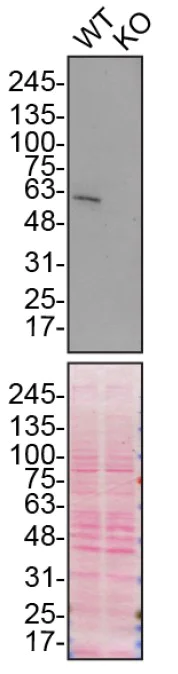
Western blot - Anti-SQSTM1 / p62 (phospho S349) antibody [EPR20451] - BSA and Azide free (AB238445)
This data was developed using the same antibody in a different buffer formulation (ab211324).
ab211324 was shown to react with SQSTM1 in wild-type U-2 OS cells in Western blot with loss of signal observed in a SQSTM1 knockout cell line. Wild-type U-2 OS and SQSTM1 knockout cell lysates were subjected to SDS-PAGE. Membranes were blocked in 5% milk in TBST for 1 hr before incubation with ab211324 overnight at 4 °C at a 1/1000 dilution. Blots were incubated with goat anti-rabbit HRP secondary antibodies at 0.2ug/mL before imaging. These data were provided by YCharOS Inc., an open science company with the mission of characterizing commercially available antibody reagents for all human proteins. Abcam and YCharOS are working together to help address the reproducibility crisis by enabling the life science community to better evaluate commercially available antibodies.
All lanes:
Western blot - Anti-SQSTM1 / p62 (phospho S349) antibody [EPR20451] (<a href='/products/primary-antibodies/sqstm1-p62-phospho-s349-antibody-epr20451-ab211324'>ab211324</a>) at 1/1000 dilution
Lane 1:
Wild-type U-2 OS cell lysate at 20 µg
Lane 2:
SQSTM1 knockout U-2 OS cell lysate at 20 µg
Predicted band size: 47 kDa
false
関連する標識済み抗体及び組成の異なる製品 (7)
-
Anti-SQSTM1 / p62 (phospho S349) antibody [EPR20451]
-
660 APC
APC Anti-SQSTM1 / p62 (phospho S349) antibody [EPR20451]
-
519 Alexa Fluor® 488
Alexa Fluor® 488 Anti-SQSTM1 / p62 (phospho S349) antibody [EPR20451]
-
565 Alexa Fluor® 555
Alexa Fluor® 555 Anti-SQSTM1 / p62 (phospho S349) antibody [EPR20451]
-
617 Alexa Fluor® 594
Alexa Fluor® 594 Anti-SQSTM1 / p62 (phospho S349) antibody [EPR20451]
-
665 Alexa Fluor® 647
Alexa Fluor® 647 Anti-SQSTM1 / p62 (phospho S349) antibody [EPR20451]
-
578 PE
PE Anti-SQSTM1 / p62 (phospho S349) antibody [EPR20451]
代替製品
Primary Antibodies
AB185015
Alexa Fluor® 488 Anti-SQSTM1 / p62 antibody [EPR4844] - Autophagosome Marker
RabMAb|Recombinant|KO Validated
- 0
- 0
Primary Antibodies
AB207305
Anti-SQSTM1 / p62 antibody [EPR18351] - Autophagosome Marker
20ul selling size|KO Validated|RabMAb|Recombinant|Lab Essentials|Trial Size

- 5
- 3
Primary Antibodies
AB109012
Anti-SQSTM1 / p62 antibody [EPR4844] - Autophagosome Marker
20ul selling size|KO Validated|RabMAb|Recombinant|Lab Essentials

- 5
- 15
Primary Antibodies
AB219581
Anti-SQSTM1 / p62 antibody [EPR4844] - BSA and Azide free
RabMAb|Recombinant|KO Validated
- 0
- 0
Primary Antibodies
AB194721
Alexa Fluor® 647 Anti-SQSTM1 / p62 antibody [EPR4844] - Autophagosome Marker
RabMAb|Recombinant|KO Validated
- 0
- 0
Primary Antibodies
AB227992
Anti-SQSTM1 / p62 antibody [EPR18351] - BSA and Azide free
RabMAb|Recombinant|KO Validated
- 3
- 1
組合せ製品
Primary Antibodies
AB109012
Anti-SQSTM1 / p62 antibody [EPR4844] - Autophagosome Marker
20ul selling size|KO Validated|RabMAb|Recombinant|Lab Essentials
- 5
- 15
Primary Antibodies
AB192890
Anti-LC3B antibody [EPR18709] - Autophagosome Marker
BOND RX™ Validated|RabMAb|Recombinant|KO Validated|Lab Essentials|20ul selling size
- 5
- 19
Primary Antibodies
AB207612
Anti-Beclin 1 antibody [EPR19662]
20ul selling size|KO Validated|RabMAb|Recombinant|Trial Size
- 5
- 10
Primary Antibodies
AB62352
20ul selling size|RabMAb|Recombinant|KO Validated

- 4
- 34
Reactivity data
製品の詳細
ab238445 is the carrier-free version of ab211324.
Patented technology
Our RabMAb® technology is a patented hybridoma-based technology for making rabbit monoclonal antibodies. For details on our patents, please refer to RabMAb® patents.
What are the advantages of a recombinant monoclonal antibody?
This product is a recombinant monoclonal antibody, which offers several advantages including:
- - High batch-to-batch consistency and reproducibility
- - Improved sensitivity and specificity
- - Long-term security of supply
- - Animal-free batch production
For more information, read more on recombinant antibodies.
Conjugation ready
Our carrier-free antibodies are typically supplied in a PBS-only formulation, purified and free of BSA, sodium azide and glycerol. This conjugation-ready format is designed for use with fluorochromes, metal isotopes, oligonucleotides, and enzymes, which makes them ideal for antibody labelling, functional and cell-based assays, flow-based assays (e.g. mass cytometry) and Multiplex Imaging applications.
Use our conjugation kits for antibody conjugates that are ready-to-use in as little as 20 minutes with 1 minute hands-on-time and 100% antibody recovery: available for fluorescent dyes, HRP, biotin and gold.
Compatibility
This product is compatible with the Maxpar® Antibody Labeling Kit from Fluidigm, without the need for antibody preparation. Maxpar® is a trademark of Fluidigm Canada Inc.
出荷温度及び保存条件
製品の状態
精製方法
バッファー組成
出荷温度
短期保存温度
長期保存温度
保管に関する情報
製品プロトコール
- Visit the General protocols
- Visit the Troubleshooting
ターゲットの情報
文献 (1)
Recent publications for all applications. Explore the full list and refine your search
Nature communications 14:7348 PubMed37963875
2023
Applications
Unspecified application
Species
Unspecified reactive species
Abcam product promise
Please note: All products are 'FOR RESEARCH USE ONLY. NOT FOR USE IN DIAGNOSTIC OR THERAPEUTIC PROCEDURES'.
For licensing inquiries, please contact partnerships@abcam.com