Anti-SGLT1 antibody [EPR26041-107]
Anti-SGLT1 antibody [EPR26041-107]
- Advanced Validation
- 20ul selling size
- BOND RX™ Validated
- Recombinant
- RabMAb
- 詳細を見る
Be the first to review this product! Submit a review
|
(1 Publication)
Rabbit Recombinant Monoclonal SGLT1 antibody. Suitable for IHC-P, mIHC and reacts with Transfected cell line - Human, Human, Rat samples. Cited in 1 publication.
別名を表示する
NAGT, SGLT1, SLC5A1, Sodium/glucose cotransporter 1, Na(+)/glucose cotransporter 1, High affinity sodium-glucose cotransporter, Solute carrier family 5 member 1
- mIHC
Lab
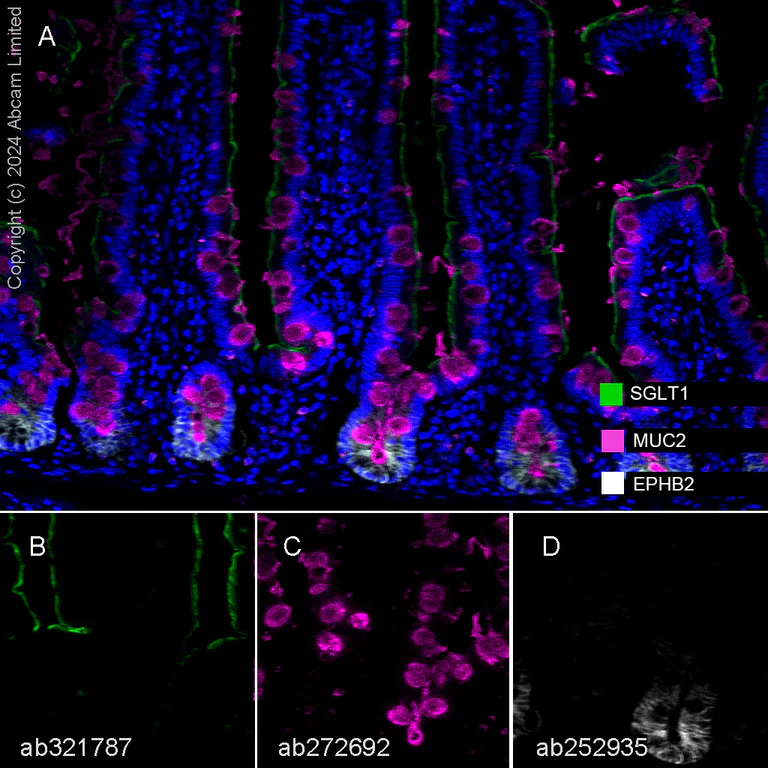
Multiplex immunohistochemistry - Anti-SGLT1 antibody [EPR26041-107] (AB321787)
Multiplex immunohistochemistry analysis of formalin/PFA-fixed paraffin-embedded human small intestine staining SGLT1 with ab321787 at a 1/2000 dilution, ab272692 anti-MUS2 used at 1/2000 dilution and ab252935 anti-EPHB2 used at a 1/500 dilution.
Panel A : merged staining of anti-SGLT1 (green; Opal™520), anti-MUC2 (magenta; Opal™690) and anti-EPHB2 (gray; Opal™570) on human small intestine.
Panel B : anti-SGLT2 staining apical side of the villi in human small intestine.
Panel C : anti-MUC2 staining goblet cells in human small intestine.
Panel D : anti-EPHB2 staining stem cells in human small intestine.
Nuclear DNA was labeled with DAPI (shown in blue).
The section was incubated in three rounds of staining : in the order of ab321787, ab272692 and ab252935 for 30 mins at room temperature. Each round was followed by a separate fluorescent tyramide signal amplification system.
The immunostaining was performed on a Leica Biosystems BOND® RX instrument with an Opal™ 4-color kit. Image acquisition was performed with Leica SP8 confocal microscope.
Heat mediated antigen retrieval with Tris-EDTA buffer (pH 9.0, epitope retrieval solution2) for 20 mins.
- IHC-P
Supplier Data
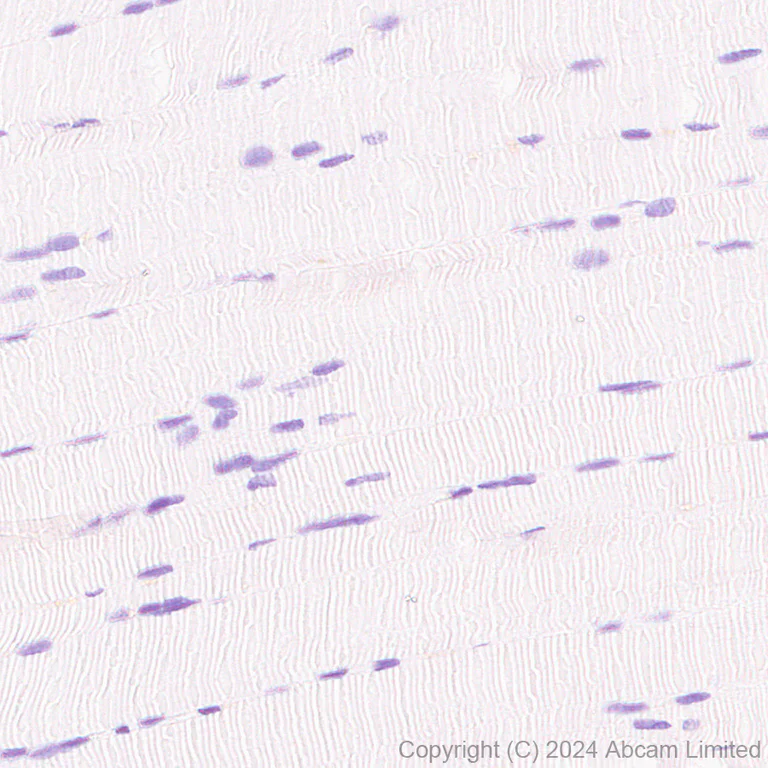
Immunohistochemistry (Formalin/PFA-fixed paraffin-embedded sections) - Anti-SGLT1 antibody [EPR26041-107] (AB321787)
Immunohistochemical analysis of paraffin-embedded Human skeletal muscle tissue labeling SGLT1 with ab321787 at 1/2000 (0.268 ug/ml) dilution, followed by a ready to use LeicaDS9800 (Bond™ Polymer Refine Detection).
Negative control : No staining on human skeletal muscle.
The section was incubated with ab321787 for 30 mins at room temperature.
The immunostaining was performed on a Leica Biosystems BOND® RX instrument
We don't expect this antibody to cross-react with SGLT3 (SLC5A4) based on the negative staining observed in skeletal muscle, which expresses SGLT3 (PMID : 33385407).
Counterstained with Hematoxylin.
Secondary antibody only control : Secondary antibody is a ready to use LeicaDS9800 (Bond™ Polymer Refine Detection).
Heat mediated antigen retrieval was performed with Tris-EDTA buffer (pH 9.0, Epitope Retrieval Solution2) for 20 mins
- IHC-P
Supplier Data
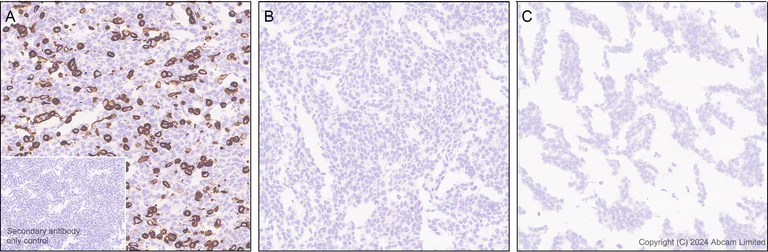
Immunohistochemistry (Formalin/PFA-fixed paraffin-embedded sections) - Anti-SGLT1 antibody [EPR26041-107] (AB321787)
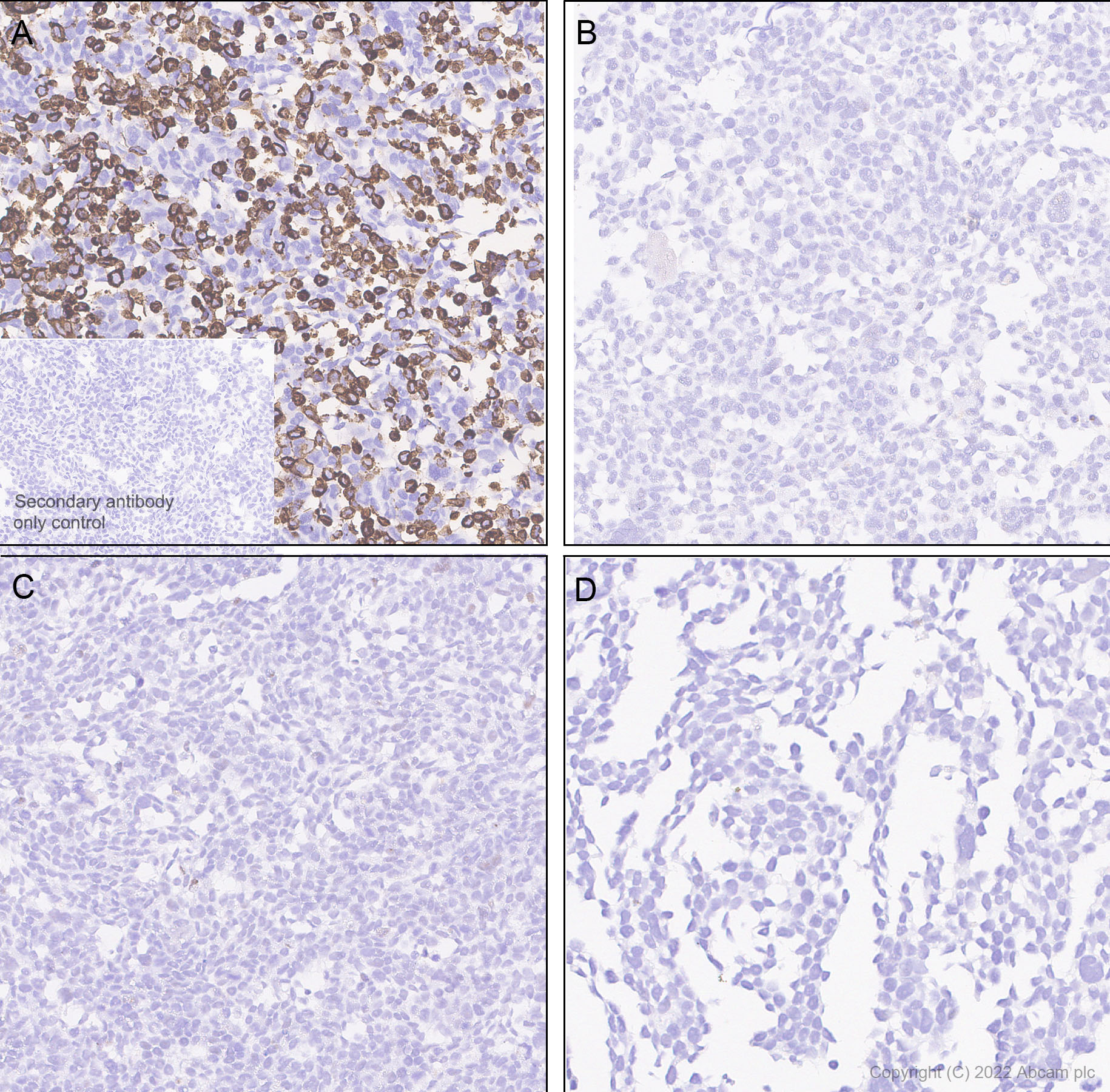
Immunohistochemical analysis of paraffin-embedded (A) HEK-293T (human embryonic kidney epithelial cell) transfected with a SGLT1 (SLC5A1) expression vector containing a his tag. (B) HEK-293T cells transfected with a SGLT2 (SLC5A2) expression vector containing a his tag. (C) HEK-293T cells transfected with empty vector containing a his tag. tissue labeling SGLT1 with ab321787 at 1/2000 (0.268 ug/ml) dilution, followed by a ready to use LeicaDS9800 (Bond™ Polymer Refine Detection).
Positive staining on (A) HEK-293T cells transfected with a SGLT1 (SLC5A1) expression vector containing a his tag, No staining on (B) HEK-293T cells transfected with a SGLT2 (SLC5A2) expression vector and (C) HEK-293T cells transfected with empty vector containing a his tag.
The section was incubated with ab321787 for 30 mins at room temperature.
The immunostaining was performed on a Leica Biosystems BOND® RX instrument
Counterstained with Hematoxylin.
Secondary antibody only control : Secondary antibody is a ready to use LeicaDS9800 (Bond™ Polymer Refine Detection).
Heat mediated antigen retrieval was performed with Tris-EDTA buffer (pH 9.0, Epitope Retrieval Solution2) for 20 mins
- mIHC
Lab
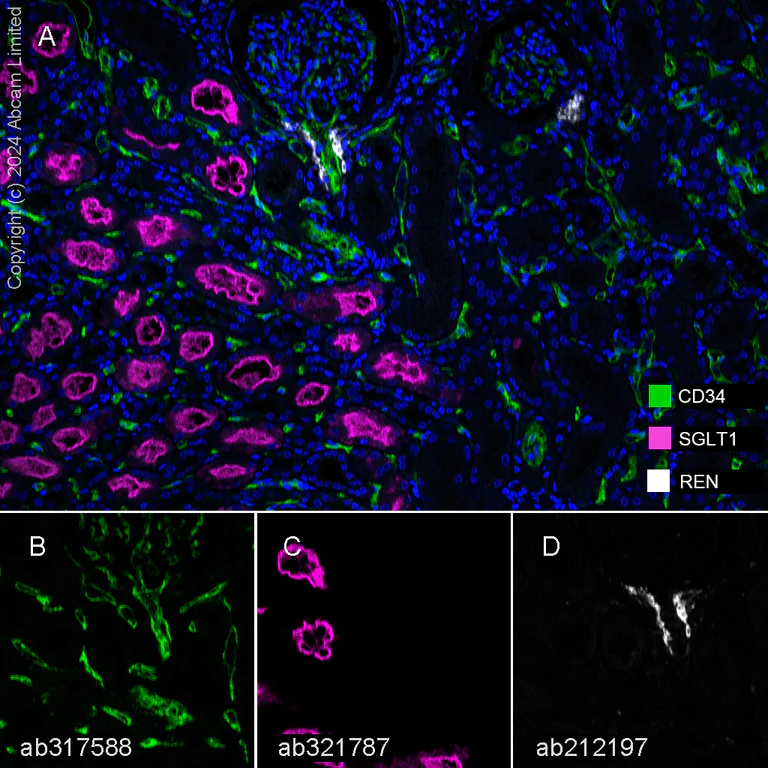
Multiplex immunohistochemistry - Anti-SGLT1 antibody [EPR26041-107] (AB321787)
Multiplex immunohistochemistry analysis of formalin/PFA-fixed paraffin-embedded human kidney tissue staining CD34 with ab317588 at a 1/2000 dilution, ab321787 anti-SGLT1 used at 1/2000 dilution and ab212197 anti-Renin used at a 1/4000 dilution.
Panel A : merged staining of anti-CD34 (green; Opal™520), anti-SGLT1 (magenta; Opal™690) and anti-Renin (gray; Opal™570) on human kidney.
Panel B : anti-CD34 staining endothelium in human kidney.
Panel C : anti-SGLT1 staining tubules in human kidney.
Panel D : anti-Renin staining juxtaglomerular cells in human kidney.
Nuclear DNA was labeled with DAPI (shown in blue).
The section was incubated in three rounds of staining : in the order of ab317588, ab321787 and ab212197 for 30 mins at room temperature. Each round was followed by a separate fluorescent tyramide signal amplification system.
The immunostaining was performed on a Leica Biosystems BOND® RX instrument with an Opal™ 4-color kit. Image acquisition was performed with Leica SP8 confocal microscope.
Heat mediated antigen retrieval with Tris-EDTA buffer (pH 9.0, epitope retrieval solution2) for 20 mins.
- IHC-P
Supplier Data
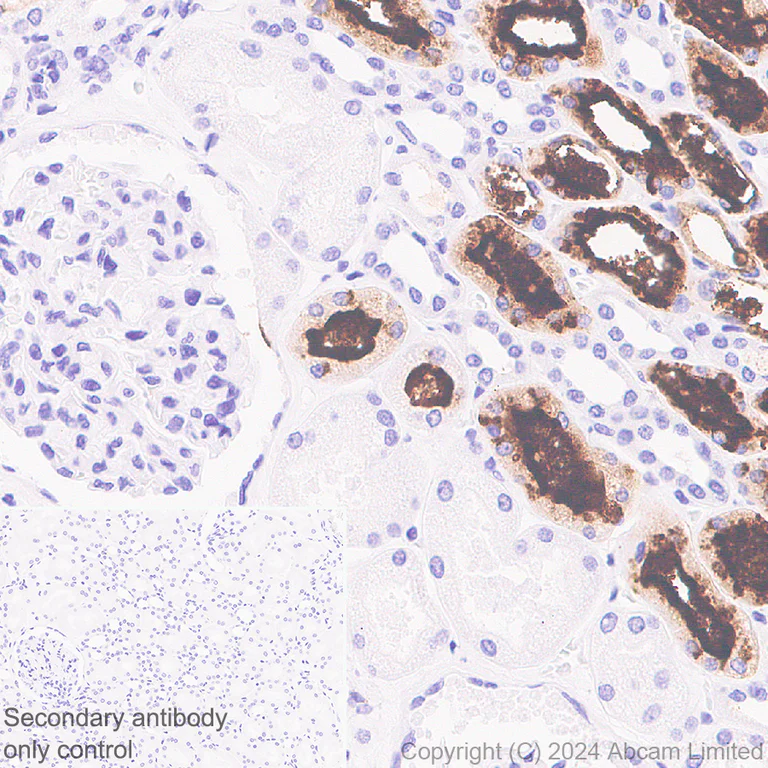
Immunohistochemistry (Formalin/PFA-fixed paraffin-embedded sections) - Anti-SGLT1 antibody [EPR26041-107] (AB321787)
Immunohistochemical analysis of paraffin-embedded Human kidney tissue labeling SGLT1 with ab321787 at 1/2000 (0.268 ug/ml) dilution, followed by a ready to use LeicaDS9800 (Bond™ Polymer Refine Detection).
Positive staining on human kidney (PMID : 26121582).
The section was incubated with ab321787 for 30 mins at room temperature.
The immunostaining was performed on a Leica Biosystems BOND® RX instrument
Counterstained with Hematoxylin.
Secondary antibody only control : Secondary antibody is a ready to use LeicaDS9800 (Bond™ Polymer Refine Detection).
Heat mediated antigen retrieval was performed with Tris-EDTA buffer (pH 9.0, Epitope Retrieval Solution2) for 20 mins
- IHC-P
Supplier Data
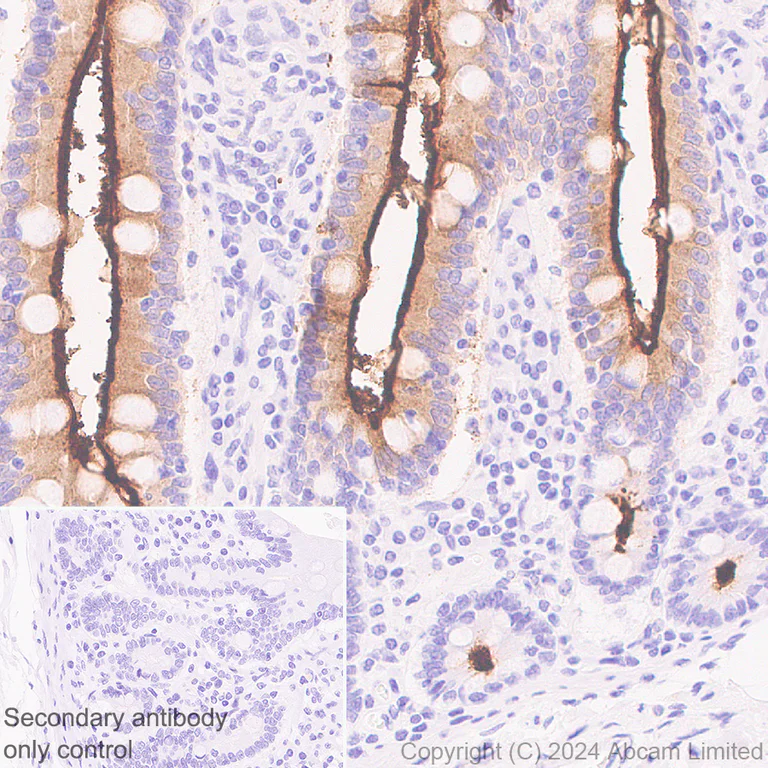
Immunohistochemistry (Formalin/PFA-fixed paraffin-embedded sections) - Anti-SGLT1 antibody [EPR26041-107] (AB321787)
Immunohistochemical analysis of paraffin-embedded Human duodenum tissue labeling SGLT1 with ab321787 at 1/2000 (0.268 ug/ml) dilution, followed by a ready to use LeicaDS9800 (Bond™ Polymer Refine Detection).
Positive staining on human duodenum.
The section was incubated with ab321787 for 30 mins at room temperature.
The immunostaining was performed on a Leica Biosystems BOND® RX instrument
Counterstained with Hematoxylin.
Secondary antibody only control : Secondary antibody is a ready to use LeicaDS9800 (Bond™ Polymer Refine Detection).
Heat mediated antigen retrieval was performed with Tris-EDTA buffer (pH 9.0, Epitope Retrieval Solution2) for 20 mins
- IHC-P
Supplier Data
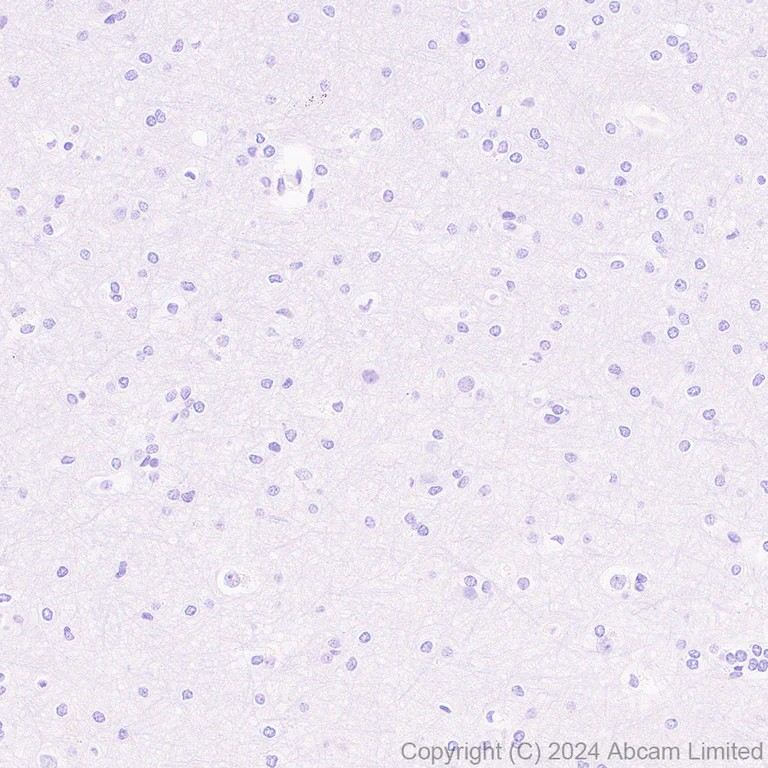
Immunohistochemistry (Formalin/PFA-fixed paraffin-embedded sections) - Anti-SGLT1 antibody [EPR26041-107] (AB321787)
Immunohistochemical analysis of paraffin-embedded Human cerebrum tissue labeling SGLT1 with ab321787 at 1/2000 (0.268 ug/ml) dilution, followed by a ready to use LeicaDS9800 (Bond™ Polymer Refine Detection).
Negative control : No staining on human cerebrum.
The section was incubated with ab321787 for 30 mins at room temperature.
The immunostaining was performed on a Leica Biosystems BOND® RX instrument
Counterstained with Hematoxylin.
Secondary antibody only control : Secondary antibody is a ready to use LeicaDS9800 (Bond™ Polymer Refine Detection).
Heat mediated antigen retrieval was performed with Tris-EDTA buffer (pH 9.0, Epitope Retrieval Solution2) for 20 mins
- IHC-P
Supplier Data
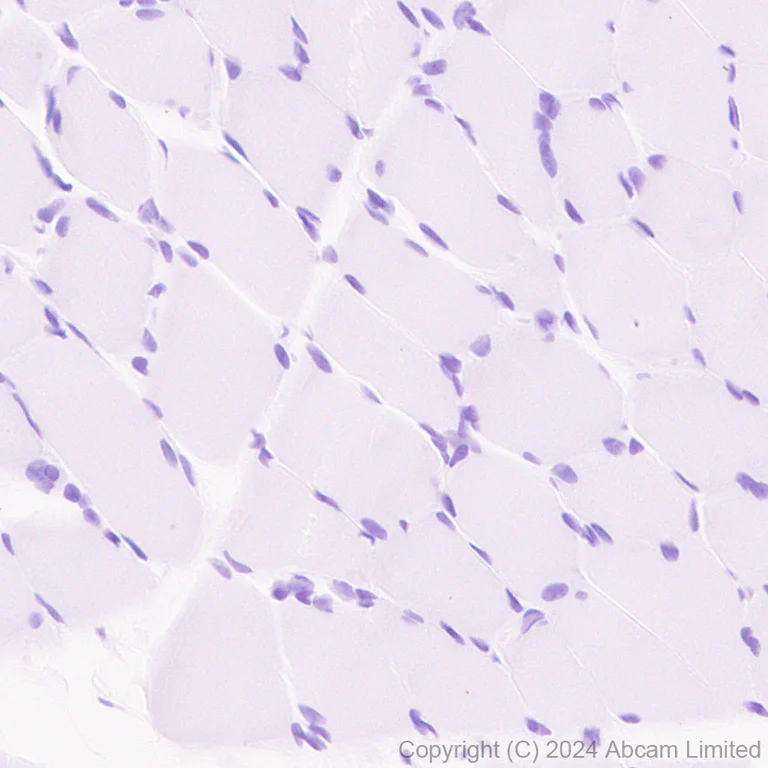
Immunohistochemistry (Formalin/PFA-fixed paraffin-embedded sections) - Anti-SGLT1 antibody [EPR26041-107] (AB321787)
Immunohistochemical analysis of paraffin-embedded Rat skeletal muscle tissue labeling SGLT1 with ab321787 at 1/2000 (0.268 ug/ml) dilution, followed by a ready to use LeicaDS9800 (Bond™ Polymer Refine Detection).
Negative control : No staining on rat skeletal muscle.
The section was incubated with ab321787 for 30 mins at room temperature.
The immunostaining was performed on a Leica Biosystems BOND® RX instrument
We don't expect this antibody to cross-react with SGLT3 (SLC5A4) based on the negative staining observed in skeletal muscle, which expresses SGLT3 (PMID : 33385407).
Counterstained with Hematoxylin.
Secondary antibody only control : Secondary antibody is a ready to use LeicaDS9800 (Bond™ Polymer Refine Detection).
Heat mediated antigen retrieval was performed with Tris-EDTA buffer (pH 9.0, Epitope Retrieval Solution2) for 20 mins
- IHC-P
Supplier Data
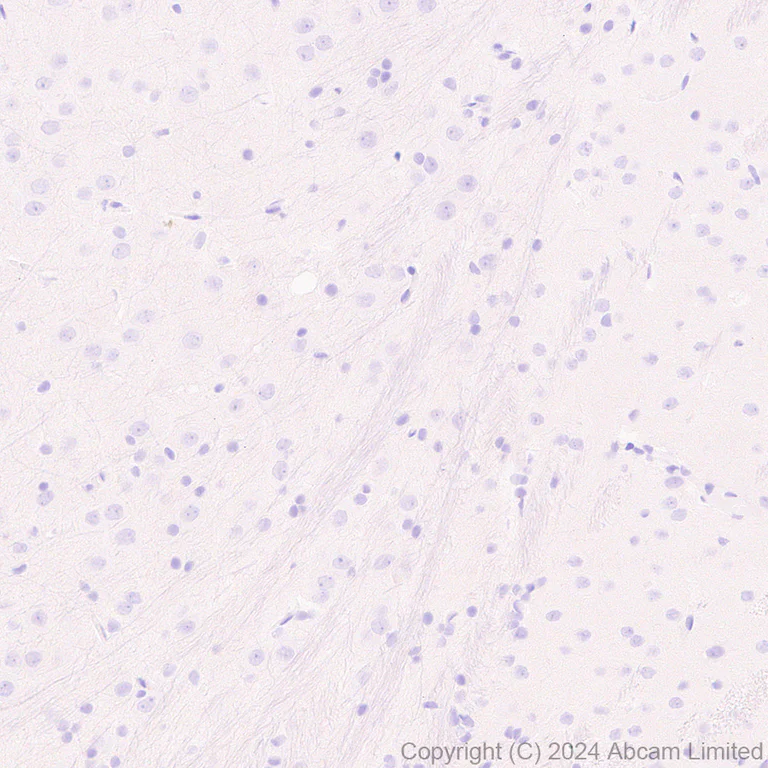
Immunohistochemistry (Formalin/PFA-fixed paraffin-embedded sections) - Anti-SGLT1 antibody [EPR26041-107] (AB321787)
Immunohistochemical analysis of paraffin-embedded Rat cerebrum tissue labeling SGLT1 with ab321787 at 1/2000 (0.268 ug/ml) dilution, followed by a ready to use LeicaDS9800 (Bond™ Polymer Refine Detection).
Negative control : No staining on rat cerebrum (PMID : 8163506).
The section was incubated with ab321787 for 30 mins at room temperature.
The immunostaining was performed on a Leica Biosystems BOND® RX instrument
Counterstained with Hematoxylin.
Secondary antibody only control : Secondary antibody is a ready to use LeicaDS9800 (Bond™ Polymer Refine Detection).
Heat mediated antigen retrieval was performed with Tris-EDTA buffer (pH 9.0, Epitope Retrieval Solution2) for 20 mins
- IHC-P
Supplier Data
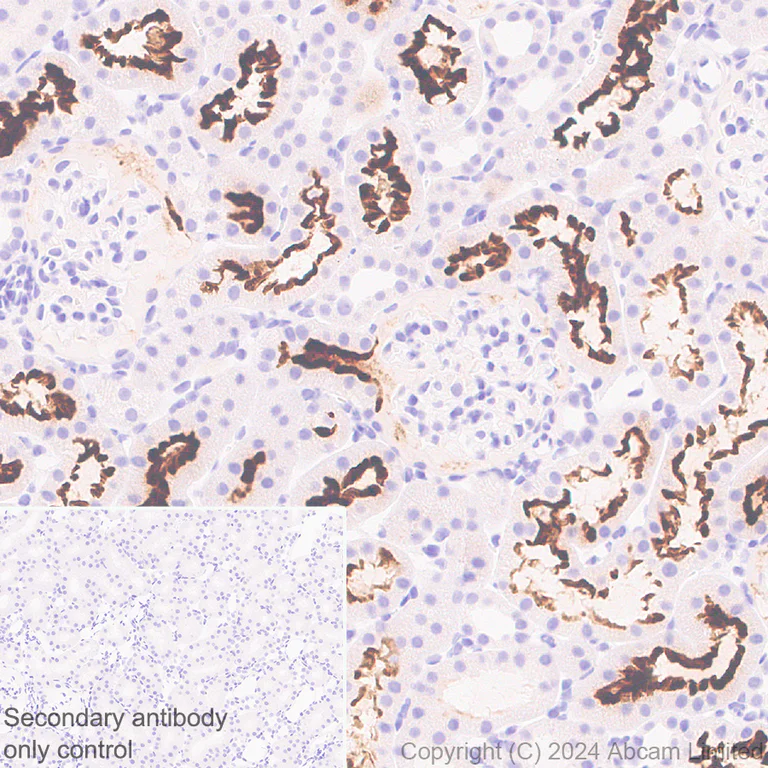
Immunohistochemistry (Formalin/PFA-fixed paraffin-embedded sections) - Anti-SGLT1 antibody [EPR26041-107] (AB321787)
Immunohistochemical analysis of paraffin-embedded Rat kidney tissue labeling SGLT1 with ab321787 at 1/2000 (0.268 ug/ml) dilution, followed by a ready to use LeicaDS9800 (Bond™ Polymer Refine Detection).
Positive staining on rat kidney.
The section was incubated with ab321787 for 30 mins at room temperature.
The immunostaining was performed on a Leica Biosystems BOND® RX instrument
Counterstained with Hematoxylin.
Secondary antibody only control : Secondary antibody is a ready to use LeicaDS9800 (Bond™ Polymer Refine Detection).
Heat mediated antigen retrieval was performed with Tris-EDTA buffer (pH 9.0, Epitope Retrieval Solution2) for 20 mins
- IHC-P
Supplier Data
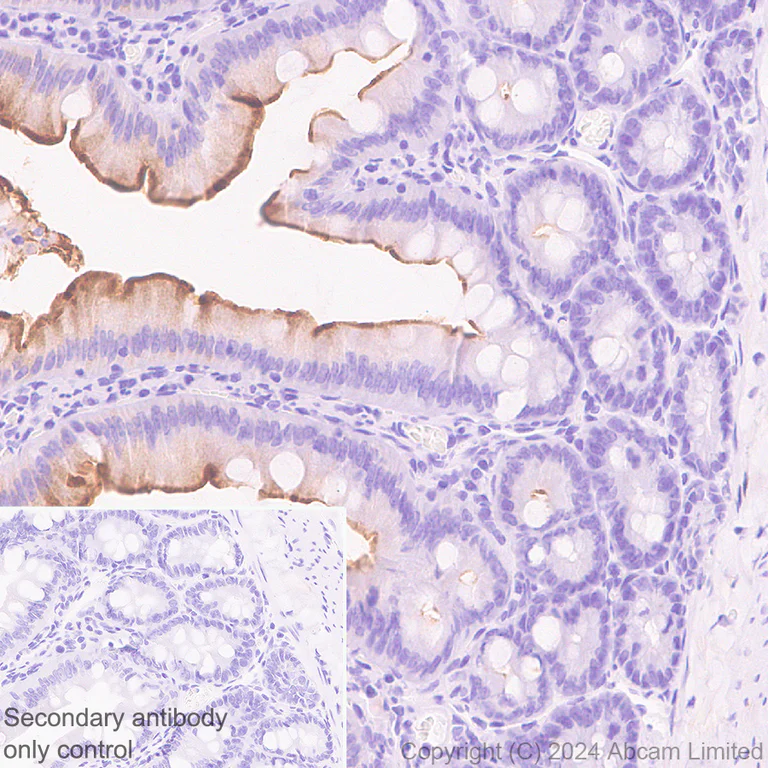
Immunohistochemistry (Formalin/PFA-fixed paraffin-embedded sections) - Anti-SGLT1 antibody [EPR26041-107] (AB321787)
Immunohistochemical analysis of paraffin-embedded Rat duodenum tissue labeling SGLT1 with ab321787 at 1/2000 (0.268 ug/ml) dilution, followed by a ready to use LeicaDS9800 (Bond™ Polymer Refine Detection).
Positive staining on rat duodenum (PMID : 8163506).
The section was incubated with ab321787 for 30 mins at room temperature.
The immunostaining was performed on a Leica Biosystems BOND® RX instrument
Counterstained with Hematoxylin.
Secondary antibody only control : Secondary antibody is a ready to use LeicaDS9800 (Bond™ Polymer Refine Detection).
Heat mediated antigen retrieval was performed with Tris-EDTA buffer (pH 9.0, Epitope Retrieval Solution2) for 20 mins
関連する標識済み抗体及び組成の異なる製品 (1)
-
Anti-SGLT1 antibody [EPR26041-107] - BSA and Azide free
組合せ製品

Primary Antibodies
AB272692
Anti-MUC2 antibody [EPR23479-47]
BOND RX™ Validated|20ul selling size|RabMAb|Advanced Validation|Recombinant|Trial Size

- 5
- 7
Primary Antibodies
AB115730
Anti-Glucose Transporter GLUT1 antibody [EPR3915]
BOND RX™ Validated|20ul selling size|RabMAb|Recombinant|KO Validated

- 4
- 20
Primary Antibodies
AB306558
Anti-SGLT2 antibody [EPR27112-7]
Advanced Validation|BOND RX™ Validated|20ul selling size|RabMAb|Recombinant
- 0
- 0
Reactivity data
製品の詳細
Patented technology
Our RabMAb® technology is a patented hybridoma-based technology for making rabbit monoclonal antibodies. For details on our patents, please refer to RabMAb® patents.
What are the advantages of a recombinant monoclonal antibody?
This product is a recombinant monoclonal antibody, which offers several advantages including:
- - High batch-to-batch consistency and reproducibility
- - Improved sensitivity and specificity
- - Long-term security of supply
- - Animal-free batch production
For more information, read more on recombinant antibodies.
出荷温度及び保存条件
製品の状態
精製方法
バッファー組成
出荷温度
短期保存期間
短期保存温度
長期保存温度
分注に関する情報
保管に関する情報
補足情報
This supplementary information is collated from multiple sources and compiled automatically.
Biological function summary
SGLT1's main role is in facilitating nutrient absorption in the gastrointestinal tract. It operates as part of the larger SGLT protein family but does not form a complex with other proteins. The protein is essential for the transport of monosaccharides from the gut into circulation. By ensuring glucose and galactose absorption during digestive processes SGLT1 provides necessary carbohydrates for cellular metabolism and systemic energy homeostasis.
Pathways
The transport protein SGLT1 is integral to the glucose uptake pathway. This pathway intersects with the insulin signaling pathway because the glucose absorbed by SGLT1 later enters systemic circulation. SGLT1 also complements the GLUT family of transporters especially GLUT2 which function downstream by facilitating glucose transport across the intestinal basolateral membrane into the bloodstream. The interplay between these transport mechanisms maintains glucose levels post-ingestion.
製品プロトコール
- Visit the General protocols
- Visit the Troubleshooting
ターゲットの情報
文献 (1)
Recent publications for all applications. Explore the full list and refine your search
BMJ open diabetes research & care 13: PubMed40716951
2025
Applications
Unspecified application
Species
Unspecified reactive species
Abcam product promise
Please note: All products are 'FOR RESEARCH USE ONLY. NOT FOR USE IN DIAGNOSTIC OR THERAPEUTIC PROCEDURES'.
For licensing inquiries, please contact partnerships@abcam.com