Anti-SCIN 抗体 [EPR16310] - C-terminal
Anti-SCIN antibody [EPR16310] - C-terminal
- RabMAb
- Recombinant
- 詳細を見る
Be the first to review this product! Submit a review
|
(2 Publications)
Rabbit Recombinant Monoclonal SCIN antibody. C-terminal. Suitable for WB, IHC-P and reacts with Mouse, Rat, Human samples. Cited in 2 publications.
別名を表示する
KIAA1905, SCIN, Scinderin, Adseverin
- IHC-P
Supplier Data
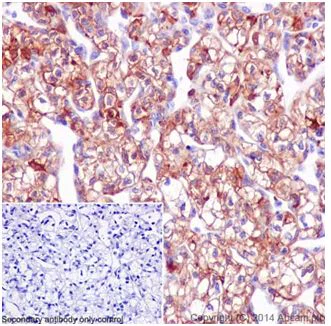
Immunohistochemistry (Formalin/PFA-fixed paraffin-embedded sections) - Anti-SCIN antibody [EPR16310] - C-terminal (AB199723)
Immunohistochemical analysis of paraffin-embedded Human clear cell carcinoma of kidney tissue labeling SCIN with ab199723 at 1/500 dilution followed by Goat Anti-Rabbit IgG H&L (HRP) (ab97051) at 1/500 dilution. Cytoplasm staining on Human clear cell carcinoma of kidney tissue is observed. Counter stained with Hematoxylin.
Negative control : Used PBS instead of primary antibody, secondary antibody is Goat Anti-Rabbit IgG H&L (HRP) (ab97051).
Perform heat mediated antigen retrieval with Tris/EDTA buffer pH 9.0 before commencing with IHC staining protocol.
- IHC-P
Supplier Data
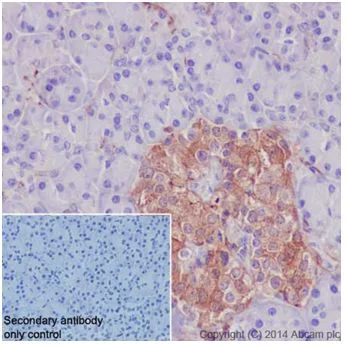
Immunohistochemistry (Formalin/PFA-fixed paraffin-embedded sections) - Anti-SCIN antibody [EPR16310] - C-terminal (AB199723)
Immunohistochemical analysis of paraffin-embedded Human pancreas tissue labeling SCIN with ab199723 at 1/500 dilution followed by Goat Anti-Rabbit IgG H&L (HRP) (ab97051) at 1/500 dilution. Cytoplasm staining on Human pancreas tissue is observed. Counter stained with Hematoxylin.
Negative control : Used PBS instead of primary antibody, secondary antibody is Goat Anti-Rabbit IgG H&L (HRP) (ab97051).
Perform heat mediated antigen retrieval with Tris/EDTA buffer pH 9.0 before commencing with IHC staining protocol.
- WB
Supplier Data
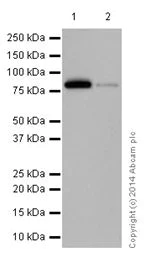
Western blot - Anti-SCIN antibody [EPR16310] - C-terminal (AB199723)
Blocking/dilution buffer : 5% NFDM/TBST.
All lanes:
Western blot - Anti-SCIN antibody [EPR16310] - C-terminal (ab199723) at 1/10000 dilution
Lane 1:
Human fetal kidney lysate at 20 µg
Lane 2:
HEK293 (Human embryonic kidney) whole cell lysate at 20 µg
Secondary
All lanes:
Anti-Rabbit IgG (HRP), specific to the non-reduced form of IgG at 1/1000 dilution
Predicted band size: 80 kDa
Observed band size: 80 kDa
false
Exposure time: 30s
- WB
Supplier Data
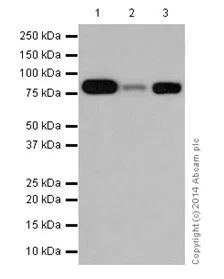
Western blot - Anti-SCIN antibody [EPR16310] - C-terminal (AB199723)
Blocking/dilution buffer : 5% NFDM/TBST.
All lanes:
Western blot - Anti-SCIN antibody [EPR16310] - C-terminal (ab199723) at 1/1000 dilution
Lane 1:
C6 (rat glial tumor cells) whole cell lysate at 10 µg
Lane 2:
PC-12 (rat adrenal gland pheochromocytoma) whole cell lysate at 10 µg
Lane 3:
NIH/3T3 (mouse embryo fibroblast cells) whole cell lysate at 10 µg
Secondary
All lanes:
Goat Anti-Rabbit IgG, (H+L), Peroxidase conjugated at 1/1000 dilution
Predicted band size: 80 kDa
Observed band size: 80 kDa
false
Exposure time: 5s
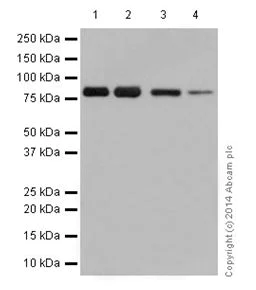
- WB
Supplier Data
Western blot - Anti-SCIN antibody [EPR16310] - C-terminal (AB199723)
Blocking/dilution buffer : 5% NFDM/TBST.
All lanes:
Western blot - Anti-SCIN antibody [EPR16310] - C-terminal (ab199723) at 1/1000 dilution
Lane 1:
Mouse kidney lysate at 10 µg
Lane 2:
Mouse spleen lysate at 10 µg
Lane 3:
Rat kidney lysate at 10 µg
Lane 4:
Rat spleen lysate at 10 µg
Secondary
All lanes:
Goat Anti-Rabbit IgG, (H+L), Peroxidase conjugated at 1/1000 dilution
Predicted band size: 80 kDa
Observed band size: 80 kDa
false
Exposure time: 1min
関連する標識済み抗体及び組成の異なる製品 (1)
-
Anti-SCIN antibody [EPR16310] - BSA and Azide free
代替製品
組合せ製品
Primary Antibodies
AB8227
Anti-beta Actin antibody - Loading Control
BOND RX™ Validated|Lab Essentials
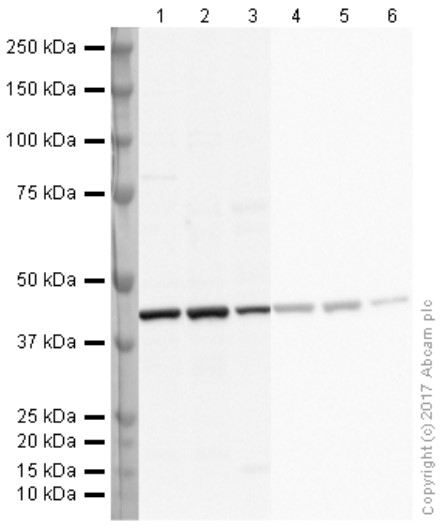
- 5
- 104
Primary Antibodies
AB8898
Anti-Histone H3 (tri methyl K9) antibody - ChIP Grade
BOND RX™ Validated

- 5
- 92
Primary Antibodies
AB81299
Anti-gamma H2A.X (phospho S139) antibody [EP854(2)Y]
BOND RX™ Validated|20ul selling size|RabMAb|Recombinant

- 4
- 18
Reactivity data
製品の詳細
Patented technology
Our RabMAb® technology is a patented hybridoma-based technology for making rabbit monoclonal antibodies. For details on our patents, please refer to RabMAb® patents.
What are the advantages of a recombinant monoclonal antibody?
This product is a recombinant monoclonal antibody, which offers several advantages including:
- - High batch-to-batch consistency and reproducibility
- - Improved sensitivity and specificity
- - Long-term security of supply
- - Animal-free batch production
For more information, read more on recombinant antibodies.
出荷温度及び保存条件
製品の状態
精製方法
バッファー組成
出荷温度
短期保存期間
短期保存温度
長期保存温度
分注に関する情報
保管に関する情報
補足情報
This supplementary information is collated from multiple sources and compiled automatically.
Biological function summary
SCIN influences cellular processes like secretion motility and division. SCIN belongs to the gelsolin/villin family of actin-modulating proteins and often acts within a protein complex to disassemble actin filaments. It regulates exocytosis by modulating actin dynamics near the plasma membrane especially in cells such as chromaffin cells and platelets. Its ability to rearrange actin filaments is important for maintaining cellular homeostasis and responsive adaptation to environmental changes.
Pathways
SCIN is involved in the cytoskeletal signaling and calcium signaling pathways. It plays a role in actin filament dynamics and is related to other actin-binding proteins like gelsolin and cofilin through these pathways. SCIN interacts with phosphatidylinositol 45-bisphosphate (PIP2) and calcium ions which are important for its activity in cellular signaling networks. These pathways optimize how cells react to stimuli by altering their shape and function.
製品プロトコール
- Visit the General protocols
- Visit the Troubleshooting
ターゲットの情報
文献 (2)
Recent publications for all applications. Explore the full list and refine your search
Nutrients 14: PubMed35893911
2022
Applications
Unspecified application
Species
Unspecified reactive species
Oncology letters 16:3207-3214 PubMed30127916
2018
Applications
Unspecified application
Species
Unspecified reactive species
Abcam product promise
Please note: All products are 'FOR RESEARCH USE ONLY. NOT FOR USE IN DIAGNOSTIC OR THERAPEUTIC PROCEDURES'.
For licensing inquiries, please contact partnerships@abcam.com