Anti-Rubicon/Baron 抗体
Anti-Rubicon/Baron antibody
- KO Validated
- 詳細を見る
4
(6 Reviews)
|
(13 Publications)
Rabbit Polyclonal Rubicon/Baron antibody. Suitable for IP, WB and reacts with Human samples. Cited in 13 publications. Immunogen corresponding to Synthetic Peptide within Human RUBCN aa 900-1000.
別名を表示する
KIAA0226, RUBCN, Run domain Beclin-1-interacting and cysteine-rich domain-containing protein, Rubicon, Beclin-1 associated RUN domain containing protein, Baron
- IP
Unknown
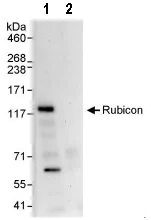
Immunoprecipitation - Anti-Rubicon/Baron antibody (AB92388)
Sample : HeLa whole cell lysate (1 mg for IP, 20% of IP loaded).
Antibodies : ab92388 used for WB 1 μg/ml (lane 1) and used for IP at 3 μg/mg lysate. Lane 2 : control IgG.
Detection : chemiluminescence with exposure time of 30 seconds.
All lanes:
Immunoprecipitation - Anti-Rubicon/Baron antibody (ab92388)
Predicted band size: 109 kDa
false
- WB
Lab
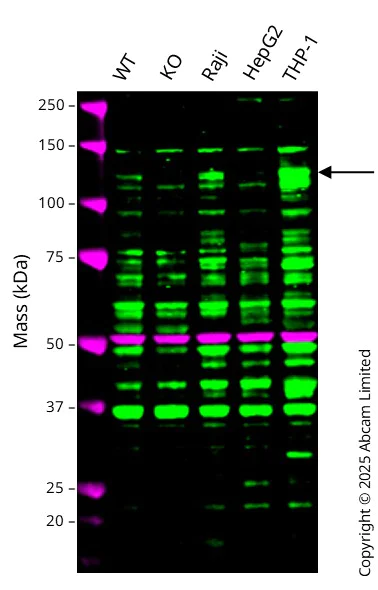
Western blot - Anti-Rubicon/Baron antibody (AB92388)
Western blot : Anti-Rubicon/Baron antibody ab92388 staining at 1/2000 dilution, shown in green; Mouse anti alpha Tubulin (ab7291) loading control staining at 1/20,000 dilution, shown in magenta. A band was observed at 130 kDa in Wild-type A549 cell lysates with no signal observed at this size in RUBCN knockout A549 cell line. To generate this image, samples were run on an SDS-PAGE gel then transferred onto a nitrocellulose membrane. Membranes were blocked in 3pc Milk in TBS-0.1 % Tween® 20 (TBS-T) before incubation with primary antibodies overnight at 4 °C. Blots were washed four times in TBS-T, incubated with secondary antibodies for 1 h at room temperature, washed again four times then imaged. Secondary antibodies used were Goat anti-Rabbit 800CW & Goat anti-Mouse 680RD at 1/20,000 dilution.
All lanes:
Western blot - Anti-Rubicon/Baron antibody (ab92388) at 1/2000 dilution
Lane 1:
Wild-type A549 at 20 µg
Lane 2:
RUBCN knockout A549 at 20 µg
Lane 3:
Raji at 20 µg
Lane 4:
HepG2 at 20 µg
Lane 5:
THP-1 at 20 µg
Secondary
Lanes 1 - 5:
Goat anti-Rabbit 800CW at 1/20000 dilution
Lanes 1 - 5:
Goat anti-Mouse 680RD at 1/20000 dilution
Predicted band size: 130 kDa
Observed band size: 130 kDa,51 kDa
false
- WB
Unknown
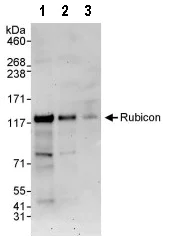
Western blot - Anti-Rubicon/Baron antibody (AB92388)
All lanes:
Western blot - Anti-Rubicon/Baron antibody (ab92388) at 0.4 µg/mL
Lane 1:
HeLa whole cell lysate at 50 µg
Lane 2:
HeLa whole cell lysate at 15 µg
Lane 3:
HeLa whole cell lysate at 5 µg
Predicted band size: 109 kDa
true
Exposure time: 3min
代替製品

組合せ製品
Primary Antibodies
AB207612
Anti-Beclin 1 antibody [EPR19662]
20ul selling size|KO Validated|RabMAb|Recombinant|Trial Size

- 5
- 10

Primary Antibodies
AB32503
BOND RX™ Validated|20ul selling size|RabMAb|Recombinant|KO Validated

- 4
- 12

Reactivity data
出荷温度及び保存条件
製品の状態
精製方法
バッファー組成
出荷温度
短期保存温度
長期保存温度
分注に関する情報
保管に関する情報
補足情報
This supplementary information is collated from multiple sources and compiled automatically.
Biological function summary
Rubicon plays a role as part of the Beclin1-PI3K complex inhibiting autophagic activity. This protein modulates the fusion of autophagosomes with lysosomes a critical step in degrading cellular components. By preventing excessive autophagy Rubicon helps maintain cellular equilibrium balancing degradation and synthesis processes. Its involvement in endo-lysosomal trafficking is essential for the management of cellular waste and nutrient recycling.
Pathways
Rubicon has an important role in the PI3K/AKT signaling and autophagy pathways. Through its interaction with proteins like Beclin1 and Rab7 Rubicon becomes a significant modulator of autophagic flux influencing cellular growth responses and survival. The protein's regulatory function in these pathways impacts how cells respond to stress and nutrient availability linking metabolic demands with appropriate cellular responses.
製品プロトコール
- Visit the General protocols
- Visit the Troubleshooting
ターゲットの情報
文献 (13)
Recent publications for all applications. Explore the full list and refine your search
Antioxidants (Basel, Switzerland) 10: PubMed34943057
2021
Applications
Unspecified application
Species
Unspecified reactive species
Therapeutic advances in respiratory disease 15:17534666211039769 PubMed34852704
2021
Applications
Unspecified application
Species
Unspecified reactive species
Autophagy 17:4323-4340 PubMed33977871
2021
Applications
Unspecified application
Species
Unspecified reactive species
Diabetes 70:562-576 PubMed33239448
2020
Applications
Unspecified application
Species
Unspecified reactive species
Autophagy 17:1714-1728 PubMed32543276
2020
Applications
Unspecified application
Species
Unspecified reactive species
Scientific reports 10:4570 PubMed32165681
2020
Applications
Unspecified application
Species
Unspecified reactive species
Frontiers in cellular and infection microbiology 8:403 PubMed30488027
2018
Applications
Unspecified application
Species
Unspecified reactive species
Autophagy 15:34-57 PubMed30081747
2018
Applications
Unspecified application
Species
Unspecified reactive species
Molecular cell 67:907-921.e7 PubMed28844862
2017
Applications
Unspecified application
Species
Unspecified reactive species
Journal of virology 91: PubMed28468885
2017
Applications
Unspecified application
Species
Unspecified reactive species
Abcam product promise
Please note: All products are 'FOR RESEARCH USE ONLY. NOT FOR USE IN DIAGNOSTIC OR THERAPEUTIC PROCEDURES'.
For licensing inquiries, please contact partnerships@abcam.com