Anti-Robo1 抗体
Anti-Robo1 antibody
3
(3 Reviews)
|
(6 Publications)
Rabbit Polyclonal ROBO1 antibody. Suitable for WB and reacts with Human, Mouse samples. Cited in 6 publications.
別名を表示する
DUTT1, ROBO1, Roundabout homolog 1, Deleted in U twenty twenty, H-Robo-1

- WB
Unknown
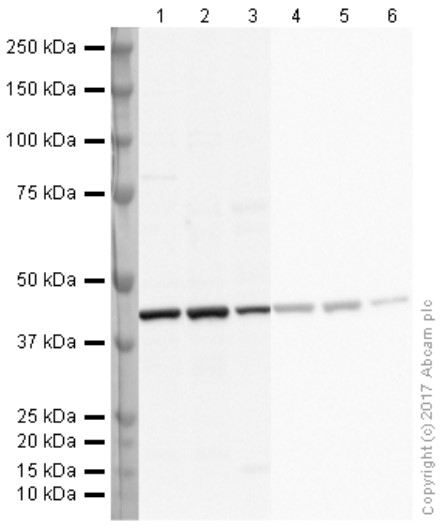
Western blot - Anti-Robo1 antibody (AB85312)
Human Roundabout homolog 1 precursor contains a number of potential glycosylation sites (SwissProt) which may explain its migration at a higher molecular weight than predicted.
All lanes:
Western blot - Anti-Robo1 antibody (ab85312) at 1 µg/mL
Lane 1:
Human brain tissue lysate - total protein (<a href='/products/unavailable/human-brain-tissue-lysate-total-protein-ab29466'>ab29466</a>) at 10 µg
Lane 2:
Brain (Mouse) Tissue Lysate at 10 µg
Secondary
All lanes:
Goat polyclonal to Rabbit IgG - H&L - Pre-Adsorbed (HRP) at 1/3000 dilution
Predicted band size: 181 kDa
Observed band size: 190 kDa
true
Exposure time: 20min
代替製品
Primary Antibodies
AB256791
Anti-Robo1 antibody [EPR23699-159]
RabMAb|Recombinant|20ul selling size

- 0
- 0

組合せ製品

Primary Antibodies
AB134166
RabMAb|Recombinant|20ul selling size|KO Validated

- 0
- 0
Primary Antibodies
AB18203
Anti-N Cadherin antibody - Intercellular Junction Marker
BOND RX™ Validated|Lab Essentials

- 4
- 48
Primary Antibodies
AB8227
Anti-beta Actin antibody - Loading Control
BOND RX™ Validated|Lab Essentials
- 5
- 104
Reactivity data
出荷温度及び保存条件
製品の状態
精製方法
バッファー組成
出荷温度
短期保存期間
短期保存温度
長期保存温度
分注に関する情報
保管に関する情報
補足情報
This supplementary information is collated from multiple sources and compiled automatically.
Biological function summary
Robo1 interacts with Slit proteins to control processes like repulsion of axonal growth cones during neuronal development. The protein acts as an important player in guiding neuronal connections and establishing boundaries. Robo1 does not function alone forming complexes with other receptors and cell adhesion molecules to execute its biological roles effectively. Structurally this receptor facilitates cellular responses to environmental cues through its cytoplasmic signaling cascade.
Pathways
Robo1 engages in the Slit-Robo signaling pathway essential for axonal guidance and cell migration. This pathway involves several key interactions with proteins such as DCC (Deleted in Colorectal Carcinoma) and Netrin impacting neuronal positioning and differentiation. Additionally Robo1 influences cellular orientation and tissue architecture by participating in the actin cytoskeleton remodeling pathway further demonstrating its significance in neuronal patterning.
製品プロトコール
- Visit the General protocols
- Visit the Troubleshooting
ターゲットの情報
文献 (6)
Recent publications for all applications. Explore the full list and refine your search
Frontiers in neuroscience 13:701 PubMed31354412
2019
Applications
Unspecified application
Species
Unspecified reactive species
Breast cancer research : BCR 20:86 PubMed30075800
2018
Applications
Unspecified application
Species
Unspecified reactive species
Neuropsychopharmacology : official publication of the American College of Neuropsychopharmacology 43:900-911 PubMed29154364
2017
Applications
Unspecified application
Species
Unspecified reactive species
Journal of cell science 130:2459-2467 PubMed28596239
2017
Applications
Unspecified application
Species
Unspecified reactive species
Scientific reports 5:16833 PubMed26582347
2015
Applications
Unspecified application
Species
Unspecified reactive species
Nature neuroscience 18:36-45 PubMed25485759
2014
Applications
Unspecified application
Species
Unspecified reactive species
Abcam product promise
Please note: All products are 'FOR RESEARCH USE ONLY. NOT FOR USE IN DIAGNOSTIC OR THERAPEUTIC PROCEDURES'.
For licensing inquiries, please contact partnerships@abcam.com