Anti-Ref2P 抗体
Anti-Ref2P antibody
4
(5 Reviews)
|
(75 Publications)
Anti-Ref2P antibody (ab178440) is a rabbit polyclonal antibody detecting Ref2P in Western Blot. Suitable for Drosophila melanogaster.
- Over 40 publications
別名を表示する
CG10360, ref(2)P, Protein ref(2)P, Refractory to sigma P
- WB
Collaborator
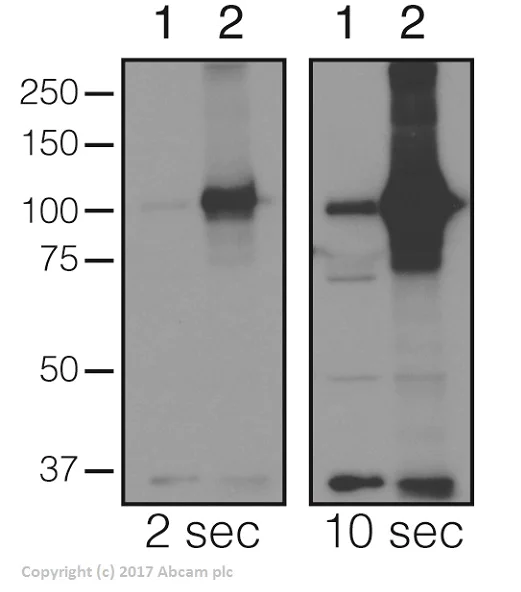
Western blot - Anti-Ref2P antibody (AB178440)
Gel 8% acrylamide, transferred onto PVDF membrane for 60 minutes at 100V in 10% ethanol buffer. Anti-Ref2P antibody 1 : 500 incubated overnight at 4°C, with gentle agitation in TBS + 0.1% Tween-20.
The genotype of the Atg8a mutant flies used is : Atg8aKG07569
All lanes:
Western blot - Anti-Ref2P antibody (ab178440) at 1/500 dilution
Lane 1:
Wt adult drosophila lysate at 20 µg
Lane 2:
Atg8a mutant adult drosophila lysate at 20 µg
Secondary
All lanes:
Anti-rabbit HRP at 1/10000 dilution
Predicted band size: 65 kDa
Observed band size: 100 kDa
false
Exposure time: 2s
This image is courtesy of Dr Anne-Claire Jacomin / Ioannis Nezis Lab, University of Warwick
- WB
Collaborator
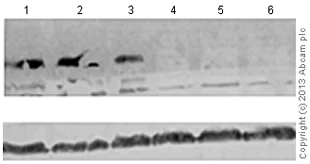
Western blot - Anti-Ref2P antibody (AB178440)
The bands observed at the bottom of the gel represent Tubulin and were used as a loading control within this experiment.
All lanes:
Western blot - Anti-Ref2P antibody (ab178440) at 1/100 dilution
Lanes 1 - 3:
Atg8a mutant fruit flies (D.melanogaster)
Lanes 4 - 6:
Fruit flies (D.melanogaster) expressing ubiquitously Ref(2)p RNAi
Predicted band size: 65 kDa
Observed band size: 92 kDa
false
組合せ製品
Primary Antibodies
AB109364
Anti-GABARAP+GABARAPL1+GABARAPL2 antibody [EPR4805]
RabMAb|Recombinant|20ul selling size
- 4
- 12
Primary Antibodies
AB183734
RabMAb|Recombinant|Lab Essentials|20ul selling size
- 5
- 24

Reactivity data
製品の詳細
Anti-Ref2P antibody (ab178440) is a rabbit polyclonal antibody and is validated for use in Western Blot (WB) in Drosophila melanogaster samples.
What is the molecular weight of Ref2P?
Anti-Ref2P (ab178440) specifically detects a band for Ref2P (UniProt: P14199) at a molecular weight of 65kDa.
Trusted by the scientific community
Anti-Ref2P (ab178440) was first used in a scientific publication in 2013 and has been cited over 40 times in peer-reviewed journals.
Reviewed by scientists
Anti-Ref2P (ab178440) has over 5 independent reviews from customers.
出荷温度及び保存条件
製品の状態
精製方法
バッファー組成
出荷温度
短期保存期間
短期保存温度
長期保存温度
分注に関する情報
保管に関する情報
補足情報
This supplementary information is collated from multiple sources and compiled automatically.
Biological function summary
This protein assists in maintaining cellular homeostasis by targeting damaged or unnecessary proteins for degradation. Ref(2)P serves as the fly homolog of the mammalian p62/SQSTM1 and is recognized as an adaptor protein within the autophagic machinery. It binds ubiquitinated proteins and interacts with LC3 a core component of the autophagosome aiding in the clearance of protein aggregates. This process is essential for protecting cells especially those under stress conditions.
Pathways
Ref(2)P integrates into the autophagy-lysosome pathway which is important for cellular recycling processes. It collaborates with key proteins like Atg1 and Atg8. Additionally the protein impacts the TOR signaling pathway. In a nutrient-rich environment TOR can inhibit autophagy while Ref(2)P acts in response to cellular stress promoting autophagy and improving metabolic homeostasis.
製品プロトコール
- Visit the General protocols
- Visit the Troubleshooting
ターゲットの情報
文献 (75)
Recent publications for all applications. Explore the full list and refine your search
PLoS genetics 21:e1011818 PubMed40825051
2025
Applications
Unspecified application
Species
Unspecified reactive species
Disease models & mechanisms 18: PubMed40747773
2025
Applications
Unspecified application
Species
Unspecified reactive species
Autophagy reports 4:2519102 PubMed40607262
2025
Applications
Unspecified application
Species
Unspecified reactive species
Nature communications 16:4909 PubMed40425608
2025
Applications
Unspecified application
Species
Unspecified reactive species
Autophagy reports 4:2471121 PubMed40395995
2025
Applications
Unspecified application
Species
Unspecified reactive species
The Journal of cell biology 224: PubMed40067150
2025
Applications
Unspecified application
Species
Unspecified reactive species
Pharmaceutical biology 63:68-81 PubMed39862058
2025
Applications
Unspecified application
Species
Unspecified reactive species
Communications biology 8:105 PubMed39838082
2025
Applications
Unspecified application
Species
Unspecified reactive species
PLoS genetics 20:e1011475 PubMed39561115
2024
Applications
Unspecified application
Species
Unspecified reactive species
Methods in molecular biology (Clifton, N.J.) 2879:23-32 PubMed39120738
2024
Applications
Unspecified application
Species
Unspecified reactive species
Abcam product promise
Please note: All products are 'FOR RESEARCH USE ONLY. NOT FOR USE IN DIAGNOSTIC OR THERAPEUTIC PROCEDURES'.
For licensing inquiries, please contact partnerships@abcam.com