Anti-PU.1/Spi1 抗体 [EPR3158Y]
Anti-PU.1/Spi1 antibody [EPR3158Y]
- BOND RX™ Validated
- RabMAb
- Recombinant
- 20ul selling size
- 詳細を見る
5
(4 Reviews)
|
(21 Publications)
Anti-PU.1/Spi1 antibody [EPR3158Y] (ab76543) is a rabbit monoclonal antibody detecting PU.1/Spi1 in Western Blot, IHC-P. Suitable for Human.
- Biophysical QC for unrivalled batch-batch consistency
- Over 10 publications
- Trusted since 2009
別名を表示する
Transcription factor PU.1, 31 kDa-transforming protein, SPI1
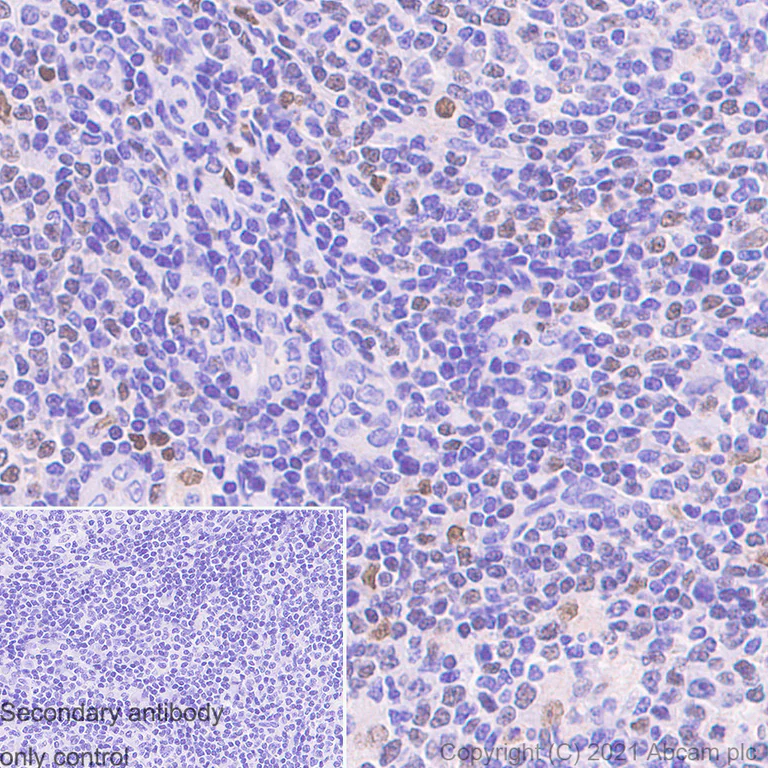
- IHC-P
Supplier Data
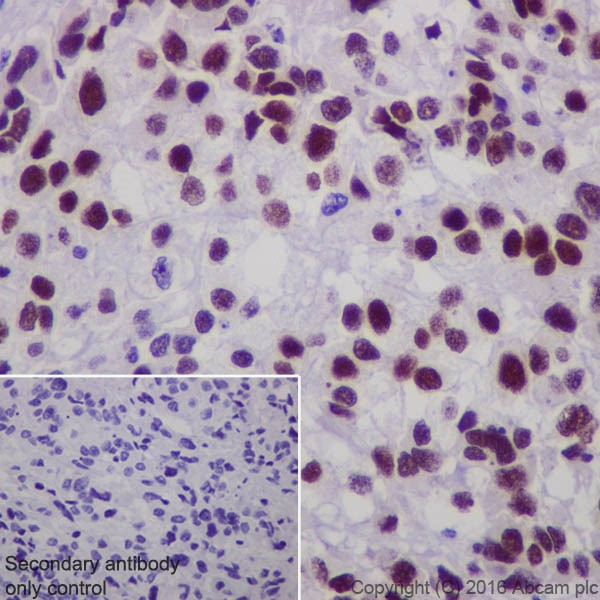
Immunohistochemistry (Formalin/PFA-fixed paraffin-embedded sections) - Anti-PU.1/Spi1 antibody [EPR3158Y] (AB76543)
Immunohistochemistry (Formalin/PFA-fixed paraffin-embedded sections) analysis of human tonsil tissue sections labeling PU.1/Spi1 with Purified ab76543 at 1 : 3000 dilution (0.035 µg/ml). Heat mediated antigen retrieval was performed using Heat mediated antigen retrieval using Bond™ Epitope Retrieval Solution 2 (pH 9.0) . Tissue was counterstained with Hematoxylin. Rabbit specific IHC polymer detection kit HRP/DAB (ab209101) secondary antibody was used. PBS instead of the primary antibody was used as the negative control.
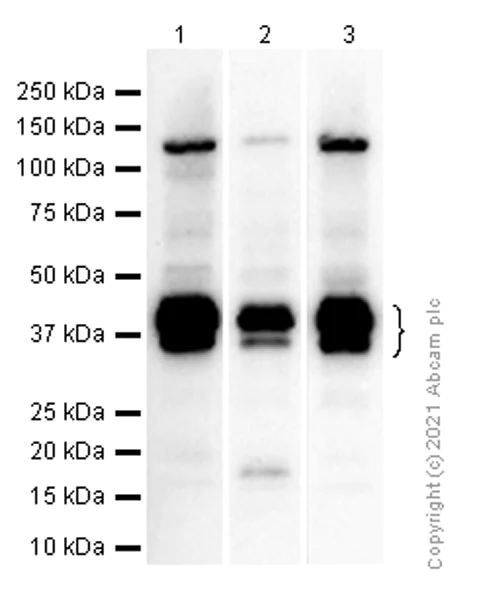
- WB
Unknown
Western blot - Anti-PU.1/Spi1 antibody [EPR3158Y] (AB76543)
PU.1 is a 37-42 kDa member of the ets family of transcription factors. The molecule weight observed is consistent with what has been described in the literature (PMID : 28362429, 31586032, 28586009).
All lanes:
Western blot - Anti-PU.1/Spi1 antibody [EPR3158Y] (ab76543) at 1/1000 dilution
Lane 1:
Daudi (Human Burkitt's lymphoma lymphoblast) whole cell lysate at 20 µg
Lane 2:
THP-1 (Human monocytic leukemia monocyte) whole cell lysate at 20 µg
Lane 3:
Raji (Human Burkitt's lymphoma B lymphocyte) whole cell lysate at 20 µg
Secondary
All lanes:
Western blot - Goat Anti-Rabbit IgG H&L (HRP) (<a href='/products/secondary-antibodies/goat-rabbit-igg-h-l-hrp-ab97051'>ab97051</a>) at 1/20000 dilution
Predicted band size: 31 kDa
Observed band size: 37-42 kDa
false
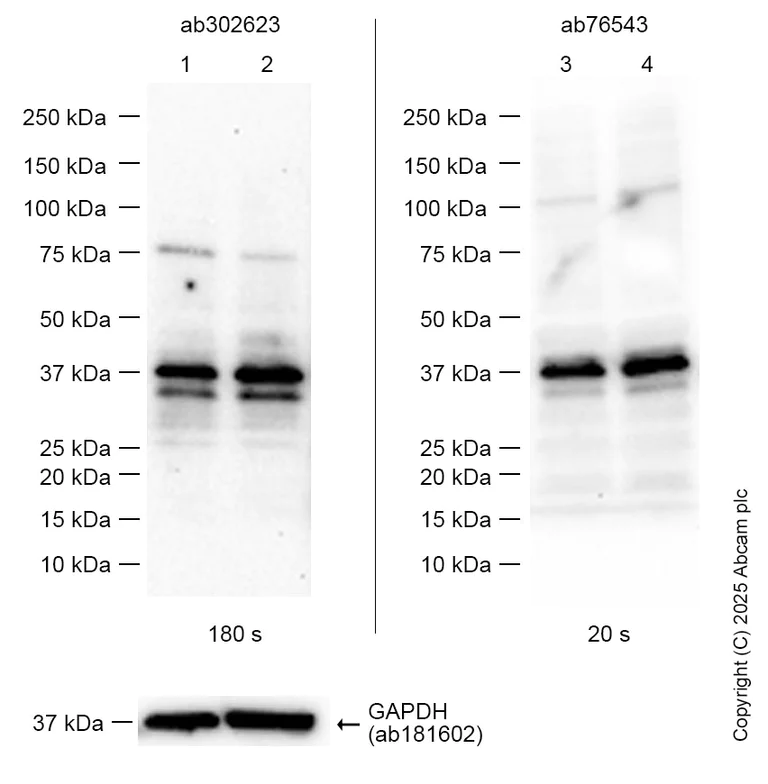
- WB
Lab
Western blot - Anti-PU.1/Spi1 antibody [EPR3158Y] (AB76543)
Exposure time : Lane 1-2 : 180 seconds; Lane 3-4 : 20 seconds
In Western blot, Anti-GAPDH antibody [EPR16891] - Loading Control (ab181602) staining at 1/1000000 dilution.
ab76543 is more sensitive than ab302623 in WB testing.
Lanes 1 - 2:
Western blot - Anti-PU.1/Spi1 antibody [EPR25123-110] (<a href='/products/primary-antibodies/pu1-spi1-antibody-epr25123-110-ab302623'>ab302623</a>) at 1/1000 dilution
Lanes 1 - 4:
Western blot - Anti-PU.1/Spi1 antibody [EPR25123-110] (BSA and Azide free) (<a href='/products/primary-antibodies/pu1-spi1-antibody-epr25123-110-bsa-and-azide-free-ab302624'>ab302624</a>) at 1/1000 dilution
Lanes 3 - 4:
Western blot - Anti-PU.1/Spi1 antibody [EPR3158Y] (ab76543) at 1/1000 dilution
Lanes 1 and 3:
Daudi whole cell lysate at 20 µg
Lanes 2 and 4:
Raji whole cell lysate at 20 µg
Secondary
All lanes:
Western blot - Goat Anti-Rabbit IgG H&L (HRP) (<a href='/products/secondary-antibodies/goat-rabbit-igg-h-l-hrp-ab97051'>ab97051</a>) at 1/20000 dilution
Predicted band size: 31 kDa
Observed band size: 37-42 kDa
false
関連する標識済み抗体及び組成の異なる製品 (2)
-
Anti-PU.1/Spi1 antibody [EPR3158Y] - BSA and Azide free
-
665 Alexa Fluor® 647
Alexa Fluor® 647 Anti-PU.1/Spi1 antibody [EPR3158Y]
代替製品
Primary Antibodies
AB264473
Anti-PU.1/Spi1 antibody [EPR22624-20] - ChIP Grade - BSA and Azide free
BOND RX™ Validated|RabMAb|Recombinant

- 0
- 0
Primary Antibodies
AB227835
Anti-PU.1/Spi1 antibody [EPR22624-20] - ChIP Grade
BOND RX™ Validated|RabMAb|Recombinant|20ul selling size
- 0
- 0
Primary Antibodies
AB271940
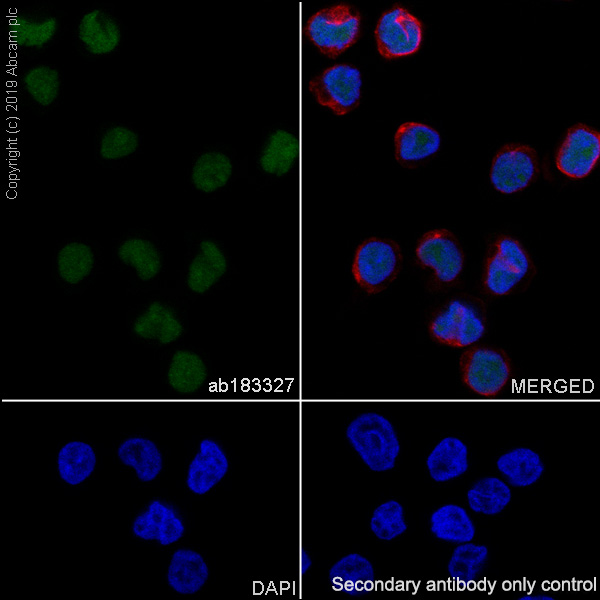
Anti-PU.1/Spi1 antibody [SP238] - BSA and Azide free
Recombinant|Advanced Validation|RabMAb
- 0
- 0

Primary Antibodies
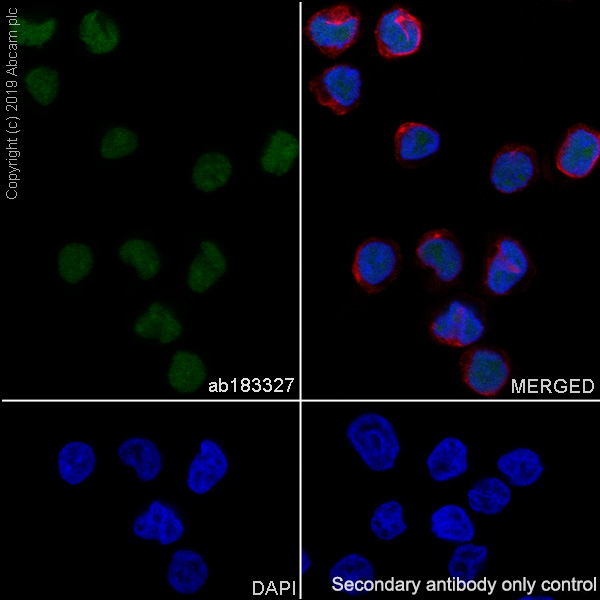
AB183327
Anti-PU.1/Spi1 antibody [SP238]
20ul selling size|Recombinant|Advanced Validation|RabMAb
- 0
- 0
組合せ製品
Primary Antibodies
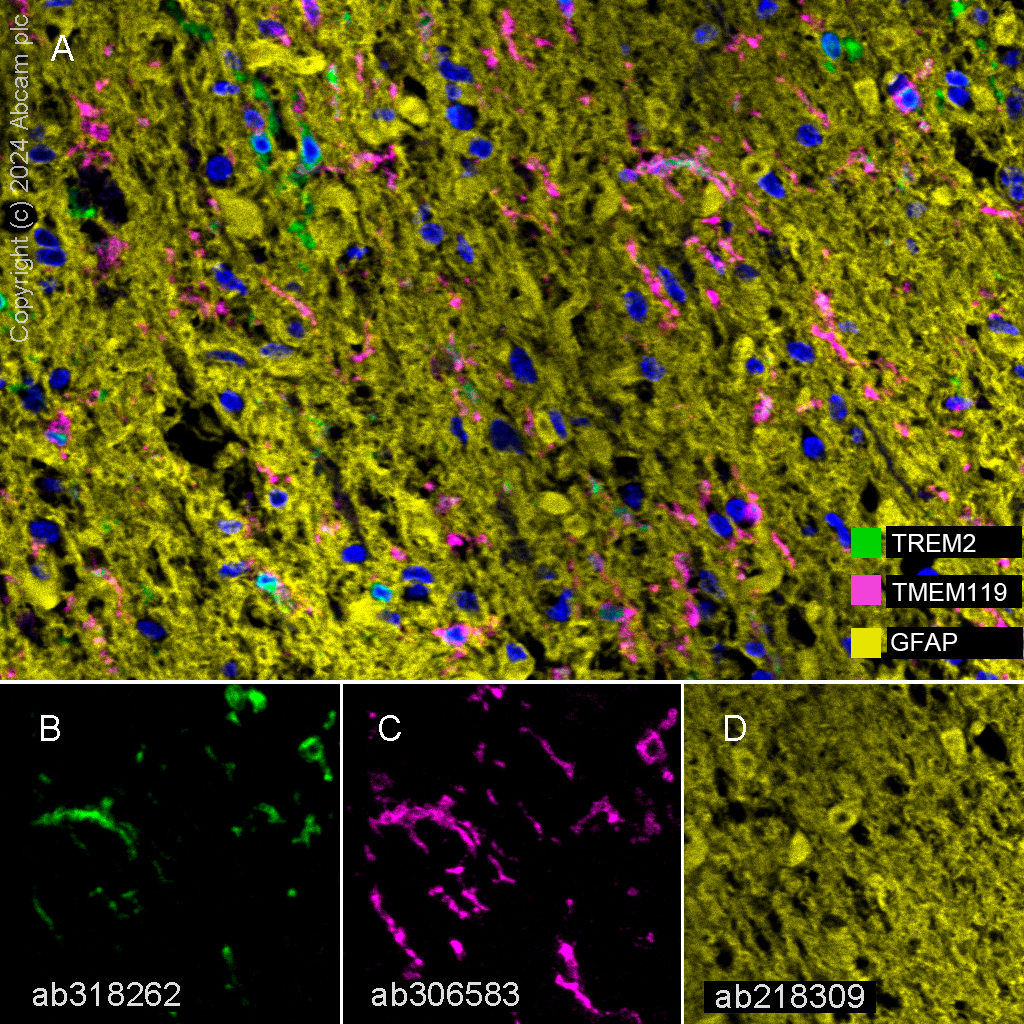
AB306583
Anti-TMEM119 antibody [EPR25865-89] - Microglial marker
BOND RX™ Validated|20ul selling size|Recombinant|Advanced Validation|RabMAb|Trial Size
- 0
- 0
Primary Antibodies
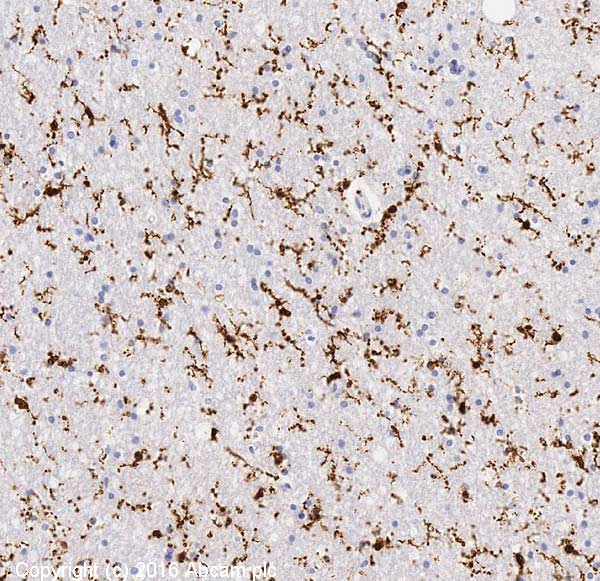
AB178846
Anti-Iba1 antibody [EPR16588] - Microglia marker
20ul selling size|BOND RX™ Validated|RabMAb|Recombinant|Lab Essentials
- 5
- 50
Primary Antibodies
AB217317
Anti-Steroidogenic Factor 1/SF-1 antibody [EPR19744]
20ul selling size|RabMAb|Recombinant|Advanced Validation
- 0
- 0
Reactivity data
製品の詳細
What is this antibody validated in?
Anti-PU.1/Spi1 antibody [EPR3158Y] (ab76543) is a rabbit recombinant monoclonal antibody and is validated for use in Western Blot (WB), Immunohistochemistry (IHC-P) in Human samples.
What is the molecular weight of PU.1/Spi1?
Anti-PU.1/Spi1 [EPR3158Y] (ab76543) specifically detects a band for PU.1/Spi1 (UniProt: P17947) at a molecular weight of 31kDa.
Trusted by the scientific community
Anti-PU.1/Spi1 [EPR3158Y] (ab76543) was first used in a scientific publication in 2009 and has been cited over 10 times in peer-reviewed journals.
Other related products
We have a range of other formats of antibody clone [EPR3158Y] also available for your convenience: ab76543, Alexa Fluor® 647 - ab225040, Carrier free - ab232383
Patented technology
Our RabMAb® technology is a patented hybridoma-based technology for making rabbit monoclonal antibodies. For details on our patents, please refer to RabMAb® patents.
What are the advantages of a recombinant monoclonal antibody?
This product is a recombinant monoclonal antibody, which offers several advantages including:
- - High batch-to-batch consistency and reproducibility
- - Improved sensitivity and specificity
- - Long-term security of supply
- - Animal-free batch production
For more information, read more on recombinant antibodies.
Trial sizes available!
Test your antibody or perform pre-screening before committing to a larger quantity. Sold in 20µl. Discover our selection of trial-size antibodies.
出荷温度及び保存条件
製品の状態
精製方法
バッファー組成
出荷温度
短期保存温度
長期保存温度
保管に関する情報
補足情報
This supplementary information is collated from multiple sources and compiled automatically.
Biological function summary
PU.1 influences the development and function of various blood cells including macrophages neutrophils and B-cells. It is essential for the regulation of genes involved in immune responses cell proliferation and survival. PU.1 functions as part of a larger transcriptional regulatory complex and often partners with other transcription factors and coactivators to exert its effects. This cooperation allows precise gene expression control in specific cell lineages.
Pathways
Expression of PU.1 is critical in the hematopoietic development pathway and the immune response pathway. It closely interacts with other transcription factors like GATA-1 and C/EBPα forming a network that affects hematopoietic lineage commitment. Within these pathways PU.1 constantly coordinates signals that influence progenitor cell fate and differentiation ensuring a balanced proportion of cell types within the blood.
製品プロトコール
- Visit the General protocols
- Visit the Troubleshooting
ターゲットの情報
文献 (21)
Recent publications for all applications. Explore the full list and refine your search
International journal of molecular sciences 25: PubMed39684718
2024
Applications
Unspecified application
Species
Unspecified reactive species
American journal of cancer research 14:1139-1156 PubMed38590399
2024
Applications
Unspecified application
Species
Unspecified reactive species
Journal of virology 98:e0170223 PubMed38078733
2023
Applications
Unspecified application
Species
Unspecified reactive species
Methods in molecular biology (Clifton, N.J.) 2683:53-68 PubMed37300766
2023
Applications
Unspecified application
Species
Unspecified reactive species
JCI insight 7: PubMed35608913
2022
Applications
Unspecified application
Species
Unspecified reactive species
Journal of virology 96:e0065222 PubMed35766490
2022
Applications
Unspecified application
Species
Unspecified reactive species
Aging 14:5390-5405 PubMed35771155
2022
Applications
Unspecified application
Species
Unspecified reactive species
Cells 11: PubMed35741044
2022
Applications
Unspecified application
Species
Unspecified reactive species
Frontiers in oncology 12:820568 PubMed35237521
2022
Applications
Unspecified application
Species
Unspecified reactive species
Cells 10: PubMed34831433
2021
Applications
Unspecified application
Species
Unspecified reactive species
Abcam product promise
Please note: All products are 'FOR RESEARCH USE ONLY. NOT FOR USE IN DIAGNOSTIC OR THERAPEUTIC PROCEDURES'.
For licensing inquiries, please contact partnerships@abcam.com