JavaScript is disabled in your browser. Please enable JavaScript to view this website.
AB224424

Anti-PPM1K 抗体

Anti-PPM1K antibody

Be the first to review this product! Submit a review

|

(2 Publications)

Rabbit Polyclonal PPM1K antibody. Suitable for ICC/IF and reacts with Human samples. Cited in 2 publications. Immunogen corresponding to Recombinant Fragment Protein within Human PPM1K aa 250-400.

別名を表示する

PP2CM, PPM1K, Protein phosphatase Mn(2+)-dependent 1K, Branched-chain alpha-ketoacid dehydrogenase phosphatase, PP2C domain-containing protein phosphatase 1K, PP2C-like mitochondrial protein, PP2C-type mitochondrial phosphoprotein phosphatase, Protein phosphatase 2C family member, Protein phosphatase 2C isoform kappa, BCKDH, BDP, PTMP, PP2C-kappa

1 Images
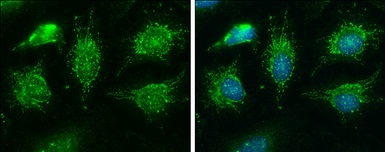
Immunocytochemistry/ Immunofluorescence - Anti-PPM1K antibody (AB224424)
  • ICC/IF

Supplier Data

Immunocytochemistry/ Immunofluorescence - Anti-PPM1K antibody (AB224424)

PFA-fixed, Triton X-100 permeabilized U-2 OS (human bone osteosarcoma epithelial cell line) cells stained for PPM1K (green) using ab224424 at 4 μg/ml in ICC/IF.

Key facts

宿主種

Rabbit

クローン性

Polyclonal

アイソタイプ

IgG

キャリアフリー

No

交差種

Human

アプリケーション

ICC/IF

applications

免疫原

Recombinant Fragment Protein within Human PPM1K aa 250-400. The exact immunogen used to generate this antibody is proprietary information.

Q8N3J5

Reactivity data

{ "title": "Reactivity Data", "filters": { "stats": ["", "Species", "Dilution Info", "Notes"], "tabs": { "all-applications": {"fullname" : "All Applications", "shortname": "All Applications"}, "ICCIF" : {"fullname" : "Immunocytochemistry/ Immunofluorescence", "shortname":"ICC/IF"} }, "product-promise": { "all": "all", "testedAndGuaranteed": "tested", "guaranteed": "expected", "predicted": "predicted", "notRecommended": "not-recommended" } }, "values": { "Human": { "ICCIF-species-checked": "testedAndGuaranteed", "ICCIF-species-dilution-info": "0.25-2 µg/mL", "ICCIF-species-notes": "<p>Fixation/Permeabilization: PFA/Triton X-100.</p>" }, "Mouse": { "ICCIF-species-checked": "predicted", "ICCIF-species-dilution-info": "", "ICCIF-species-notes": "" }, "Cow": { "ICCIF-species-checked": "predicted", "ICCIF-species-dilution-info": "", "ICCIF-species-notes": "" } } }

出荷温度及び保存条件

製品の状態
Liquid
精製方法
Affinity purification Immunogen
バッファー組成
pH: 7.2 Preservative: 0.02% Sodium azide Constituents: PBS, 40% Glycerol (glycerin, glycerine)
出荷温度
Blue Ice
短期保存期間
1-2 weeks
短期保存温度
+4°C
長期保存温度
-20°C
分注に関する情報
Upon delivery aliquot
保管に関する情報
Avoid freeze / thaw cycle

補足情報

This supplementary information is collated from multiple sources and compiled automatically.

PPM1K also known as Protein Phosphatase Mg2+/Mn2+ Dependent 1K is a mitochondrial phosphatase with a molecular weight of approximately 42 kDa. It is expressed in a variety of tissues with notable expression in the liver and skeletal muscle. PPM1K plays a critical role in regulating various cellular processes through the dephosphorylation of specific substrates involved in metabolic pathways.
Biological function summary

PPM1K influences mitochondrial function and energy metabolism by modulating branch-chained amino acid (BCAA) catabolism. It forms part of a metabolically linked complex that regulates the enzymatic activity essential for breaking down BCAAs into vital intermediates for energy production. The modulatory effect of PPM1K on these pathways highlights its importance in maintaining cellular energy balance and metabolic homeostasis.

Pathways

PPM1K contributes significantly to the regulation of the branched-chain alpha-keto acid dehydrogenase (BCKDH) complex which is important in the catabolic pathway of BCAAs. By dephosphorylating and activating BCKDH PPM1K facilitates the breakdown of leucine isoleucine and valine. PPM1K’s interaction with components of the BCKDH complex links it to broader metabolic processes and connects it functionally to other enzymes responsible for maintaining amino acid homeostasis.

PPM1K has connections to disorders related to energy imbalance and mitochondrial dysfunctions such as Maple Syrup Urine Disease (MSUD) and diabetes. Deficiencies or mutations in the PPM1K gene influence the stability and function of the BCKDH complex leading to impaired BCAA catabolism. This impairment results in the accumulation of toxic metabolites contributing to the pathophysiology of MSUD. PPM1K’s regulation of BCKDH activity also indirectly connects it to enzymes involved in gluconeogenesis and energy production highlighting its broad relevance in metabolic disorders.

製品プロトコール

For this product, it's our understanding that no specific protocols are required. You can visit:

ターゲットの情報

Serine/threonine-protein phosphatase component of macronutrients metabolism. Forms a functional kinase and phosphatase pair with BCKDK, serving as a metabolic regulatory node that coordinates branched-chain amino acids (BCAAs) with glucose and lipid metabolism via two distinct phosphoprotein targets : mitochondrial BCKDHA subunit of the branched-chain alpha-ketoacid dehydrogenase (BCKDH) complex and cytosolic ACLY, a lipogenic enzyme of Krebs cycle (PubMed : 17336929, PubMed : 17374715, PubMed : 19411760, PubMed : 22291014, PubMed : 22589535, PubMed : 23086801, PubMed : 29779826). At high levels of branched-chain ketoacids, dephosphorylates and activates mitochondrial BCKDH complex, a multisubunit complex consisting of three multimeric components each involved in different steps of BCAA catabolism : E1 composed of BCKDHA and BCKDHB, E2 core composed of DBT monomers, and E3 composed of DLD monomers. Tightly associates with the E2 component of BCKDH complex and dephosphorylates BCKDHA on Ser-337 (PubMed : 17336929, PubMed : 17374715, PubMed : 19411760, PubMed : 22291014, PubMed : 22589535, PubMed : 23086801, PubMed : 29779826). Regulates the reversible phosphorylation of ACLY in response to changes in cellular carbohydrate abundance such as occurs during fasting to feeding metabolic transition. At fasting state, appears to dephosphorylate ACLY on Ser-455 and inactivate it. Refeeding stimulates MLXIPL/ChREBP transcription factor, leading to increased BCKDK to PPM1K expression ratio, phosphorylation and activation of ACLY that ultimately results in the generation of malonyl-CoA and oxaloacetate immediate substrates of de novo lipogenesis and gluconeogenesis, respectively (PubMed : 29779826). Recognizes phosphosites having SxS or RxxS motifs and strictly depends on Mn(2+) ions for the phosphatase activity (PubMed : 29779826). Regulates Ca(2+)-induced opening of mitochondrial transition pore and apoptotic cell death (PubMed : 17374715).
See full target information PPM1K

文献 (2)

Recent publications for all applications. Explore the full list and refine your search

Experimental physiology 108:961-974 PubMed37139700

2023

High doses of rosuvastatin induce impaired branched-chain amino acid catabolism and lead to insulin resistance.

Applications

Unspecified application

Species

Unspecified reactive species

Xue Bai,Xingzhen Long,Fang Song,Baolin Chen,Changcheng Sheng,Cailin Tang,Li Li,Jiaxing Zhang,Rui Zhang,Jiquan Zhang,Jiali Li

Gastroenterology 159:1019-1035.e22 PubMed32446697

2020

Protein Kinase D1, Reduced in Human Pancreatic Tumors, Increases Secretion of Small Extracellular Vesicles From Cancer Cells That Promote Metastasis to Lung in Mice.

Applications

Unspecified application

Species

Unspecified reactive species

Milena Armacki,Sandra Polaschek,Mareike Waldenmaier,Mareen Morawe,Claudia Ruhland,Rebecca Schmid,André Lechel,Umesh Tharehalli,Christoph Steup,Yasin Bektas,Hongxia Li,Johann M Kraus,Hans A Kestler,Stephan Kruger,Steffen Ormanns,Paul Walther,Tim Eiseler,Thomas Seufferlein
View all publications

Abcam product promise

当社は、高品質な試薬を通じてお客様の研究を力強くサポートすることをお約束いたします。ご使用いただく各段階で、常にお客様をサポートできる体制を整えております。万が一、製品が期待通りに機能しない場合は、「Abcam Product Promise」による当社保証制度に基づき、安心してご利用いただけます。
保証に関する詳細については利用規約をご確認ください。

Please note: All products are 'FOR RESEARCH USE ONLY. NOT FOR USE IN DIAGNOSTIC OR THERAPEUTIC PROCEDURES'.

For licensing inquiries, please contact partnerships@abcam.com