JavaScript is disabled in your browser. Please enable JavaScript to view this website.
AB70804

Anti-PPM1B 抗体

Anti-PPM1B antibody

4

(1 Review)

|

(7 Publications)

Rabbit Polyclonal PPM1B antibody. Suitable for IP, WB and reacts with Human samples. Cited in 7 publications. Immunogen corresponding to Synthetic Peptide within Human PPM1B aa 450-500.

別名を表示する

PP2CB, PPM1B, Protein phosphatase 1B, Protein phosphatase 2C isoform beta, PP2C-beta
2 Images
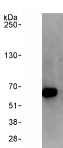
Immunoprecipitation - Anti-PPM1B antibody (AB70804)
  • IP

Unknown

Immunoprecipitation - Anti-PPM1B antibody (AB70804)

Detection of PPM1B by Western Blot of Immunoprecipitate.
1mg whole cell lysate from HeLa cells was immunoprecipitated using ab70804 at 3ug/mg of lysate. for the subsequent western blot, 20% of the immunoprecipitate was probed with ab70804 at 1ug/ml.
Detection : chemiluminescence with exposure time of 10 seconds.

All lanes:

Immunoprecipitation - Anti-PPM1B antibody (ab70804)

Predicted band size: 52 kDa

false
Western blot - Anti-PPM1B antibody (AB70804)
  • WB

Supplier Data

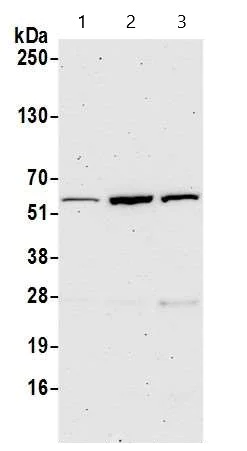
Western blot - Anti-PPM1B antibody (AB70804)

All lanes:

Western blot - Anti-PPM1B antibody (ab70804) at 0.04 µg/mL

Lane 1:

Jurkat (human T cell leukemia cell line from peripheral blood) whole cell lysate at 50 µg

Lane 2:

A549 (human lung carcinoma cell line) whole cell lysate at 50 µg

Lane 3:

HEK-293T (human epithelial cell line from embryonic kidney transformed with large T antigen) whole cell lysate at 50 µg

Predicted band size: 52 kDa

false

Exposure time: 75s

Key facts

宿主種

Rabbit

クローン性

Polyclonal

アイソタイプ

IgG

キャリアフリー

No

交差種

Human

アプリケーション

IP, WB

applications

免疫原

Synthetic Peptide within Human PPM1B aa 450-500. The exact immunogen used to generate this antibody is proprietary information.

O75688

Reactivity data

{ "title": "Reactivity Data", "filters": { "stats": ["", "Species", "Dilution Info", "Notes"], "tabs": { "all-applications": {"fullname" : "All Applications", "shortname": "All Applications"}, "IP" : {"fullname" : "Immunoprecipitation", "shortname":"IP"}, "WB" : {"fullname" : "Western blot", "shortname":"WB"} }, "product-promise": { "all": "all", "testedAndGuaranteed": "tested", "guaranteed": "expected", "predicted": "predicted", "notRecommended": "not-recommended" } }, "values": { "Human": { "IP-species-checked": "testedAndGuaranteed", "IP-species-dilution-info": "2-5 µg/mg of lysate", "IP-species-notes": "<p></p>", "WB-species-checked": "testedAndGuaranteed", "WB-species-dilution-info": "1/2000 - 1/10000", "WB-species-notes": "<p></p>" } } }

出荷温度及び保存条件

製品の状態
Liquid
精製方法
Affinity purification Immunogen
バッファー組成
pH: 6.8 - 7.4 Preservative: 0.09% Sodium azide Constituents: Tris buffered saline, 0.1% BSA
出荷温度
Blue Ice
短期保存温度
+4°C
長期保存温度
+4°C
分注に関する情報
Upon delivery aliquot
保管に関する情報
Avoid freeze / thaw cycle

補足情報

This supplementary information is collated from multiple sources and compiled automatically.

PPM1B also known as protein phosphatase 1B is a serine/threonine phosphatase with a molecular mass of approximately 55 kDa. This protein plays an important role in dephosphorylating serine/threonine residues on its target proteins adjusting their functional states. PPM1B is widely expressed in various tissues throughout the body including the heart skeletal muscle and liver. Its activity helps in modulating different signaling pathways by reversing the phosphorylation status of target proteins.
Biological function summary

PPM1B influences diverse cellular processes such as cell cycle regulation and stress response. It is not part of a large complex but interacts with specific substrates to exert its effects. PPM1B can impact apoptosis and cell differentiation through its action on certain substrates. Its regulatory function is important for maintaining cellular homeostasis and adaptation to environmental changes.

Pathways

Multiple signaling cascades demonstrate the involvement of PPM1B. It plays a significant role in the regulation of the p38 MAPK pathway which is important for stress response and inflammatory processes. In this pathway PPM1B interacts with MAPKAPK2 modulating its activity. PPM1B also participates in the TGF-beta signaling pathway where it can affect the phosphorylation status of SMADs. These interactions emphasize PPM1B's regulatory importance in response to extracellular signals.

Alterations in PPM1B activity are linked to cardiovascular and inflammatory conditions. For example changes in its function can contribute to the pathogenesis of hypertension through its effect on the TGF-beta pathway and related proteins like SMAD2. In inflammatory diseases the role of PPM1B in the p38 MAPK pathway shows its connection to proteins such as MAPKAP2 highlighting its potential involvement in inflammatory responses. These connections demonstrate the therapeutic interest in targeting PPM1B for disease treatment and management.

製品プロトコール

For this product, it's our understanding that no specific protocols are required. You can visit:

ターゲットの情報

Enzyme with a broad specificity. Dephosphorylates CDK2 and CDK6 in vitro. Dephosphorylates PRKAA1 and PRKAA2. Inhibits TBK1-mediated antiviral signaling by dephosphorylating it at 'Ser-172'. Plays an important role in the termination of TNF-mediated NF-kappa-B activation through dephosphorylating and inactivating IKBKB/IKKB.
See full target information PPM1B

文献 (7)

Recent publications for all applications. Explore the full list and refine your search

Cell death and differentiation 31:1085-1098 PubMed38783090

2024

MLKL promotes hepatocarcinogenesis through inhibition of AMPK-mediated autophagy.

Applications

Unspecified application

Species

Unspecified reactive species

Xianjun Yu,Mengyuan Feng,Jian Guo,Haoyu Wang,Jun Yu,Anjie Zhang,Jingyi Wu,Yamei Han,Zequn Sun,Yingying Liao,Qun Zhao

The Journal of biological chemistry 300:105695 PubMed38301894

2024

The BHLHE40‒PPM1F‒AMPK pathway regulates energy metabolism and is associated with the aggressiveness of endometrial cancer.

Applications

Unspecified application

Species

Unspecified reactive species

Kazuo Asanoma,Hiroshi Yagi,Ichiro Onoyama,Lin Cui,Emiko Hori,Minoru Kawakami,Shoji Maenohara,Kazuhisa Hachisuga,Hiroshi Tomonobe,Keisuke Kodama,Masafumi Yasunaga,Tatsuhiro Ohgami,Kaoru Okugawa,Hideaki Yahata,Hiroyuki Kitao,Kiyoko Kato

Cell biology international 48:143-153 PubMed37798941

2023

Overexpression of PPM1B inhibited chemoresistance to temozolomide and proliferation in glioma cells.

Applications

Unspecified application

Species

Unspecified reactive species

Yunhu Yu,Qian Liu,Qishan Ran,Fang Cao

Autophagy 17:3607-3621 PubMed33563064

2021

PRKAA/AMPKα phosphorylation switches the role of RASAL2 from a suppressor to an activator of autophagy.

Applications

Unspecified application

Species

Unspecified reactive species

Yong Bao,Christopher Qian,Meng-Yue Liu,Fei Jiang,Xiaoxiao Jiang,Huijuan Liu,Zhuqing Zhang,Fanghui Sun,Ningwei Fu,Zhaoyuan Hou,Ya Ke,Yan Li,Zhong-Ming Qian

Cancer discovery 10:460-475 PubMed31810986

2019

TBK1 Is a Synthetic Lethal Target in Cancer with Loss.

Applications

Unspecified application

Species

Unspecified reactive species

Lianxin Hu,Haibiao Xie,Xijuan Liu,Frances Potjewyd,Lindsey I James,Emily M Wilkerson,Laura E Herring,Ling Xie,Xian Chen,Johnny Castillo Cabrera,Kai Hong,Chengheng Liao,Xianming Tan,Albert S Baldwin,Kan Gong,Qing Zhang

Artificial cells, nanomedicine, and biotechnology 47:3004-3012 PubMed31322007

2019

TNF-α induces apoptosis of human nucleus pulposus cells via activating the TRIM14/NF-κB signalling pathway.

Applications

Unspecified application

Species

Unspecified reactive species

Hao Zhu,Bao Sun,Qiang Shen

Oncoimmunology 5:e1186314 PubMed27757297

2016

Novel non-canonical role of STAT1 in Natural Killer cell cytotoxicity.

Applications

Unspecified application

Species

Unspecified reactive species

Eva Maria Putz,Andrea Majoros,Dagmar Gotthardt,Michaela Prchal-Murphy,Eva Maria Zebedin-Brandl,Daniela Alexandra Fux,Andreas Schlattl,Robert D Schreiber,Sebastian Carotta,Mathias Müller,Christopher Gerner,Thomas Decker,Veronika Sexl
View all publications

Abcam product promise

当社は、高品質な試薬を通じてお客様の研究を力強くサポートすることをお約束いたします。ご使用いただく各段階で、常にお客様をサポートできる体制を整えております。万が一、製品が期待通りに機能しない場合は、「Abcam Product Promise」による当社保証制度に基づき、安心してご利用いただけます。
保証に関する詳細については利用規約をご確認ください。

Please note: All products are 'FOR RESEARCH USE ONLY. NOT FOR USE IN DIAGNOSTIC OR THERAPEUTIC PROCEDURES'.

For licensing inquiries, please contact partnerships@abcam.com