JavaScript is disabled in your browser. Please enable JavaScript to view this website.
AB173285

Anti-PNUTS 抗体 [EPR11706]

Anti-PNUTS antibody [EPR11706]

Be the first to review this product! Submit a review

|

(2 Publications)

Rabbit Recombinant Monoclonal PNUTS antibody. Suitable for IHC-P, WB, ICC/IF and reacts with Human samples. Cited in 2 publications.

別名を表示する

CAT53, FB19, PNUTS, PPP1R10, Serine/threonine-protein phosphatase 1 regulatory subunit 10, MHC class I region proline-rich protein CAT53, PP1-binding protein of 114 kDa, Phosphatase 1 nuclear targeting subunit, p99
4 Images
Immunohistochemistry (Formalin/PFA-fixed paraffin-embedded sections) - Anti-PNUTS antibody [EPR11706] (AB173285)
  • IHC-P

Supplier Data

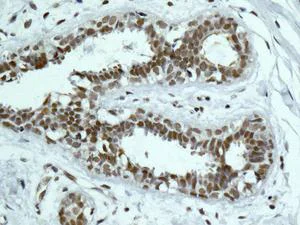
Immunohistochemistry (Formalin/PFA-fixed paraffin-embedded sections) - Anti-PNUTS antibody [EPR11706] (AB173285)

Immunohistochemical analysis of paraffin-embedded Human breast tissue labeling PNUTS with ab173285 at 1/50 dilution.

Perform heat mediated antigen retrieval with citrate buffer pH 6 before commencing with IHC staining protocol.
Immunocytochemistry/ Immunofluorescence - Anti-PNUTS antibody [EPR11706] (AB173285)
  • ICC/IF

Supplier Data

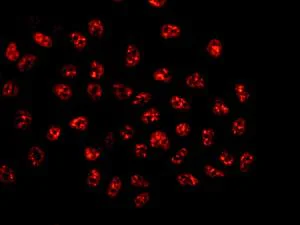
Immunocytochemistry/ Immunofluorescence - Anti-PNUTS antibody [EPR11706] (AB173285)

Immunofluorescent analysis of HeLa cells labeling PNUTS with ab173285 at 1/100 dilution.
Immunohistochemistry (Formalin/PFA-fixed paraffin-embedded sections) - Anti-PNUTS antibody [EPR11706] (AB173285)
  • IHC-P

Supplier Data

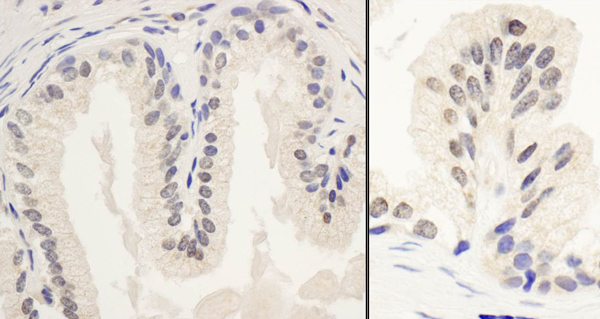
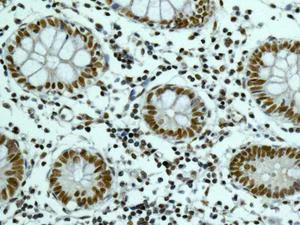
Immunohistochemistry (Formalin/PFA-fixed paraffin-embedded sections) - Anti-PNUTS antibody [EPR11706] (AB173285)

Immunohistochemical analysis of paraffin-embedded Human colon tissue labeling PNUTS with ab173285 at 1/50 dilution.

Perform heat mediated antigen retrieval with citrate buffer pH 6 before commencing with IHC staining protocol.
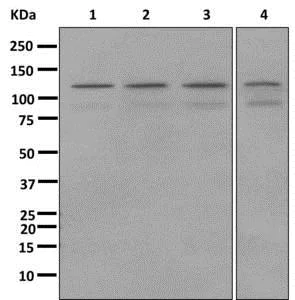
Western blot - Anti-PNUTS antibody [EPR11706] (AB173285)
  • WB

Supplier Data

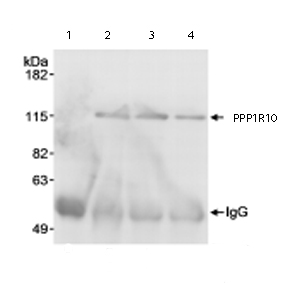
Western blot - Anti-PNUTS antibody [EPR11706] (AB173285)

All lanes:

Western blot - Anti-PNUTS antibody [EPR11706] (ab173285) at 1/1000 dilution

Lane 1:

HeLa cell lysate at 10 µg

Lane 2:

Human fetal brain tissue lysate at 10 µg

Lane 3:

HepG2 cell lysate at 10 µg

Lane 4:

Jurkat cell lysate at 10 µg

Predicted band size: 99 kDa

false

関連する標識済み抗体及び組成の異なる製品 (1)

  • Carrier free

    Anti-PNUTS antibody [EPR11706] - BSA and Azide free

Key facts

宿主種

Rabbit

クローン性

Monoclonal

クローン番号

EPR11706

アイソタイプ

IgG

キャリアフリー

No

交差種

Human

アプリケーション

IHC-P, ICC/IF, WB

applications

免疫原

The exact immunogen used to generate this antibody is proprietary information.

Reactivity data

{ "title": "Reactivity Data", "filters": { "stats": ["", "Species", "Dilution Info", "Notes"], "tabs": { "all-applications": {"fullname" : "All Applications", "shortname": "All Applications"}, "IHCP" : {"fullname" : "Immunohistochemistry (Formalin/PFA-fixed paraffin-embedded sections)", "shortname":"IHC-P"}, "IP" : {"fullname" : "Immunoprecipitation", "shortname":"IP"}, "FlowCyt" : {"fullname" : "Flow Cytometry", "shortname":"Flow Cyt"}, "WB" : {"fullname" : "Western blot", "shortname":"WB"}, "ICCIF" : {"fullname" : "Immunocytochemistry/ Immunofluorescence", "shortname":"ICC/IF"} }, "product-promise": { "all": "all", "testedAndGuaranteed": "tested", "guaranteed": "expected", "predicted": "predicted", "notRecommended": "not-recommended" } }, "values": { "Human": { "IHCP-species-checked": "testedAndGuaranteed", "IHCP-species-dilution-info": "1/50 - 1/100", "IHCP-species-notes": "<p></p>", "IP-species-checked": "notRecommended", "IP-species-dilution-info": "", "IP-species-notes": "<p></p>", "FlowCyt-species-checked": "notRecommended", "FlowCyt-species-dilution-info": "", "FlowCyt-species-notes": "<p></p>", "WB-species-checked": "testedAndGuaranteed", "WB-species-dilution-info": "1/1000 - 1/10000", "WB-species-notes": "<p></p>", "ICCIF-species-checked": "testedAndGuaranteed", "ICCIF-species-dilution-info": "1/100 - 1/250", "ICCIF-species-notes": "<p></p>" } } }

製品の詳細

Species reactivity
Mouse, Rat: We have preliminary internal testing data to indicate this antibody may not react with these species.
Please contact us for more information.

Patented technology
Our RabMAb® technology is a patented hybridoma-based technology for making rabbit monoclonal antibodies. For details on our patents, please refer to RabMAb® patents.

What are the advantages of a recombinant monoclonal antibody?
This product is a recombinant monoclonal antibody, which offers several advantages including:

  • - High batch-to-batch consistency and reproducibility
  • - Improved sensitivity and specificity
  • - Long-term security of supply
  • - Animal-free batch production

For more information, read more on recombinant antibodies.

出荷温度及び保存条件

製品の状態
Liquid
精製方法
Affinity purification Protein A
バッファー組成
pH: 7.2 - 7.4 Preservative: 0.01% Sodium azide Constituents: PBS, 40% Glycerol (glycerin, glycerine), 0.05% BSA
出荷温度
Conditional Ambient
短期保存期間
1-2 weeks
短期保存温度
+4°C
長期保存温度
-20°C
分注に関する情報
Upon delivery aliquot
保管に関する情報
Avoid freeze / thaw cycle

補足情報

This supplementary information is collated from multiple sources and compiled automatically.

The PNUTS protein also known as 'little PNUTS' acts as a regulatory subunit in the cell. It plays a role in controlling the activity of protein phosphatase 1 (PP1) essential for various cellular processes. The PNUTS protein has a molecular mass of approximately 106 kDa. It is expressed in multiple tissues with significant presence in the brain and heart suggesting its importance in these areas.
Biological function summary

The PNUTS protein influences many cellular events as it is part of a larger complex. It controls the dephosphorylation activity of PP1 impacting processes like cell cycle regulation and chromatin structure modification. This protein contributes to the dynamic regulation of transcription DNA repair and cell survival. Its ability to interact with other proteins positions it as a versatile component in cell biology.

Pathways

The PNUTS protein interacts in several notable pathways that affect cell function. It is involved in the DNA damage response pathway where it regulates DNA repair through its interaction with components like PP1. It also plays a role in the Rb signaling pathway related to cell cycle progression linking its function to cell growth and division. Through these pathways PNUTS connects with other proteins emphasizing its versatility.

Alterations in the PNUTS protein correlate with various conditions. Its dysfunction is associated with cancer impacting cell proliferation through its role in the Rb pathway. The connection between PNUTS and neurodegenerative disorders also emerges due to its high expression in the brain. In diseases like Alzheimer's PNUTS interactions with proteins like tau influence disease progression making it a target of interest in therapeutic research.

製品プロトコール

For this product, it's our understanding that no specific protocols are required. You can visit:

ターゲットの情報

Substrate-recognition component of the PNUTS-PP1 protein phosphatase complex, a protein phosphatase 1 (PP1) complex that promotes RNA polymerase II transcription pause-release, allowing transcription elongation (PubMed : 39603239, PubMed : 39603240). Promoter-proximal pausing by RNA polymerase II is a transcription halt following transcription initiation but prior to elongation, which acts as a checkpoint to control that transcripts are favorably configured for transcriptional elongation (PubMed : 39603239, PubMed : 39603240). The PNUTS-PP1 complex mediates the release of RNA polymerase II from promoter-proximal region of genes by catalyzing dephosphorylation of proteins involved in transcription, such as AFF4, CDK9, MEPCE, INTS12, NCBP1, POLR2M/GDOWN1 and SUPT6H (PubMed : 39603239, PubMed : 39603240). The PNUTS-PP1 complex also regulates RNA polymerase II transcription termination by mediating dephosphorylation of SUPT5H in termination zones downstream of poly(A) sites, thereby promoting deceleration of RNA polymerase II transcription (PubMed : 31677974). PNUTS-PP1 complex is also involved in the response to replication stress by mediating dephosphorylation of POLR2A at 'Ser-5' of the CTD, promoting RNA polymerase II degradation (PubMed : 33264625). The PNUTS-PP1 complex also plays a role in the control of chromatin structure and cell cycle progression during the transition from mitosis into interphase (By similarity). PNUTS-PP1 complex mediates dephosphorylation of MYC, promoting MYC stability by preventing MYC ubiquitination by the SCF(FBXW7) complex (PubMed : 30158517). In addition to acts as a substrate-recognition component, PPP1R10/PNUTS also acts as a nuclear targeting subunit for the PNUTS-PP1 complex (PubMed : 9450550). In some context, PPP1R10/PNUTS also acts as an inhibitor of protein phosphatase 1 (PP1) activity by preventing access to substrates, such as RB (PubMed : 18360108).
See full target information PPP1R10

文献 (2)

Recent publications for all applications. Explore the full list and refine your search

Nature cell biology 19:1443 PubMed29184176

2017

Addendum: A regulated PNUTS mRNA to lncRNA splice switch mediates EMT and tumour progression.

Applications

Unspecified application

Species

Unspecified reactive species

Simon Grelet,Laura A Link,Breege Howley,Clémence Obellianne,Viswanathan Palanisamy,Vamsi K Gangaraju,J Alan Diehl,Philip H Howe

eNeuro 4: PubMed28955722

2017

The Progestin Receptor Interactome in the Female Mouse Hypothalamus: Interactions with Synaptic Proteins Are Isoform Specific and Ligand Dependent.

Applications

Unspecified application

Species

Unspecified reactive species

Kalpana D Acharya,Sabin A Nettles,Katherine J Sellers,Dana D Im,Moriah Harling,Cassandra Pattanayak,Didem Vardar-Ulu,Cheryl F Lichti,Shixia Huang,Dean P Edwards,Deepak P Srivastava,Larry Denner,Marc J Tetel
View all publications

Abcam product promise

当社は、高品質な試薬を通じてお客様の研究を力強くサポートすることをお約束いたします。ご使用いただく各段階で、常にお客様をサポートできる体制を整えております。万が一、製品が期待通りに機能しない場合は、「Abcam Product Promise」による当社保証制度に基づき、安心してご利用いただけます。
保証に関する詳細については利用規約をご確認ください。

Please note: All products are 'FOR RESEARCH USE ONLY. NOT FOR USE IN DIAGNOSTIC OR THERAPEUTIC PROCEDURES'.

For licensing inquiries, please contact partnerships@abcam.com