PE Anti-F4/80 抗体 [EPR20548]
PE Anti-F4/80 antibody [EPR20548]
- RabMAb
- Recombinant
- 詳細を見る
Be the first to review this product! Submit a review
|
(3 Publications)
Rabbit Recombinant Monoclonal F4/80 antibody - conjugated to PE. Suitable for Flow Cyt and reacts with Mouse samples. Cited in 3 publications.
別名を表示する
Emr1, Gpf480, Adgre1, Adhesion G protein-coupled receptor E1, Cell surface glycoprotein F4/80, EGF-like module receptor 1, EGF-like module-containing mucin-like hormone receptor-like 1, EMR1 hormone receptor
- Flow Cyt
Unknown
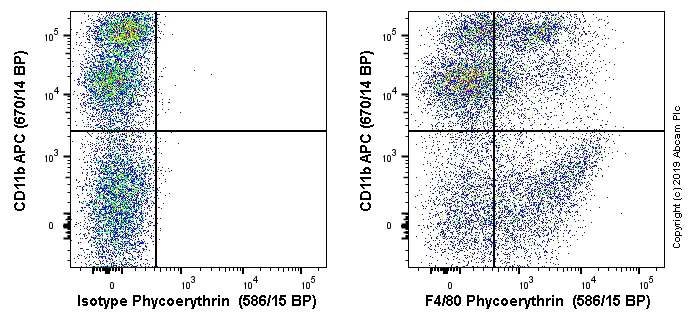
Flow Cytometry - PE Anti-F4/80 antibody [EPR20548] (AB237335)
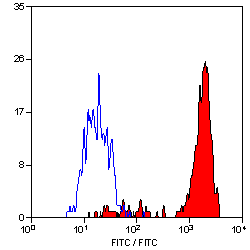
C57BL/6 mouse splenocytes stained with ab237335 (right) or Rabbit IgG (monoclonal) Phycoerythrin (ab209478) isotype (left). C57BL/6 mouse splenocytes were incubated for 30 min on ice in 1x PBS containing 10 μg/ml anti CD16/CD32 and 10 % normal goat serum to block FC receptors and non-specific protein-protein interaction followed by the antibody (ab237335) or Rabbit IgG (monoclonal) Phycoerythrin (ab209478) isotype (1x 10⁶ in 100 μl at 5 μg/ml (1/100)) for 30 min on ice. The cells were simultaneously stained with CD11b.
Acquisition of >30,000 events were collected using a 50 mW Yellow/Green laser (561nm) and 586/15 bandpass filter. Events were gated on viable CD19 and CD3 negative lymphocytes.
関連する標識済み抗体及び組成の異なる製品 (5)
-
Anti-F4/80 antibody [EPR20548]
-
Anti-F4/80 antibody [EPR20548] - BSA and Azide free
-
660 APC
APC Anti-F4/80 antibody [EPR20548]
-
519 Alexa Fluor® 488
Alexa Fluor® 488 Anti-F4/80 antibody [EPR20548]
-
665 Alexa Fluor® 647
Alexa Fluor® 647 Anti-F4/80 antibody [EPR20548]
代替製品




Primary Antibodies
AB111101
RabMAb|Recombinant|Lab Essentials|20ul selling size

- 4
- 20

組合せ製品
Primary Antibodies
AB303467
Alexa Fluor® 647 Anti-Ly6g antibody [EPR22909-135]
RabMAb|Recombinant

- 0
- 0
Reactivity data
製品の詳細
Patented technology
Our RabMAb® technology is a patented hybridoma-based technology for making rabbit monoclonal antibodies. For details on our patents, please refer to RabMAb® patents.
What are the advantages of a recombinant monoclonal antibody?
This product is a recombinant monoclonal antibody, which offers several advantages including:
- - High batch-to-batch consistency and reproducibility
- - Improved sensitivity and specificity
- - Long-term security of supply
- - Animal-free batch production
For more information, read more on recombinant antibodies.
出荷温度及び保存条件
製品の状態
精製方法
バッファー組成
出荷温度
短期保存期間
短期保存温度
長期保存温度
分注に関する情報
保管に関する情報
補足情報
This supplementary information is collated from multiple sources and compiled automatically.
Biological function summary
F4/80 plays a role in modulating the immune response by interacting with other cell surface molecules. While not part of a larger protein complex F4/80 influences macrophage functions such as phagocytosis and cytokine production. Its expression contributes to the regulation of tissue homeostasis and inflammation. The protein is critical in maintaining the macrophage population required for reliable immune surveillance and response to pathogens.
Pathways
F4/80 is an integral part of the immunological and inflammatory signaling pathways. It interacts with TLRs (Toll-like receptors) and other cell surface molecules that sense microbial components therefore helping in the initiation of innate immune responses. F4/80 is connected to proteins like cytokine receptors which play roles in mediating and resolving inflammatory signals important for maintaining balanced immune activity.
製品プロトコール
- Visit the General protocols
- Visit the Troubleshooting
ターゲットの情報
文献 (3)
Recent publications for all applications. Explore the full list and refine your search
Cellular & molecular biology letters 29:100 PubMed38977961
2024
Applications
Unspecified application
Species
Unspecified reactive species
European journal of histochemistry : EJH 67: PubMed36546420
2023
Applications
Unspecified application
Species
Unspecified reactive species
Journal of clinical laboratory analysis 36:e24455 PubMed35524480
2022
Applications
Unspecified application
Species
Unspecified reactive species
Abcam product promise
Please note: All products are 'FOR RESEARCH USE ONLY. NOT FOR USE IN DIAGNOSTIC OR THERAPEUTIC PROCEDURES'.
For licensing inquiries, please contact partnerships@abcam.com