Anti-PCSK9 抗体 [EPR7627(2)]
Anti-PCSK9 antibody [EPR7627(2)]
- 20ul selling size
- RabMAb
- Recombinant
- 詳細を見る
Be the first to review this product! Submit a review
|
(29 Publications)
Anti-PCSK9 antibody [EPR7627(2)] (ab181142) is a rabbit monoclonal antibody detecting PCSK9 in Western Blot, IP. Suitable for Human.
- Biophysical QC for unrivalled batch-batch consistency
- Over 10 publications
別名を表示する
NARC1, PSEC0052, PCSK9, Proprotein convertase subtilisin/kexin type 9, Neural apoptosis-regulated convertase 1, Proprotein convertase 9, Subtilisin/kexin-like protease PC9, NARC-1, PC9
- IP
Supplier Data
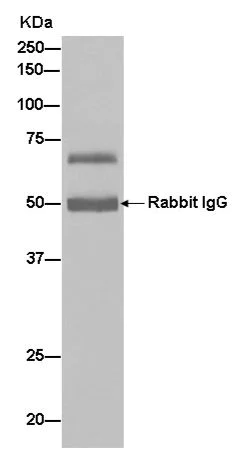
Immunoprecipitation - Anti-PCSK9 antibody [EPR7627(2)] (AB181142)
Western blot analysis of PCSK9 in HepG2 cell lysate immunoprecipitated using unpurified ab181142 at a dilution of 1/50.
Secondary : Goat Anti-Rabbit IgG, (H+L), Peroxidase conjugated at 1/1000 dilution.
All lanes:
Immunoprecipitation - Anti-PCSK9 antibody [EPR7627(2)] (ab181142)
Predicted band size: 74 kDa
Observed band size: 62 kDa
false
- IP
Lab
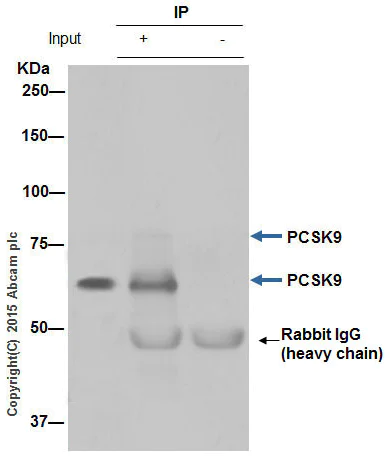
Immunoprecipitation - Anti-PCSK9 antibody [EPR7627(2)] (AB181142)
ab181142 (purified) at 1/50 immunoprecipitating PCSK9 in HepG2 whole cell lysate.
Lane 1 (input) : HepG2 whole cell lysate (10μg)
Lane 2 (+) : ab181142 + HepG2 whole cell lysate.
Lane 3 (-) : Rabbit monoclonal IgG (ab172730) instead of ab181142 in HepG2 whole cell lysate.
For western blotting, a HRP-conjugated anti-rabbit IgG, specific to the non-reduced form of IgG was used as the secondary antibody (1/1500).
Blocking buffer and concentration : 5% NFDM/TBST.
Diluting buffer and concentration : 5% NFDM /TBST.
All lanes:
Immunoprecipitation - Anti-PCSK9 antibody [EPR7627(2)] (ab181142)
Predicted band size: 74 kDa
Observed band size: 62 kDa,78 kDa
false
- WB
Lab
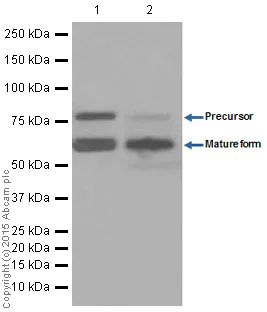
Western blot - Anti-PCSK9 antibody [EPR7627(2)] (AB181142)
Blocking and dilution buffer : 5% NFDM/TBST.
All lanes:
Western blot - Anti-PCSK9 antibody [EPR7627(2)] (ab181142) at 1/20000 dilution
Lane 1:
A431 whole cell lysate at 10 µg
Lane 2:
HepG2 whole cell lysate at 10 µg
Secondary
All lanes:
Western blot - Goat Anti-Rabbit IgG H&L (HRP) (<a href='/products/secondary-antibodies/goat-rabbit-igg-h-l-hrp-ab97051'>ab97051</a>) at 1/50000 dilution
Predicted band size: 74 kDa
Observed band size: 62 kDa,78 kDa
false
- WB
Supplier Data
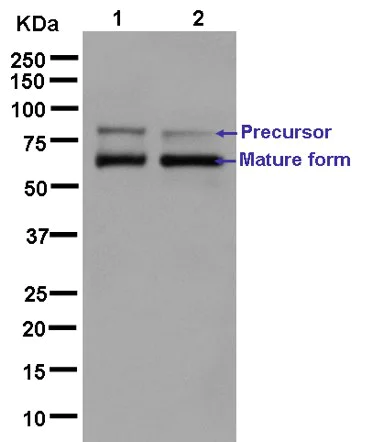
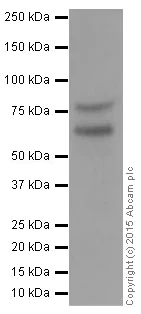
Western blot - Anti-PCSK9 antibody [EPR7627(2)] (AB181142)
All lanes:
Western blot - Anti-PCSK9 antibody [EPR7627(2)] (ab181142) at 1/10000 dilution
Lane 1:
A431 (Human epidermoid carcinoma cell line) cell lysate at 20 µg
Lane 2:
HepG2 (Human liver hepatocellular carcinoma cell line) cell lysate at 20 µg
Secondary
All lanes:
Goat Anti-Rabbit IgG, (H+L), Peroxidase conjugate at 1/1000 dilution
Predicted band size: 74 kDa
Observed band size: 62 kDa,78 kDa
false
- WB
Lab
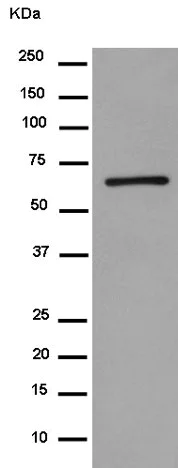
Western blot - Anti-PCSK9 antibody [EPR7627(2)] (AB181142)
Blocking and dilution buffer : 5% NFDM/TBST.
All lanes:
Western blot - Anti-PCSK9 antibody [EPR7627(2)] (ab181142) at 1/5000 dilution
All lanes:
BxPC-3 whole cell lysate at 20 µg
Secondary
All lanes:
Western blot - Goat Anti-Rabbit IgG H&L (HRP) (<a href='/products/secondary-antibodies/goat-rabbit-igg-h-l-hrp-ab97051'>ab97051</a>) at 1/5000 dilution
Predicted band size: 23 kDa,39 kDa,48 kDa,74 kDa
Observed band size: 26 kDa,39 kDa,62 kDa,78 kDa
false
- WB
Supplier Data
Western blot - Anti-PCSK9 antibody [EPR7627(2)] (AB181142)
All lanes:
Western blot - Anti-PCSK9 antibody [EPR7627(2)] (ab181142) at 1/2000 dilution
All lanes:
Human fetal liver lysate at 20 µg
Secondary
All lanes:
Goat Anti-Rabbit IgG, (H+L), Peroxidase conjugate at 1/1000 dilution
Predicted band size: 74 kDa
Observed band size: 62 kDa
false
関連する標識済み抗体及び組成の異なる製品 (2)
-
Anti-PCSK9 antibody [EPR7627(2)] - BSA and Azide free
-
HRP Anti-PCSK9 antibody [EPR7627(2)]
代替製品
Primary Antibodies
AB246322
Anti-PCSK9 antibody [EPR17827-117] - BSA and Azide free
RabMAb|Recombinant

- 0
- 0
Primary Antibodies
AB185194
Anti-PCSK9 antibody [EPR17827-117]
RabMAb|Recombinant|20ul selling size

- 0
- 0
組合せ製品

Primary Antibodies
AB52818
Anti-LDL Receptor antibody [EP1553Y]
20ul selling size|RabMAb|KO Validated|Recombinant

- 4
- 16

Primary Antibodies
AB181602
Anti-GAPDH antibody [EPR16891] - Loading Control
KD Validated|RabMAb|Recombinant|Lab Essentials|20ul selling size

- 5
- 23
Primary Antibodies
AB32537
BOND RX™ Validated|KO Validated|RabMAb|Recombinant|Lab Essentials|20ul selling size

- 5
- 4
Reactivity data
製品の詳細
What is this antibody validated in?
Anti-PCSK9 antibody [EPR7627(2)] (ab181142) is a rabbit recombinant monoclonal antibody and is validated for use in Western Blot (WB), Immunoprecipitation (IP) in Human samples.
What is the molecular weight of PCSK9?
Anti-PCSK9 [EPR7627(2)] (ab181142) specifically detects a band for PCSK9 (UniProt: Q8NBP7) at a molecular weight of 74kDa.
Trusted by the scientific community
Anti-PCSK9 [EPR7627(2)] (ab181142) was first used in a scientific publication in 2013 and has been cited over 10 times in peer-reviewed journals.
Other related products
We have a range of other formats of antibody clone [EPR7627(2)] also available for your convenience: ab181142, Carrier free - ab238995, HRP - ab323661
Patented technology
Our RabMAb® technology is a patented hybridoma-based technology for making rabbit monoclonal antibodies. For details on our patents, please refer to RabMAb® patents.
What are the advantages of a recombinant monoclonal antibody?
This product is a recombinant monoclonal antibody, which offers several advantages including:
- - High batch-to-batch consistency and reproducibility
- - Improved sensitivity and specificity
- - Long-term security of supply
- - Animal-free batch production
For more information, read more on recombinant antibodies.
Trial sizes available!
Test your antibody or perform pre-screening before committing to a larger quantity. Sold in 20µl. Discover our selection of trial-size antibodies.
出荷温度及び保存条件
製品の状態
精製方法
バッファー組成
出荷温度
短期保存期間
短期保存温度
長期保存温度
分注に関する情報
保管に関する情報
補足情報
This supplementary information is collated from multiple sources and compiled automatically.
Biological function summary
PCSK9 influences cholesterol homeostasis by its important role in degrading LDL receptors. It functions independently rather than as part of larger protein complexes. PCSK9 gains particular interest in therapeutic contexts where its inhibition can lead to increased LDLR levels and enhanced clearance of LDL cholesterol. Biotinylated PCSK9 and mouse PCSK9 variants provide significant tools for experimental study. Kits such as the PCSK9 ELISA kit enable detailed measurement of PCSK9 levels in blood samples providing insights into cholesterol metabolism dynamics.
Pathways
PCSK9 operates within the lipid metabolism pathway and the cholesterol biosynthesis pathway. The protein's activity affects the fate of LDL cholesterol within these pathways. It interacts with proteins such as apolipoprotein B (ApoB) which plays a central role in the structural component of LDL particles. The modulation of these pathways by PCSK9 highlights the significance of its function in maintaining cardiovascular health and managing cholesterol levels.
製品プロトコール
- Visit the General protocols
- Visit the Troubleshooting
ターゲットの情報
文献 (29)
Recent publications for all applications. Explore the full list and refine your search
Food & function 16:7823-7834 PubMed40938307
2025
Applications
Unspecified application
Species
Unspecified reactive species
Cardiovascular research 121:1373-1384 PubMed40653676
2025
Applications
Unspecified application
Species
Unspecified reactive species
Cancers 17: PubMed40563628
2025
Applications
Unspecified application
Species
Unspecified reactive species
Scientific reports 15:15696 PubMed40325086
2025
Applications
Unspecified application
Species
Unspecified reactive species
Biology direct 20:46 PubMed40189560
2025
Applications
Unspecified application
Species
Unspecified reactive species
Frontiers in genetics 15:1469094 PubMed39628814
2024
Applications
Unspecified application
Species
Unspecified reactive species
ACS omega 9:24308-24320 PubMed38882153
2024
Applications
Unspecified application
Species
Unspecified reactive species
European journal of medicinal chemistry 265:116063 PubMed38160616
2024
Applications
Unspecified application
Species
Unspecified reactive species
Journal of experimental & clinical cancer research : CR 41:303 PubMed36242053
2022
Applications
Unspecified application
Species
Unspecified reactive species
Analytical biochemistry 655:114846 PubMed35973625
2022
Applications
Unspecified application
Species
Unspecified reactive species
Abcam product promise
Please note: All products are 'FOR RESEARCH USE ONLY. NOT FOR USE IN DIAGNOSTIC OR THERAPEUTIC PROCEDURES'.
For licensing inquiries, please contact partnerships@abcam.com