Anti-Parkin (phospho S65) 抗体 [MJF-R17-42-4]
Anti-Parkin (phospho S65) antibody [MJF-R17-42-4]
- 20ul selling size
- RabMAb
- Recombinant
- 詳細を見る
Be the first to review this product! Submit a review
|
(5 Publications)
Rabbit Recombinant Monoclonal Parkin phospho S65 antibody. Suitable for WB, ICC/IF and reacts with Transfected cell lysate - Human, Transfected cell line - Human samples. Cited in 5 publications.
別名を表示する
PARK2, PRKN, E3 ubiquitin-protein ligase parkin, Parkin, Parkin RBR E3 ubiquitin-protein ligase, Parkinson juvenile disease protein 2, Parkinson disease protein 2
- ICC/IF
Lab
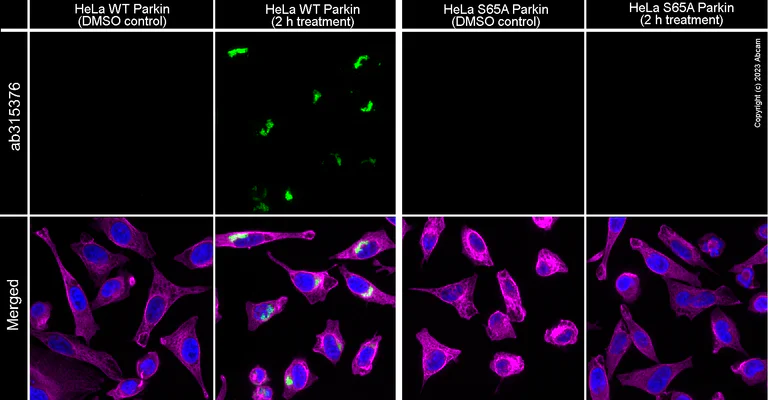
Immunocytochemistry/ Immunofluorescence - Anti-Parkin (phospho S65) antibody [MJF-R17-42-4] (AB315376)
ab315376 staining phosphorylated Parkin (S65). HeLa cell lines with WT Parkin or S65A mutant overexpression (kindly provided by the Muqit lab, for details see PMID 26116755) were treated with 10 µM antimycin A and 1 µM oligomycin for 2 h. DMSO was used as control. The cells were fixed with 4% paraformaldehyde (10 min), permeabilized with 0.1% PBS-Triton X-100 for 5 minutes and then blocked with 1% BSA/10% normal goat serum/0.3M glycine in 0.1%PBS-Tween for 1h. The cells were then incubated overnight at 4°C with ab315376 at 0.016 µg/ml and ab7291, Mouse monoclonal [DM1A] to alpha Tubulin - Loading Control. Cells were then incubated with ab150083, Goat polyclonal Secondary Antibody to Rabbit IgG - H&L (Alexa Fluor®647), pre-adsorbed at 1/1000 dilution (shown in green) and ab150120, Goat polyclonal Secondary Antibody to Mouse IgG - H&L (Alexa Fluor®594), pre-adsorbed at 1/1000 dilution (shown in magenta). Nuclear DNA was labelled with DAPI (shown in blue). Staining is seen in A+O treated HeLa WT Parkin cells, but not in the other conditions. Absence of staining in the HeLa S65A Parkin cells indicates phospho-specificity towards residue S65.
Image was acquired with a high-content analyser (Operetta CLS, Perkin Elmer) and a maximum intensity projection of confocal sections is shown.
- ICC/IF
Lab
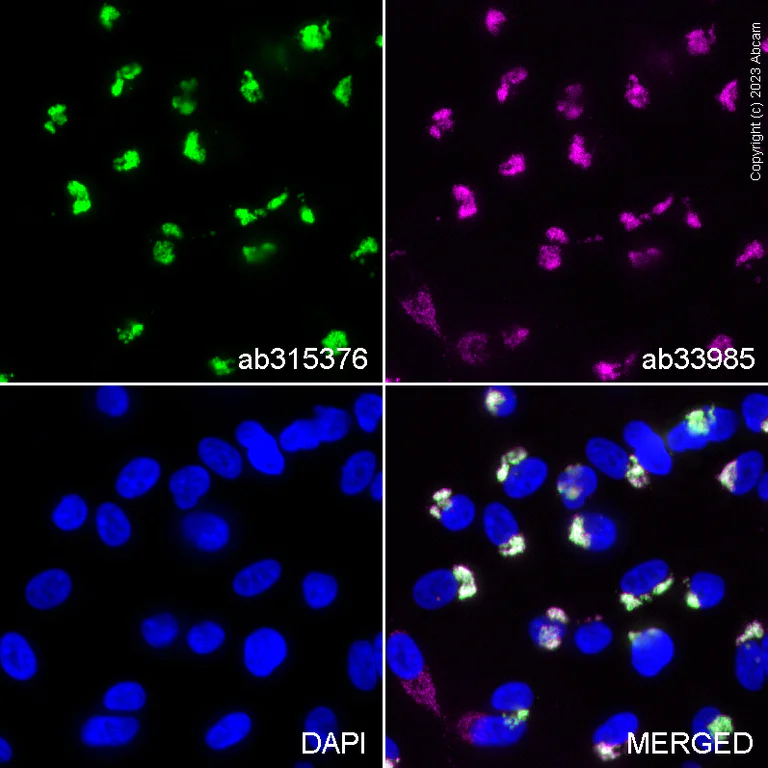
Immunocytochemistry/ Immunofluorescence - Anti-Parkin (phospho S65) antibody [MJF-R17-42-4] (AB315376)
ab315376 staining phosphorylated Parkin (S65) and the staining co-localises with mitochondrial marker (Anti-COX IV antibody, ab33985). HeLa cell line with WT Parkin overexpression (kindly provided by the Muqit lab, for details see PMID 26116755) were treated with 10 μM antimycin A and 1 μM oligomycin for 2 h. DMSO was used as control. The cells were fixed with 4% paraformaldehyde (10 min), permeabilized with 0.1% PBS-Triton X-100 for 5 minutes and then blocked with 1% BSA/10% normal goat serum/0.3M glycine in 0.1%PBS-Tween for 1h. The cells were then incubated overnight at 4°C with ab315376 at 0.08 μg/ml and ab33985, Mouse monoclonal Anti-COX IV antibody [mAbcam33985]. Cells were then incubated with ab150083, Goat polyclonal Secondary Antibody to Rabbit IgG - H&L (Alexa Fluor®647), pre-adsorbed at 1/1000 dilution (shown in green) and ab150120, Goat polyclonal Secondary Antibody to Mouse IgG - H&L (Alexa Fluor® 594), pre-adsorbed at 1/1000 dilution (shown in magenta). Nuclear DNA was labelled with DAPI (shown in blue).
Image was acquired with a high-content analyser (Operetta CLS, Perkin Elmer) and a maximum intensity projection of confocal sections is shown.
関連する標識済み抗体及び組成の異なる製品 (1)
-
Anti-Parkin (phospho S65) antibody [MJF-R17-42-4] - BSA and Azide free
組合せ製品
Primary Antibodies
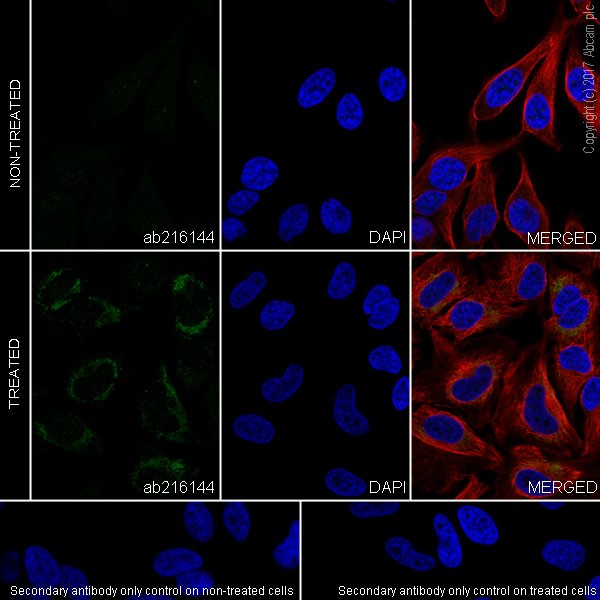
AB216144
Anti-PINK1 antibody [EPR20730]
RabMAb|Recombinant|KO Validated|20ul selling size
- 4
- 4
Primary Antibodies
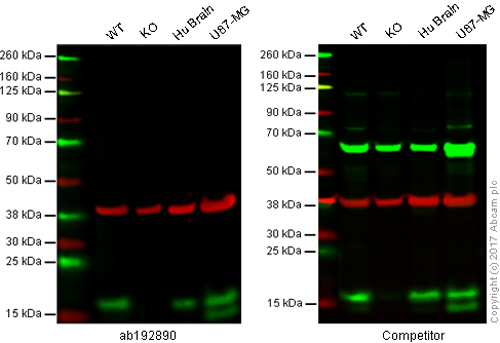
AB192890
Anti-LC3B antibody [EPR18709] - Autophagosome Marker
BOND RX™ Validated|RabMAb|Recombinant|KO Validated|Lab Essentials|20ul selling size
- 5
- 19
Primary Antibodies
AB109012
Anti-SQSTM1 / p62 antibody [EPR4844] - Autophagosome Marker
20ul selling size|KO Validated|RabMAb|Recombinant|Lab Essentials

- 5
- 15
Reactivity data
製品の詳細
Patented technology
Our RabMAb® technology is a patented hybridoma-based technology for making rabbit monoclonal antibodies. For details on our patents, please refer to RabMAb® patents.
What are the advantages of a recombinant monoclonal antibody?
This product is a recombinant monoclonal antibody, which offers several advantages including:
- - High batch-to-batch consistency and reproducibility
- - Improved sensitivity and specificity
- - Long-term security of supply
- - Animal-free batch production
For more information, read more on recombinant antibodies.
Collaborations
This antibody was developed with support from The Michael J. Fox Foundation.

出荷温度及び保存条件
製品の状態
精製方法
バッファー組成
出荷温度
短期保存期間
短期保存温度
長期保存温度
分注に関する情報
保管に関する情報
補足情報
This supplementary information is collated from multiple sources and compiled automatically.
Biological function summary
Parkin is essential for the regulation of mitochondria through its involvement in the mitochondrial quality control system. It functions as part of a complex with other proteins that respond to mitochondrial damage by tagging them with ubiquitin molecules. This mechanism allows for the removal of defective mitochondria via mitophagy critical for preventing the accumulation of damaged cellular components.
Pathways
Parkin interacts with pathways involved in the cellular stress response particularly the PINK1 (PTEN Induced Kinase
- pathway. PINK1 phosphorylates Parkin activating it to label damaged mitochondria. Another critical pathway involves proteasomal degradation where Parkin collaborates with Ubiquitin to manage protein turnover. These pathways highlight its relationships with other cellular stress-regulating proteins enhancing our understanding of its roles in maintaining cellular integrity.
製品プロトコール
- Visit the General protocols
- Visit the Troubleshooting
ターゲットの情報
文献 (5)
Recent publications for all applications. Explore the full list and refine your search
Cell communication and signaling : CCS 23:414 PubMed41039555
2025
Applications
Unspecified application
Species
Unspecified reactive species
Histology and histopathology :18958 PubMed40654025
2025
Applications
Unspecified application
Species
Unspecified reactive species
Stem cell research & therapy 16:218 PubMed40312745
2025
Applications
Unspecified application
Species
Unspecified reactive species
Advanced science (Weinheim, Baden-Wurttemberg, Germany) 12:e2404109 PubMed39520088
2024
Applications
Unspecified application
Species
Unspecified reactive species
Translational andrology and urology 13:2209-2228 PubMed39507862
2024
Applications
Unspecified application
Species
Unspecified reactive species
Abcam product promise
Please note: All products are 'FOR RESEARCH USE ONLY. NOT FOR USE IN DIAGNOSTIC OR THERAPEUTIC PROCEDURES'.
For licensing inquiries, please contact partnerships@abcam.com