JavaScript is disabled in your browser. Please enable JavaScript to view this website.
AB5247

Anti-PAK1 + PAK2 + PAK3 (phospho S141) 抗体

Anti-PAK1 + PAK2 + PAK3 (phospho S141) antibody

Be the first to review this product! Submit a review

|

(2 Publications)

Rabbit Polyclonal PAK2 phospho S141 antibody. Suitable for WB and reacts with Human samples. Cited in 2 publications. Immunogen corresponding to Synthetic Peptide within Human PAK2 pS141.

別名を表示する

Serine/threonine-protein kinase PAK 2, Gamma-PAK, PAK65, S6/H4 kinase, p21-activated kinase 2, p58, PAK-2, PAK2, Serine/threonine-protein kinase PAK 1, Alpha-PAK, p21-activated kinase 1, p65-PAK, PAK-1, PAK1, OPHN3, PAK3, Serine/threonine-protein kinase PAK 3, Beta-PAK, Oligophrenin-3, p21-activated kinase 3, PAK-3
1 Images
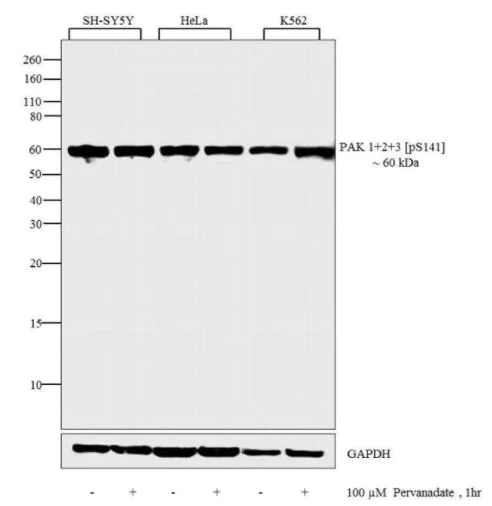
Western blot - Anti-PAK1 + PAK2 + PAK3 (phospho S141) antibody (AB5247)
  • WB

Supplier Data

Western blot - Anti-PAK1 + PAK2 + PAK3 (phospho S141) antibody (AB5247)

All lanes:

Western blot - Anti-PAK1 + PAK2 + PAK3 (phospho S141) antibody (ab5247) at 1/500 dilution

Lane 1:

SH-SY5Y whole cell extracts at 30 µg

Lane 2:

SH-SY5Y treated with 100 uM Pervanadate for 1 h at 30 µg

Lane 3:

HeLa whole cell extract at 30 µg

Lane 4:

HeLa treated with 100 uM Pervanadate for 1 h at 30 µg

Lane 5:

K562 whole cell extract at 30 µg

Lane 6:

K562 treated with 100 uM Pervanadate for 1 h at 30 µg

Secondary

All lanes:

Goat anti-Rabbit IgG (H+L) Secondary Antibody, HRP conjugate at 1/5000 dilution

Predicted band size: 65 kDa

false

Key facts

宿主種

Rabbit

クローン性

Polyclonal

アイソタイプ

IgG

キャリアフリー

No

交差種

Human

アプリケーション

WB

applications

免疫原

Synthetic Peptide within Human PAK2 pS141. The exact immunogen used to generate this antibody is proprietary information.

Q13177

Reactivity data

{ "title": "Reactivity Data", "filters": { "stats": ["", "Species", "Dilution Info", "Notes"], "tabs": { "all-applications": {"fullname" : "All Applications", "shortname": "All Applications"}, "WB" : {"fullname" : "Western blot", "shortname":"WB"} }, "product-promise": { "all": "all", "testedAndGuaranteed": "tested", "guaranteed": "expected", "predicted": "predicted", "notRecommended": "not-recommended" } }, "values": { "Human": { "WB-species-checked": "testedAndGuaranteed", "WB-species-dilution-info": "1/1000", "WB-species-notes": "<p></p>" }, "Rat": { "WB-species-checked": "predicted", "WB-species-dilution-info": "", "WB-species-notes": "" }, "Rabbit": { "WB-species-checked": "predicted", "WB-species-dilution-info": "", "WB-species-notes": "" } } }

製品の詳細

P21-activated kinase (PAK) is actually a family of serine/threonine protein kinases, members of which are activated by small molecular weight GTPases. The three most common isoforms are PAK 1, PAK 2, and PAK 3 (also known as alpha PAK, gamma PAK, and beta PAK, respectively). These kinases contain numerous regulatory elements that trigger diverse signaling processes such as those initiated by activated GTPases, interaction with Src homology 3 (SH3) domains, and caspase mediated proteolytic cleavage. Autophosphorylation of serine 141 (serine 144 for PAK 1 and serine 139 PAK 3), catalyzed by Cdc42, is required for activation of PAK.

出荷温度及び保存条件

製品の状態
Liquid
精製方法
Affinity purification Immunogen
精製に関する特記事項
Purified from rabbit serum by sequential epitope-specific chromatography. The antibody has been negatively preadsorbed using a non-phosphopeptide corresponding to the site of phosphorylation to remove antibody that is reactive with non-phosphorylated PAK. The final product is generated by affinity chromatography using a PAK 2 derived peptide that is phosphorylated at serine 141.
バッファー組成
pH: 7.3 Preservative: 0.05% Sodium azide Constituents: PBS, 0.1% BSA
出荷温度
Blue Ice
短期保存温度
+4°C
長期保存温度
-20°C
分注に関する情報
Upon delivery aliquot
保管に関する情報
Avoid freeze / thaw cycle

製品プロトコール

For this product, it's our understanding that no specific protocols are required. You can visit:

ターゲットの情報

Serine/threonine protein kinase that plays a role in a variety of different signaling pathways including cytoskeleton regulation, cell motility, cell cycle progression, apoptosis or proliferation (PubMed : 12853446, PubMed : 16617111, PubMed : 19273597, PubMed : 19923322, PubMed : 33693784, PubMed : 7744004, PubMed : 9171063). Acts as a downstream effector of the small GTPases CDC42 and RAC1 (PubMed : 7744004). Activation by the binding of active CDC42 and RAC1 results in a conformational change and a subsequent autophosphorylation on several serine and/or threonine residues (PubMed : 7744004). Full-length PAK2 stimulates cell survival and cell growth (PubMed : 7744004). Phosphorylates MAPK4 and MAPK6 and activates the downstream target MAPKAPK5, a regulator of F-actin polymerization and cell migration (PubMed : 21317288). Phosphorylates JUN and plays an important role in EGF-induced cell proliferation (PubMed : 21177766). Phosphorylates many other substrates including histone H4 to promote assembly of H3.3 and H4 into nucleosomes, BAD, ribosomal protein S6, or MBP (PubMed : 21724829). Phosphorylates CASP7, thereby preventing its activity (PubMed : 21555521, PubMed : 27889207). Additionally, associates with ARHGEF7 and GIT1 to perform kinase-independent functions such as spindle orientation control during mitosis (PubMed : 19273597, PubMed : 19923322). On the other hand, apoptotic stimuli such as DNA damage lead to caspase-mediated cleavage of PAK2, generating PAK-2p34, an active p34 fragment that translocates to the nucleus and promotes cellular apoptosis involving the JNK signaling pathway (PubMed : 12853446, PubMed : 16617111, PubMed : 9171063). Caspase-activated PAK2 phosphorylates MKNK1 and reduces cellular translation (PubMed : 15234964).
See full target information PAK2 pS141

追加のターゲット

,

文献 (2)

Recent publications for all applications. Explore the full list and refine your search

PloS one 9:e92560 PubMed24664099

2014

Group I PAK inhibitor IPA-3 induces cell death and affects cell adhesivity to fibronectin in human hematopoietic cells.

Applications

WB

Species

Human

Kateřina Kuželová,Dana Grebeňová,Aleš Holoubek,Pavla Röselová,Adam Obr

The Journal of experimental medicine 207:1923-38 PubMed20733035

2010

Rap1b facilitates NK cell functions via IQGAP1-mediated signalosomes.

Applications

WB

Species

Mouse

Aradhana Awasthi,Asanga Samarakoon,Haiyan Chu,Rajasekaran Kamalakannan,Lawrence A Quilliam,Magdalena Chrzanowska-Wodnicka,Gilbert C White,Subramaniam Malarkannan
View all publications

Abcam product promise

当社は、高品質な試薬を通じてお客様の研究を力強くサポートすることをお約束いたします。ご使用いただく各段階で、常にお客様をサポートできる体制を整えております。万が一、製品が期待通りに機能しない場合は、「Abcam Product Promise」による当社保証制度に基づき、安心してご利用いただけます。
保証に関する詳細については利用規約をご確認ください。

Please note: All products are 'FOR RESEARCH USE ONLY. NOT FOR USE IN DIAGNOSTIC OR THERAPEUTIC PROCEDURES'.

For licensing inquiries, please contact partnerships@abcam.com