Anti-p63 抗体 [Y289] - BSA and Azide free
Anti-p63 antibody [Y289] - BSA and Azide free
- RabMAb
- Recombinant
- 詳細を見る
Be the first to review this product! Submit a review
|
(1 Publication)
Rabbit Recombinant Monoclonal P63 antibody. Carrier free. Suitable for ICC/IF, WB, Flow Cyt (Intra), IHC-P and reacts with Human samples. Cited in 1 publication.
別名を表示する
KET, P63, P73H, P73L, TP73L, TP63, Tumor protein 63, p63, Chronic ulcerative stomatitis protein, Keratinocyte transcription factor KET, Transformation-related protein 63, Tumor protein p73-like, p40, p51, CUSP, p73L
- ICC/IF
Unknown
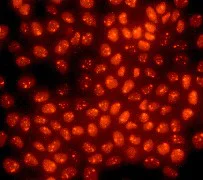
Immunocytochemistry/ Immunofluorescence - Anti-p63 antibody [Y289] - BSA and Azide free (AB247245)
This data was developed using ab32353, the same antibody clone in a different buffer formulation.
Immunocytochemistry/Immunofluorescence analysis of A431 cells labelling p63 with unpurified ab32353 at 1/250 dilution.
- Flow Cyt (Intra)
Lab
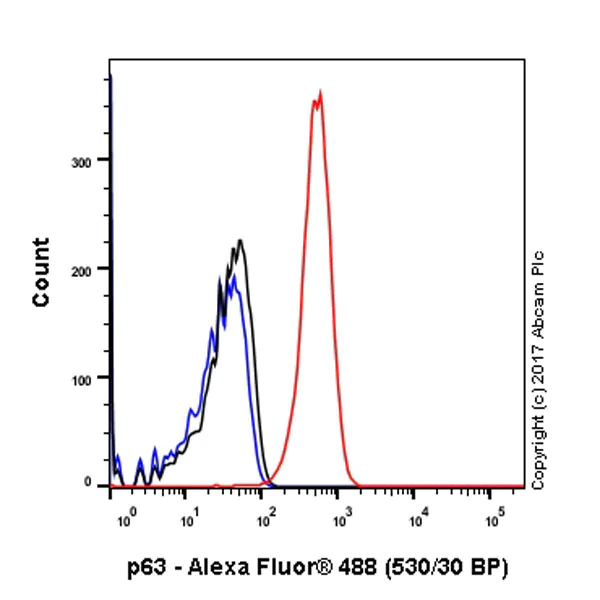
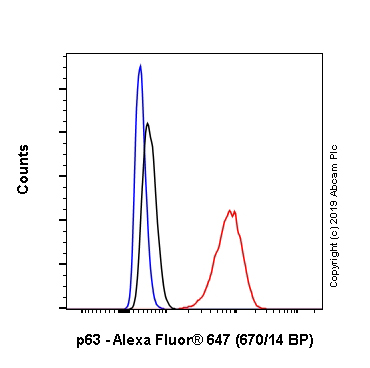
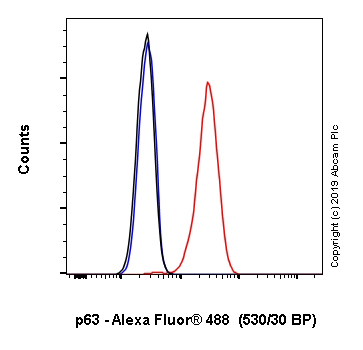
Flow Cytometry (Intracellular) - Anti-p63 antibody [Y289] - BSA and Azide free (AB247245)
This data was developed using ab32353, the same antibody clone in a different buffer formulation.
Intracellular Flow Cytometry analysis of A431 (human epidermoid carcinoma) cells labeling p63 with purified ab32353at 1/500 dilution (1ug/ml) (red). Cells were fixed with 4% paraformaldehyde and permeabilised with 90% methanol. A Goat anti rabbit IgG (Alexa Fluor® 488) (1/2000 dilution) was used as the secondary antibody. Rabbit monoclonal IgG (Black) was used as the isotype control, cells without incubation with primary antibody and secondary antibody (Blue) were used as the unlabeled control.
- IHC-P
Unknown
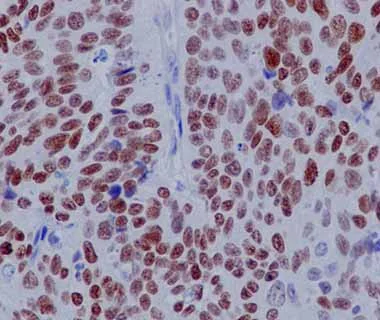
Immunohistochemistry (Formalin/PFA-fixed paraffin-embedded sections) - Anti-p63 antibody [Y289] - BSA and Azide free (AB247245)
This data was developed using ab32353, the same antibody clone in a different buffer formulation.
Immunohistochemistry (Formalin/PFA-fixed paraffin-embedded sections) analysis of human hepatocellular skin tissue labelling p63 with purified ab32353 at 1/50. Heat mediated antigen retrieval was performed using Tris/EDTA buffer pH 9. A prediluted HRP-polymer conjugated anti-rabbit IgG was used as the secondary antibody. Counterstained with Hematoxylin.
- ICC/IF
Unknown
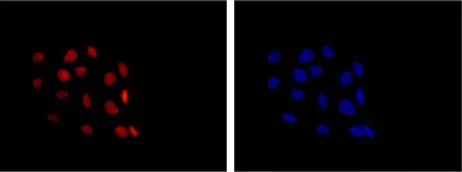
Immunocytochemistry/ Immunofluorescence - Anti-p63 antibody [Y289] - BSA and Azide free (AB247245)
This data was developed using ab32353, the same antibody clone in a different buffer formulation.
Immunocytochemsitry/Immunofluorescence analysis of A431 cells labelling p63 (red) with purified ab32353 at 1/200. Cells were fixed with 4% paraformaldehyde. An Alexa Fluor® 555-conjugated goat anti-rabbit IgG (1/200) was used as the secondary antibody. Counterstained with DAPI (blue).
- WB
Lab
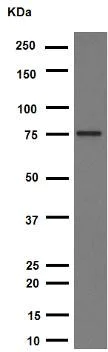
Western blot - Anti-p63 antibody [Y289] - BSA and Azide free (AB247245)
This data was developed using ab32353, the same antibody clone in a different buffer formulation.
Blocking and dilution buffer : 5% NFDM/TBST.
All lanes:
Western blot - Anti-p63 antibody [Y289] (<a href='/products/primary-antibodies/p63-antibody-y289-ab32353'>ab32353</a>) at 1/4000 dilution
All lanes:
A431 cell lysate at 10 µg
Secondary
All lanes:
Peroxidase-conjugated goat anti-rabbit IgG (H+L) at 1/1000 dilution
Predicted band size: 77 kDa
Observed band size: 73 kDa
false
- WB
Lab
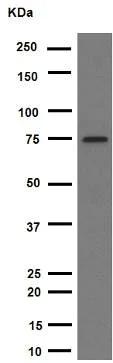
Western blot - Anti-p63 antibody [Y289] - BSA and Azide free (AB247245)
This data was developed using ab32353, the same antibody clone in a different buffer formulation.
Blocking and dilution buffer : 5% NFDM/TBST.
All lanes:
Western blot - Anti-p63 antibody [Y289] (<a href='/products/primary-antibodies/p63-antibody-y289-ab32353'>ab32353</a>) at 1/10000 dilution
All lanes:
A431 cell lysate at 10 µg
Secondary
All lanes:
Peroxidase-conjugated goat anti-rabbit IgG (H+L) at 1/1000 dilution
Predicted band size: 77 kDa
Observed band size: 73 kDa
false
関連する標識済み抗体及び組成の異なる製品 (10)
-
Anti-p63 antibody [Y289]
-
660 APC
APC Anti-p63 antibody [Y289]
-
519 Alexa Fluor® 488
Alexa Fluor® 488 Anti-p63 antibody [Y289]
-
565 Alexa Fluor® 555
Alexa Fluor® 555 Anti-p63 antibody [Y289]
-
603 Alexa Fluor® 568
Alexa Fluor® 568 Anti-p63 antibody [Y289]
-
617 Alexa Fluor® 594
Alexa Fluor® 594 Anti-p63 antibody [Y289]
-
665 Alexa Fluor® 647
Alexa Fluor® 647 Anti-p63 antibody [Y289]
-
775 Alexa Fluor® 750
Alexa Fluor® 750 Anti-p63 antibody [Y289]
-
HRP Anti-p63 antibody [Y289]
-
578 PE
PE Anti-p63 antibody [Y289]
代替製品
組合せ製品

Primary Antibodies
AB16667
BOND RX™ Validated|KO Validated|RabMAb|Advanced Validation|Recombinant|20ul selling size

- 5
- 133
Primary Antibodies
AB52635
Anti-Cytokeratin 5 antibody [EP1601Y] - Cytoskeleton Marker
BOND RX™ Validated|RabMAb|Recombinant|Lab Essentials
- 5
- 11
Primary Antibodies
AB172730
Rabbit IgG, monoclonal [EPR25A] - Isotype Control
KD Validated|RabMAb|Advanced Validation|Recombinant

- 0
- 0
Reactivity data
製品の詳細
ab247245 is the carrier-free version of ab32353.
Species reactivity
Mouse, Rat: We have preliminary internal testing data to indicate this antibody may not react with these species.
Please contact us for more information.
Patented technology
Our RabMAb® technology is a patented hybridoma-based technology for making rabbit monoclonal antibodies. For details on our patents, please refer to RabMAb® patents.
What are the advantages of a recombinant monoclonal antibody?
This product is a recombinant monoclonal antibody, which offers several advantages including:
- - High batch-to-batch consistency and reproducibility
- - Improved sensitivity and specificity
- - Long-term security of supply
- - Animal-free batch production
For more information, read more on recombinant antibodies.
Conjugation ready
Our carrier-free antibodies are typically supplied in a PBS-only formulation, purified and free of BSA, sodium azide and glycerol. This conjugation-ready format is designed for use with fluorochromes, metal isotopes, oligonucleotides, and enzymes, which makes them ideal for antibody labelling, functional and cell-based assays, flow-based assays (e.g. mass cytometry) and Multiplex Imaging applications.
Use our conjugation kits for antibody conjugates that are ready-to-use in as little as 20 minutes with 1 minute hands-on-time and 100% antibody recovery: available for fluorescent dyes, HRP, biotin and gold.
Compatibility
This product is compatible with the Maxpar® Antibody Labeling Kit from Fluidigm, without the need for antibody preparation. Maxpar® is a trademark of Fluidigm Canada Inc.
出荷温度及び保存条件
製品の状態
精製方法
バッファー組成
出荷温度
短期保存温度
長期保存温度
保管に関する情報
補足情報
This supplementary information is collated from multiple sources and compiled automatically.
Biological function summary
P63 participates in the control of epithelial cell differentiation and proliferation. It functions as a member of the p53 family which includes p53 and p73. This family forms an important part of the complex regulatory network that maintains genomic stability. Research using methods like p63 staining in immunohistochemistry highlights its critical role in stratified epithelia. The gene encodes several isoforms with different biological activities impacting processes such as cellular senescence and development.
Pathways
P63 integrates into various signaling pathways that influence cellular growth and adherence. It notably impacts the Notch and Wnt pathways both of which are critical for developmental processes and cancer progression. Through these pathways p63 interacts with proteins like β-catenin and Notch receptors facilitating cross-talk that influences cell fate decisions. Its function relates closely to other transcription factors forming feedback loops that reinforce its regulatory impact.
製品プロトコール
- Visit the General protocols
- Visit the Troubleshooting
ターゲットの情報
文献 (1)
Recent publications for all applications. Explore the full list and refine your search
Medicine 102:e32862 PubMed36749274
2023
Applications
Unspecified application
Species
Unspecified reactive species
Abcam product promise
Please note: All products are 'FOR RESEARCH USE ONLY. NOT FOR USE IN DIAGNOSTIC OR THERAPEUTIC PROCEDURES'.
For licensing inquiries, please contact partnerships@abcam.com