JavaScript is disabled in your browser. Please enable JavaScript to view this website.
AB203383

Anti-MyoD1 抗体

Anti-MyoD1 antibody

3

(3 Reviews)

|

(23 Publications)

Rabbit Polyclonal MYOD1 antibody. Suitable for IHC-P, WB and reacts with Human, Rat, Mouse samples. Cited in 23 publications. Immunogen corresponding to Synthetic Peptide within Mouse Myod1 aa 50-150 conjugated to Keyhole Limpet Haemocyanin.

別名を表示する

BHLHC1, MYF3, MYOD, MYOD1, Myoblast determination protein 1, Class C basic helix-loop-helix protein 1, Myogenic factor 3, bHLHc1, Myf-3
1 Images
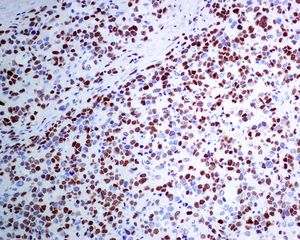
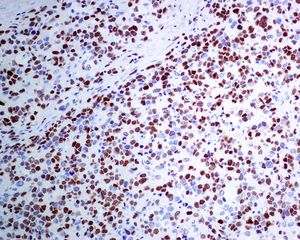
Immunohistochemistry (Formalin/PFA-fixed paraffin-embedded sections) - Anti-MyoD1 antibody (AB203383)
  • IHC-P

Supplier Data

Immunohistochemistry (Formalin/PFA-fixed paraffin-embedded sections) - Anti-MyoD1 antibody (AB203383)

Immunohistochemical analysis of formalin-fixed and paraffin embedded embryonic rhabdomyoma tissue labeling MyoD1using ab203333 at 1/200, followed by secondary detection and DAB staining.

Key facts

宿主種

Rabbit

クローン性

Polyclonal

アイソタイプ

IgG

キャリアフリー

No

交差種

Mouse, Rat, Human

アプリケーション

IHC-P, WB

applications

免疫原

Synthetic Peptide within Mouse Myod1 aa 50-150 conjugated to Keyhole Limpet Haemocyanin. The exact immunogen used to generate this antibody is proprietary information.

P10085

Reactivity data

{ "title": "Reactivity Data", "filters": { "stats": ["", "Species", "Dilution Info", "Notes"], "tabs": { "all-applications": {"fullname" : "All Applications", "shortname": "All Applications"}, "IHCP" : {"fullname" : "Immunohistochemistry (Formalin/PFA-fixed paraffin-embedded sections)", "shortname":"IHC-P"}, "WB" : {"fullname" : "Western blot", "shortname":"WB"} }, "product-promise": { "all": "all", "testedAndGuaranteed": "tested", "guaranteed": "expected", "predicted": "predicted", "notRecommended": "not-recommended" } }, "values": { "Human": { "IHCP-species-checked": "testedAndGuaranteed", "IHCP-species-dilution-info": "1/100 - 1/500", "IHCP-species-notes": "<p>Use at 1/50 - 1/200 with fluorescent detection methods.</p> Perform heat-mediated antigen retrieval with citrate buffer pH 6 before commencing with IHC staining protocol.", "WB-species-checked": "guaranteed", "WB-species-dilution-info": "", "WB-species-notes": "" }, "Mouse": { "IHCP-species-checked": "guaranteed", "IHCP-species-dilution-info": "", "IHCP-species-notes": "", "WB-species-checked": "testedAndGuaranteed", "WB-species-dilution-info": "1/100 - 1/1000", "WB-species-notes": "<p></p>" }, "Rat": { "IHCP-species-checked": "guaranteed", "IHCP-species-dilution-info": "", "IHCP-species-notes": "", "WB-species-checked": "testedAndGuaranteed", "WB-species-dilution-info": "1/100 - 1/1000", "WB-species-notes": "<p></p>" } } }

出荷温度及び保存条件

製品の状態
Liquid
精製方法
Affinity purification Protein A
バッファー組成
pH: 7.4 Preservative: 0.02% Proclin 300 Constituents: 50% Glycerol (glycerin, glycerine), 48.98% TBS, 1X, 1% BSA
出荷温度
Blue Ice
短期保存期間
1-2 weeks
短期保存温度
+4°C
長期保存温度
-20°C
分注に関する情報
Upon delivery aliquot
保管に関する情報
Avoid freeze / thaw cycle

補足情報

This supplementary information is collated from multiple sources and compiled automatically.

MyoD1 also known as Myogenic Differentiation 1 is a master regulator of muscle differentiation. It functions mechanically as a transcription factor binding to DNA at specific sequences thereby activating the transcription of genes necessary for muscle tissue development. MyoD1 has a molecular weight of approximately 45 kDa. It is expressed in skeletal muscle tissues and also detected in some non-muscle tissues though at lower levels. MyoD1 is essential in the early stages of muscle cell lineage commitment.
Biological function summary

MyoD1 plays an important role in muscle differentiation by activating muscle-specific genes. It belongs to the myogenic regulatory factor family and often operates within a protein complex alongside Myf5 and myogenin aiding in the conversion of mesodermal stem cells into muscle cells. These partnerships enhance its ability to initiate the muscle-specific gene expression that drives myogenesis. MyoD1 acts like a molecular switch shifting cells into the pathway leading to muscle formation.

Pathways

MyoD1 is an integral component of myogenesis and muscle regeneration pathways. MyoD1 interacts with key pathway components such as Myf5 and MRF4 which reinforce MyoD1 activity in muscle tissue lineage determination and cell cycle arrest during differentiation. The activity of MyoD1 in these pathways highlights its role in skeletal muscle growth. MyoD1 also demonstrates functional redundancy with Myogenin as both share overlapping roles in these critical pathways.

MyoD1 is associated with muscular dystrophy and some sarcomas. Aberrant expression or mutations in MyoD1 can disrupt normal muscle differentiation contributing to muscle-related disorders like rhabdomyosarcoma a form of cancer comprising cells resembling skeletal muscle. Its relationship with other proteins like Myf5 further highlights its role in such pathological conditions as faults in these connections can amplify or alter disease progression.

製品プロトコール

For this product, it's our understanding that no specific protocols are required. You can visit:

ターゲットの情報

Acts as a transcriptional activator that promotes transcription of muscle-specific target genes and plays a role in muscle differentiation. Together with MYF5 and MYOG, co-occupies muscle-specific gene promoter core region during myogenesis. Induces fibroblasts to differentiate into myoblasts. Interacts with and is inhibited by the twist protein. This interaction probably involves the basic domains of both proteins (By similarity).
See full target information MYOD1

文献 (23)

Recent publications for all applications. Explore the full list and refine your search

Journal of cosmetic dermatology 24:e16749 PubMed39719683

2024

Focused Electric Field Technology: A Novel Myoelectrical Stimulation Technology for Noninvasive Aging Muscle Rejuvenation.

Applications

Unspecified application

Species

Unspecified reactive species

Boyang Jiang,Bingbing Chen,Jia Xu,Jieshu Luo,Min Yao

BMB reports 57:539-545 PubMed39567207

2024

Recombinant ADAMTS1 promotes muscle cell differentiation and alleviates muscle atrophy by repressing NOTCH1.

Applications

Unspecified application

Species

Unspecified reactive species

Sang Hyup Lee,Sang Yoon Kim,Yun Gu Gwon,Chanwoo Lee,Changhwan Kim,Ick Hyun Cho,Tae-Won Kim,Bong-Keun Choi

Orthopaedic journal of sports medicine 12:23259671241252421 PubMed38840789

2024

Influence of Frequent Corticosteroid Local Injections on the Expression of Genes and Proteins Related to Fatty Infiltration, Muscle Atrophy, Inflammation, and Fibrosis in Patients With Chronic Rotator Cuff Tears: A Pilot Study.

Applications

Unspecified application

Species

Unspecified reactive species

JiHwan Lee,Taewoo Lho,Jongwon Lee,Jeongkun Lee,Seok Won Chung

NPJ microgravity 10:18 PubMed38365862

2024

Simulated microgravity attenuates myogenesis and contractile function of 3D engineered skeletal muscle tissues.

Applications

Unspecified application

Species

Unspecified reactive species

Zhanping Ren,Eun Hyun Ahn,Minjae Do,Devin B Mair,Amir Monemianesfahani,Peter H U Lee,Deok-Ho Kim

Intractable & rare diseases research 12:180-190 PubMed37662621

2023

The novel role of IFITM1-3 in myogenic differentiation of C2C12 cells.

Applications

Unspecified application

Species

Unspecified reactive species

Yongtao Zhang,Yanqin Lu,Xianxian Li,Shanshan Zhang,Pengchao Liu,Xiaoyang Hao,Jinxiang Han

Advanced healthcare materials 12:e2203056 PubMed36782053

2023

Hierarchically Injectable Hydrogel Sequentially Delivers AntagomiR-467a-3p-Loaded and AntagomiR-874-5p-Loaded Satellite-Cell-Targeting Bioengineered Extracellular Vesicles Attenuating Sarcopenia.

Applications

Unspecified application

Species

Unspecified reactive species

Hanhao Dai,Jun Luo,Lili Deng,Chao Song,Zhibo Deng,Yijing Wu,Song Gu,Jie Xu

Evidence-based complementary and alternative medicine : eCAM 2022:2695679 PubMed35966754

2022

Electroacupuncture of Weizhong (BL-40) Acupoint Inspires Muscular Satellite Cell Regeneration and Promotes Muscle Repair Capacity after Back Muscle Injury in Sprague-Dawley Rat Model.

Applications

Unspecified application

Species

Unspecified reactive species

Bi-Xiu Huo,Zhi-Ling Wang,Ying-Qian Jiao,Xiao-Yi Wang,Yan-Li Lang,Yong-Jun Mi,Zhi-Xin Li,Zhi-Zhong Ma

Journal of orthopaedic translation 35:23-36 PubMed35846725

2022

Inhibiting uptake of extracellular vesicles derived from senescent bone marrow mesenchymal stem cells by muscle satellite cells attenuates sarcopenia.

Applications

Unspecified application

Species

Unspecified reactive species

Hanhao Dai,Wu Zheng,Jun Luo,Guoyu Yu,Chao Song,Yijing Wu,Jie Xu

Frontiers in endocrinology 12:693977 PubMed34484115

2021

An Study on Extracellular Vesicles From Adipose-Derived Mesenchymal Stem Cells in Protecting Stress Urinary Incontinence Through MicroRNA-93/F3 Axis.

Applications

Unspecified application

Species

Unspecified reactive species

Lu Wang,Yali Wang,Yuancui Xiang,Jinping Ma,Hui Zhang,Jingfang Dai,Yanan Hou,Yupei Yang,Jingru Ma,Hongjuan Li

International journal of molecular medicine 48: PubMed34080654

2021

Role and mechanism underlying FoxO6 in skeletal muscle and .

Applications

Unspecified application

Species

Unspecified reactive species

Lei Zhang,Yiyi Zhang,Min Zhou,Shuang Wang,Tiane Li,Zhangyong Hu,Chengwu Jin
View all publications

Abcam product promise

当社は、高品質な試薬を通じてお客様の研究を力強くサポートすることをお約束いたします。ご使用いただく各段階で、常にお客様をサポートできる体制を整えております。万が一、製品が期待通りに機能しない場合は、「Abcam Product Promise」による当社保証制度に基づき、安心してご利用いただけます。
保証に関する詳細については利用規約をご確認ください。

Please note: All products are 'FOR RESEARCH USE ONLY. NOT FOR USE IN DIAGNOSTIC OR THERAPEUTIC PROCEDURES'.

For licensing inquiries, please contact partnerships@abcam.com