Anti-MIRO1 抗体 [MJF-D29136-145] - BSA and Azide free (Detector)
Anti-MIRO1 antibody [MJF-D29136-145] - BSA and Azide free (Detector)
- Recombinant
- RabMAb
- KO Validated
- 詳細を見る
Be the first to review this product! Submit a review
|
(0 Publication)
Knockout Tested Rabbit Recombinant Monoclonal MIRO1 antibody. Carrier free. Suitable for sELISA and reacts with Human, Mouse, Rat samples.
別名を表示する
ARHT1, RHOT1, Mitochondrial Rho GTPase 1, MIRO-1, hMiro-1, Rac-GTP-binding protein-like protein, Ras homolog gene family member T1
- sELISA
Supplier Data
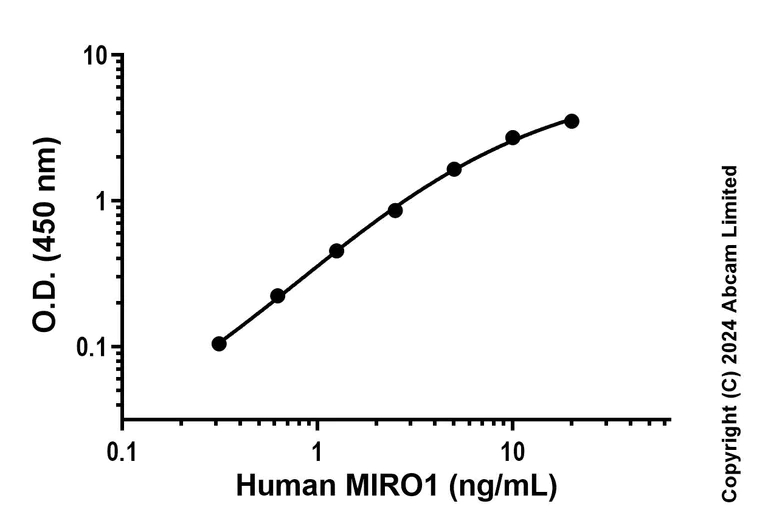
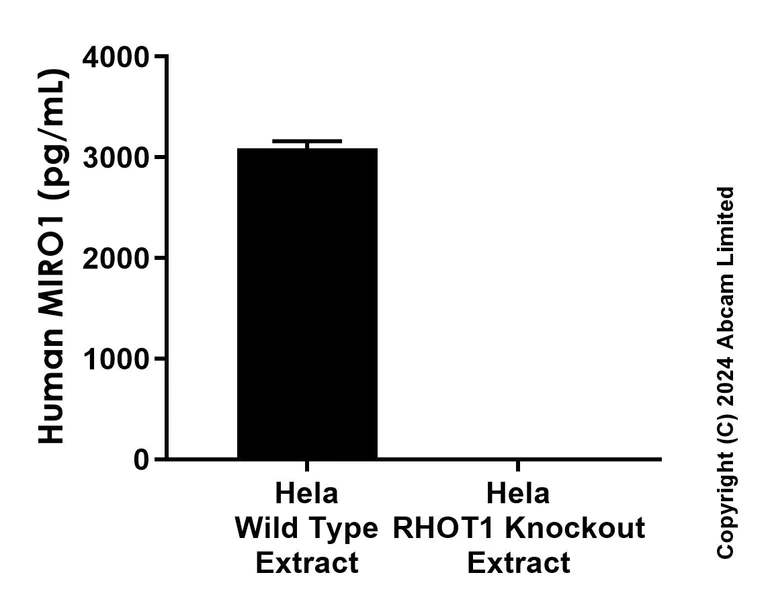
Sandwich ELISA - Anti-MIRO1 antibody [MJF-D29136-145] - BSA and Azide free (Detector) (AB320019)
Interpolated concentrations of native MIRO1 in human control wild type HeLa (human cervical adenocarcinoma epithelial cell) and RHOT1 (MIRO1) knockout HeLa cell based on 250 ug/mL extract loads. The concentrations of MIRO1 were measured in duplicate and interpolated from the MIRO1 standard curve and corrected for sample dilution. The interpolated dilution factor corrected values are plotted (mean +/- SD, n=2). The mean MIRO1 concentration was determined to be 3087.8 pg/mL in wild type HeLa extract (Human wild-type HeLa cell line ab255928) and undetectable in RHOT1 (MIRO1) knockout HeLa extract (Human RHOT1 (MIRO1) knockout HeLa cell line ab265792).
組合せ製品

Primary Antibodies
AB320739
Anti-MIRO2 antibody [EPR29118-85]
BOND RX™ Validated|20ul selling size|KO Validated|Recombinant|RabMAb
- 0
- 0
Primary Antibodies
AB124773
Anti-Mitofusin 2 antibody [NIAR164]
20ul selling size|KO Validated|RabMAb|Recombinant
- 4
- 6
Reactivity data
製品の詳細
ab320019 is a BSA and Azide free antibody supplied in an unconjugated format and it is suitable for sandwich ELISAs to quantify MIRO1. The recommended pair for sandwich ELISA is:
Capture: ab320018, MIRO1 Capture Antibody (unconjugated)
Detector: ab320019, MIRO1 Detector Antibody (unconjugated)
The reference range value is 0.31-20 ng/mL.
The recommended antibody orientation is based on internal optimization for ELISAbased assays. Antibody orientation is assay dependent and needs to be optimized for each assay type. Please note that the range provided for this antibody is only an estimation based on the performance of the product using the recommended antibody pair. Performance of the antibody pair will depend on the specific characteristics of your assay. We guarantee the product works in sandwich ELISA, but we do not guarantee the sensitivity or dynamic range of the antibody in your assay.
Our carrier-free formats are supplied in a buffer free of BSA, sodium azide and glycerol for higher conjugation efficiency. The antibodies are provided at an approximate concentration of 1 mg/ml as measured by the protein A280 method. Use our conjugation kits for antibody conjugates that are ready-to-use in as little as 20 minutes with <1 minute hands-on-time and 100% antibody recovery: available for fluorescent dyes, HRP, biotin and gold.
Patented technology
Our RabMAb® technology is a patented hybridoma-based technology for making rabbit monoclonal antibodies. For details on our patents, please refer to RabMAb® patents.
What are the advantages of a recombinant monoclonal antibody?
This product is a recombinant monoclonal antibody, which offers several advantages including:
- - High batch-to-batch consistency and reproducibility
- - Improved sensitivity and specificity
- - Long-term security of supply
- - Animal-free batch production
For more information, read more on recombinant antibodies.
Conjugation ready
Our carrier-free antibodies are typically supplied in a PBS-only formulation, purified and free of BSA, sodium azide and glycerol. This conjugation-ready format is designed for use with fluorochromes, metal isotopes, oligonucleotides, and enzymes, which makes them ideal for antibody labelling, functional and cell-based assays, flow-based assays (e.g. mass cytometry) and Multiplex Imaging applications.
Use our conjugation kits for antibody conjugates that are ready-to-use in as little as 20 minutes with 1 minute hands-on-time and 100% antibody recovery: available for fluorescent dyes, HRP, biotin and gold.
Collaborations
This antibody was developed with support from The Michael J. Fox Foundation.

出荷温度及び保存条件
製品の状態
精製方法
バッファー組成
出荷温度
短期保存温度
長期保存温度
補足情報
This supplementary information is collated from multiple sources and compiled automatically.
Biological function summary
MIRO1 plays a significant role in regulating mitochondrial trafficking along the cytoskeleton. It forms part of a protein complex with TRAK1/2 kinesin and dynein motor proteins. MIRO1's presence in this complex allows it to modulate mitochondrial distribution and dynamics which are essential for neural development and function. It also influences mitochondrial shape and interaction with the endoplasmic reticulum impacting intracellular calcium homeostasis.
Pathways
MIRO1 is an integral component of pathways involving mitochondrial transport and cellular energy homeostasis. It actively participates in the regulation of calcium signaling pathways alongside related proteins like TRAK1. Additionally MIRO1's involvement in the maintenance of mitochondrial dynamics links it to mitophagy pathways. These pathways regulate the removal of damaged mitochondria a vital process for cellular health and longevity.
製品プロトコール
- Visit the General protocols
- Visit the Troubleshooting
ターゲットの情報
Abcam product promise
Please note: All products are 'FOR RESEARCH USE ONLY. NOT FOR USE IN DIAGNOSTIC OR THERAPEUTIC PROCEDURES'.
For licensing inquiries, please contact partnerships@abcam.com