JavaScript is disabled in your browser. Please enable JavaScript to view this website.
AB315877

Anti-MCPIP1 抗体 [EPR26062-59]

Anti-MCPIP1 antibody [EPR26062-59]

Be the first to review this product! Submit a review

|

(0 Publication)

Anti-MCPIP1 antibody [EPR26062-59] (ab315877) is a rabbit monoclonal antibody detecting MCPIP1 in Western Blot, Dot Blot. Suitable for Human, Mouse.

- Biophysical QC for unrivalled batch-batch consistency

別名を表示する

MCPIP, MCPIP1, ZC3H12A, Endoribonuclease ZC3H12A, Monocyte chemotactic protein-induced protein 1, Regnase-1, Zinc finger CCCH domain-containing protein 12A, MCP-induced protein 1, MCPIP-1, Reg1
5 Images
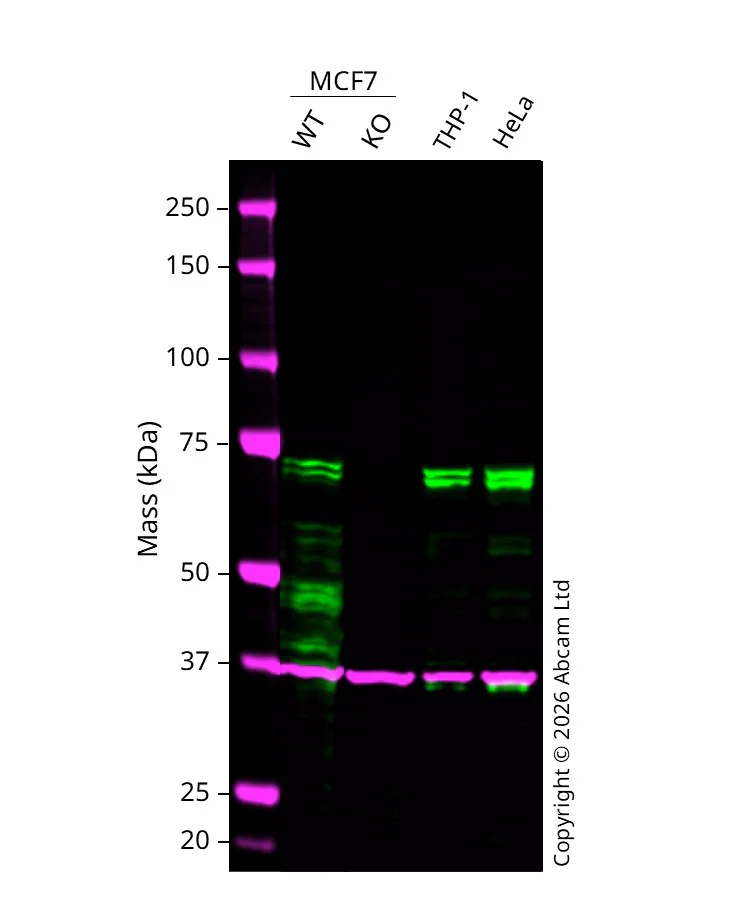
Western blot - Anti-MCPIP1 antibody [EPR26062-59] (AB315877)
  • WB

Lab

Western blot - Anti-MCPIP1 antibody [EPR26062-59] (AB315877)

Western blot : Anti-MCPIP1 antibody [EPR26062-59] ab315877 staining at 1/1000 dilution, shown in green; Mouse anti GAPDH ab8245 loading control staining at 1/20000 dilution, shown in magenta. A band was observed at 70 kDa in Wild-type MCF7 cell lysates with no signal observed at this size in ZC3H12A knockout MCF7 cell line. To generate this image, samples were run on an SDS-PAGE gel then transferred onto a nitrocellulose membrane. Membranes were blocked in 5% Milk in TBS-0.1 % Tween® 20 (TBS-T) before incubation with primary antibodies overnight at 4 °C. Blots were washed four times in TBS-T, incubated with secondary antibodies for 1 h at room temperature, washed again four times then imaged. Secondary antibodies used were Goat anti-Rabbit 800CW and Goat anti-Mouse 680RD at 1/20,000 dilution.

All lanes:

Western blot - Anti-MCPIP1 antibody [EPR26062-59] (ab315877) at 1/1000 dilution

Lane 1:

Wild-type MCF7 cell lysates at 40 µg

Lane 2:

ZC3H12A knockout MCF7 cell lysates at 40 µg

Lane 3:

THP-1 cell lysates at 20 µg

Lane 4:

HeLa cell lysates at 20 µg

Secondary

All lanes:

Goat anti-Rabbit 800CW & Goat anti-Mouse 680RD at 1/20000 dilution

Predicted band size: 66 kDa

Observed band size: 70 kDa

false
Western blot - Anti-MCPIP1 antibody [EPR26062-59] (AB315877)
  • WB

Supplier Data

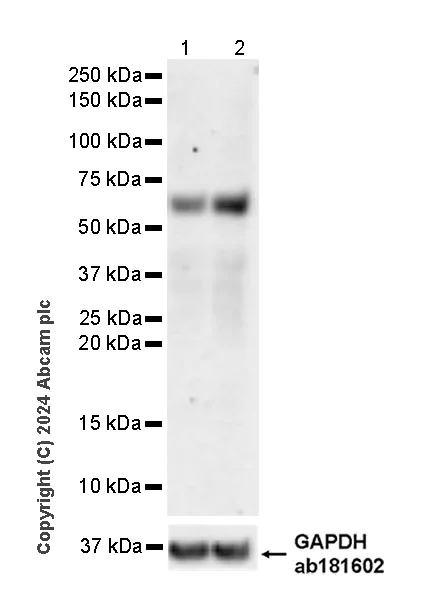
Western blot - Anti-MCPIP1 antibody [EPR26062-59] (AB315877)

MCPIP1 expression can be induced by TNF alpha treatment (PMID : 18178554).

In Western blot, Anti-GAPDH antibody [EPR16891] - Loading Control (ab181602) staining at 1/200000 dilution.

All lanes:

Western blot - Anti-MCPIP1 antibody [EPR26062-59] (ab315877) at 1/1000 dilution

Lane 1:

Untreated THP-1 (human monocytic leukemia monocyte) whole cell lysate at 20 µg

Lane 2:

THP-1 treated with /ml TNF alpha for 8 hours whole cell lysate at 20 µg

Secondary

All lanes:

Western blot - Goat Anti-Rabbit IgG H&L (HRP) (<a href='/products/secondary-antibodies/goat-rabbit-igg-h-l-hrp-ab97051'>ab97051</a>) at 1/20000 dilution

Observed band size: 70 kDa,36 kDa

false

Exposure time: 121s
Western blot - Anti-MCPIP1 antibody [EPR26062-59] (AB315877)
  • WB

Supplier Data

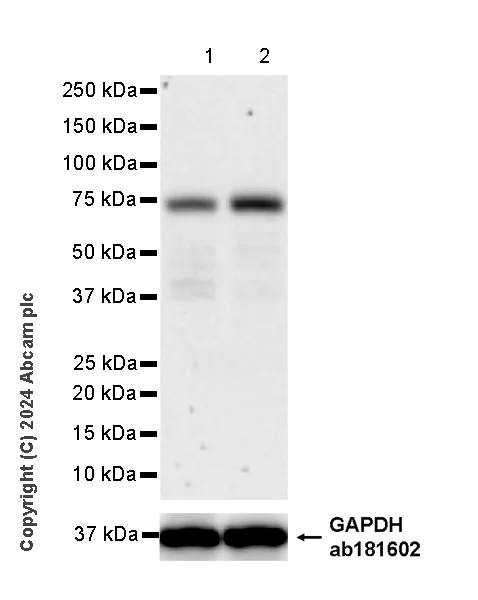
Western blot - Anti-MCPIP1 antibody [EPR26062-59] (AB315877)

In Western blot, Anti-GAPDH antibody [EPR16891] - Loading Control (ab181602) staining at 1/200000 dilution.

All lanes:

Western blot - Anti-MCPIP1 antibody [EPR26062-59] (ab315877) at 1/1000 dilution

Lane 1:

HeLa (human cervix adenocarcinoma epithelial cell) whole cell lysate at 20 µg

Lane 2:

Raji (human Burkitts lymphoma B lymphocyte) whole cell lysate at 20 µg

Secondary

All lanes:

Western blot - Goat Anti-Rabbit IgG H&L (HRP) (<a href='/products/secondary-antibodies/goat-rabbit-igg-h-l-hrp-ab97051'>ab97051</a>) at 1/20000 dilution

Observed band size: 70 kDa,36 kDa

false

Exposure time: 147s
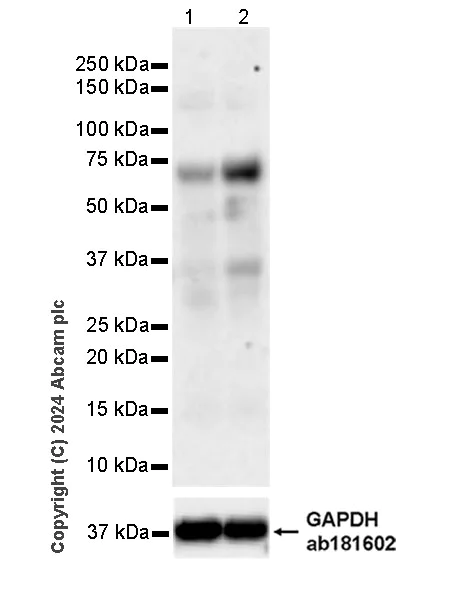
Western blot - Anti-MCPIP1 antibody [EPR26062-59] (AB315877)
  • WB

Supplier Data

Western blot - Anti-MCPIP1 antibody [EPR26062-59] (AB315877)

MCPIP1 expression can be induced by LPS treatment (PMID : 18178554, 30811042).

The identity of the lower MW bands are unknown.

In Western blot, Anti-GAPDH antibody [EPR16891] - Loading Control (ab181602) staining at 1/200000 dilution.

All lanes:

Western blot - Anti-MCPIP1 antibody [EPR26062-59] (ab315877) at 1/1000 dilution

Lane 1:

Untreated RAW264.7 (mouse Abelson murine leukemia virus-induced tumor macrophage) whole cell lysate at 20 µg

Lane 2:

RAW264.7 treated with 500ng/ml LPS for 6 hours whole cell lysate at 20 µg

Secondary

All lanes:

Western blot - Goat Anti-Rabbit IgG H&L (HRP) (<a href='/products/secondary-antibodies/goat-rabbit-igg-h-l-hrp-ab97051'>ab97051</a>) at 1/20000 dilution

Observed band size: 70 kDa,36 kDa

false

Exposure time: 136s
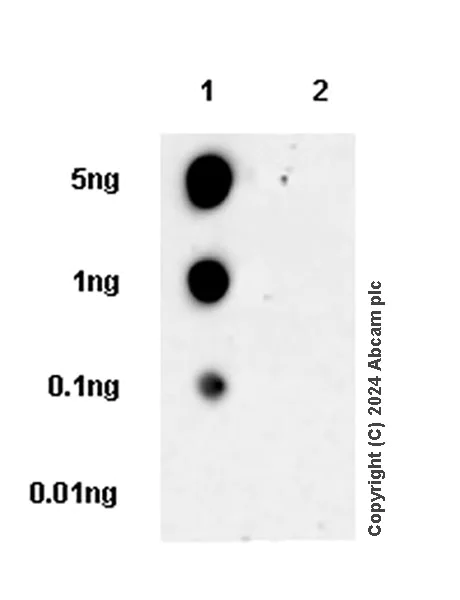
Dot Blot - Anti-MCPIP1 antibody [EPR26062-59] (AB315877)
  • Dot

Supplier Data

Dot Blot - Anti-MCPIP1 antibody [EPR26062-59] (AB315877)

Dot blot analysis of MCPIP1 using ab315877 at 1 : 1000 (0.531 ug/ml) followed by a Goat Anti-Rabbit IgG, (H+L), Peroxidase conjugated (ab97051) at 1 : 100,000 dilution.

Blocking and diluting buffer and concentration : 5% NFDM/TBST.

All lanes:

Dot Blot - Anti-MCPIP1 antibody [EPR26062-59] (ab315877) at 1/1000 dilution

Lane 1:

Human MCPIP1 peptide

Lane 2:

Human MCPIP2 peptide

Secondary

All lanes:

Dot Blot - Goat Anti-Rabbit IgG H&L (HRP) (<a href='/products/secondary-antibodies/goat-rabbit-igg-h-l-hrp-ab97051'>ab97051</a>) at 1/100000 dilution

false

Exposure time: 180s

関連する標識済み抗体及び組成の異なる製品 (1)

  • Carrier free

    Anti-MCPIP1 antibody [EPR26062-59] - BSA and Azide free

Key facts

宿主種

Rabbit

クローン性

Monoclonal

クローン番号

EPR26062-59

アイソタイプ

IgG

キャリアフリー

No

交差種

Human, Mouse

アプリケーション

WB, Dot

applications

免疫原

The exact immunogen used to generate this antibody is proprietary information.

Reactivity data

{ "title": "Reactivity Data", "filters": { "stats": ["", "Species", "Dilution Info", "Notes"], "tabs": { "all-applications": {"fullname" : "All Applications", "shortname": "All Applications"}, "Dot" : {"fullname" : "Dot Blot", "shortname":"Dot"}, "WB" : {"fullname" : "Western blot", "shortname":"WB"}, "IP" : {"fullname" : "Immunoprecipitation", "shortname":"IP"}, "IHCP" : {"fullname" : "Immunohistochemistry (Formalin/PFA-fixed paraffin-embedded sections)", "shortname":"IHC-P"}, "ICCIF" : {"fullname" : "Immunocytochemistry/ Immunofluorescence", "shortname":"ICC/IF"}, "FlowCytIntra" : {"fullname" : "Flow Cytometry (Intracellular)", "shortname":"Flow Cyt (Intra)"} }, "product-promise": { "all": "all", "testedAndGuaranteed": "tested", "guaranteed": "expected", "predicted": "predicted", "notRecommended": "not-recommended" } }, "values": { "Human": { "Dot-species-checked": "guaranteed", "Dot-species-dilution-info": "", "Dot-species-notes": "", "WB-species-checked": "testedAndGuaranteed", "WB-species-dilution-info": "1/1000", "WB-species-notes": "<p></p>", "IP-species-checked": "notRecommended", "IP-species-dilution-info": "", "IP-species-notes": "<p></p>", "IHCP-species-checked": "notRecommended", "IHCP-species-dilution-info": "", "IHCP-species-notes": "<p></p>", "ICCIF-species-checked": "notRecommended", "ICCIF-species-dilution-info": "", "ICCIF-species-notes": "<p></p>", "FlowCytIntra-species-checked": "notRecommended", "FlowCytIntra-species-dilution-info": "", "FlowCytIntra-species-notes": "<p></p>" }, "Mouse": { "Dot-species-checked": "guaranteed", "Dot-species-dilution-info": "", "Dot-species-notes": "", "WB-species-checked": "testedAndGuaranteed", "WB-species-dilution-info": "1/1000", "WB-species-notes": "<p></p>", "IP-species-checked": "notRecommended", "IP-species-dilution-info": "", "IP-species-notes": "", "IHCP-species-checked": "notRecommended", "IHCP-species-dilution-info": "", "IHCP-species-notes": "<p></p>", "ICCIF-species-checked": "notRecommended", "ICCIF-species-dilution-info": "", "ICCIF-species-notes": "<p></p>", "FlowCytIntra-species-checked": "notRecommended", "FlowCytIntra-species-dilution-info": "", "FlowCytIntra-species-notes": "<p></p>" }, "Rat": { "Dot-species-checked": "notRecommended", "Dot-species-dilution-info": "", "Dot-species-notes": "", "WB-species-checked": "notRecommended", "WB-species-dilution-info": "", "WB-species-notes": "<p></p>", "IP-species-checked": "notRecommended", "IP-species-dilution-info": "", "IP-species-notes": "", "IHCP-species-checked": "notRecommended", "IHCP-species-dilution-info": "", "IHCP-species-notes": "<p></p>", "ICCIF-species-checked": "notRecommended", "ICCIF-species-dilution-info": "", "ICCIF-species-notes": "", "FlowCytIntra-species-checked": "notRecommended", "FlowCytIntra-species-dilution-info": "", "FlowCytIntra-species-notes": "" }, "Synthetic peptide - Human": { "Dot-species-checked": "testedAndGuaranteed", "Dot-species-dilution-info": "1/1000", "Dot-species-notes": "<p></p>", "WB-species-checked": "notRecommended", "WB-species-dilution-info": "", "WB-species-notes": "", "IP-species-checked": "notRecommended", "IP-species-dilution-info": "", "IP-species-notes": "", "IHCP-species-checked": "notRecommended", "IHCP-species-dilution-info": "", "IHCP-species-notes": "", "ICCIF-species-checked": "notRecommended", "ICCIF-species-dilution-info": "", "ICCIF-species-notes": "", "FlowCytIntra-species-checked": "notRecommended", "FlowCytIntra-species-dilution-info": "", "FlowCytIntra-species-notes": "" } } }

製品の詳細

What is this antibody validated in?
Anti-MCPIP1 antibody [EPR26062-59] (ab315877) is a rabbit recombinant monoclonal antibody and is validated for use in Western Blot (WB), Dot Blot in Human, Mouse samples.

What is the molecular weight of MCPIP1?
Anti-MCPIP1 [EPR26062-59] (ab315877) specifically detects a band for MCPIP1 (UniProt: Q5D1E8) at a molecular weight of 65kDa.

Other related products
We have a range of other formats of antibody clone [EPR26062-59] also available for your convenience: ab315877, Carrier free - ab315878

Patented technology
Our RabMAb® technology is a patented hybridoma-based technology for making rabbit monoclonal antibodies. For details on our patents, please refer to RabMAb® patents.

What are the advantages of a recombinant monoclonal antibody?
This product is a recombinant monoclonal antibody, which offers several advantages including:

  • - High batch-to-batch consistency and reproducibility
  • - Improved sensitivity and specificity
  • - Long-term security of supply
  • - Animal-free batch production

For more information, read more on recombinant antibodies.

Trial sizes available!
Test your antibody or perform pre-screening before committing to a larger quantity. Sold in 20µl. Discover our selection of trial-size antibodies.

出荷温度及び保存条件

製品の状態
Liquid
精製方法
Affinity purification Protein A
バッファー組成
pH: 7.2 - 7.4 Preservative: 0.01% Sodium azide Constituents: PBS, 40% Glycerol (glycerin, glycerine), 0.05% BSA
出荷温度
Conditional Ambient
短期保存期間
1-2 weeks
短期保存温度
+4°C
長期保存温度
-20°C
分注に関する情報
Upon delivery aliquot
保管に関する情報
Avoid freeze / thaw cycle

補足情報

This supplementary information is collated from multiple sources and compiled automatically.

The MCPIP1 (Monocyte Chemotactic Protein-Induced Protein 1) also known by the name Regnase-1 is a protein involved in RNA degradation and inflammation regulation. It acts as an RNase specifically targeting mRNAs for degradation impacting gene expression post-transcriptionally. The protein weighs around 66 kDa and shows expression in various tissues including heart spleen and macrophages. MCPIP1 also demonstrates notable expression in response to external stimuli like lipopolysaccharides.
Biological function summary

MCPIP1 modulates the immune response and inflammation by degrading mRNA of cytokines. Its action helps in controlling inflammation and immune response duration. MCPIP1 interacts with cellular complexes that manage mRNA stability including those involved in decay processes. This activity positions MCPIP1 as a regulator in the production of pro-inflammatory cytokines contributing to the cellular response to external pathogens.

Pathways

MCPIP1 functions within the inflammatory and immune signaling pathways. It is involved in the MAPK pathway which regulates gene expression in response to stress and cytokines. MCPIP1 also interacts with proteins such as TNF-alpha and IL-6 linking it to the inflammatory signaling cascade. These interactions highlight MCPIP1's role in mediating immune and inflammatory pathways contributing to maintaining cellular homeostasis.

MCPIP1 connections relate to inflammatory diseases and autoimmune disorders. Aberrant expression or malfunction of MCPIP1 associates with pathological conditions including rheumatoid arthritis and systemic lupus erythematosus. The regulation of cytokines by MCPIP1 positions it centrally in these conditions as inappropriate levels of proteins like IL-6 and TNF-alpha contribute to disease progression. Consequently MCPIP1 serves as a potential therapeutic target in managing inflammation-driven diseases.

製品プロトコール

For this product, it's our understanding that no specific protocols are required. You can visit:

ターゲットの情報

Endoribonuclease involved in various biological functions such as cellular inflammatory response and immune homeostasis, glial differentiation of neuroprogenitor cells, cell death of cardiomyocytes, adipogenesis and angiogenesis. Functions as an endoribonuclease involved in mRNA decay (PubMed : 19909337). Modulates the inflammatory response by promoting the degradation of a set of translationally active cytokine-induced inflammation-related mRNAs, such as IL6 and IL12B, during the early phase of inflammation (PubMed : 26320658). Prevents aberrant T-cell-mediated immune reaction by degradation of multiple mRNAs controlling T-cell activation, such as those encoding cytokines (IL6 and IL2), cell surface receptors (ICOS, TNFRSF4 and TNFR2) and transcription factor (REL) (By similarity). Inhibits cooperatively with ZC3H12A the differentiation of helper T cells Th17 in lungs. They repress target mRNA encoding the Th17 cell-promoting factors IL6, ICOS, REL, IRF4, NFKBID and NFKBIZ. The cooperation requires RNA-binding by RC3H1 and the nuclease activity of ZC3H12A (By similarity). Together with RC3H1, destabilizes TNFRSF4/OX40 mRNA by binding to the conserved stem loop structure in its 3'UTR (By similarity). Self regulates by destabilizing its own mRNA (By similarity). Cleaves mRNA harboring a stem-loop (SL), often located in their 3'-UTRs, during the early phase of inflammation in a helicase UPF1-dependent manner (PubMed : 19909337, PubMed : 22561375, PubMed : 26134560, PubMed : 26320658). Plays a role in the inhibition of microRNAs (miRNAs) biogenesis (PubMed : 22055188). Cleaves the terminal loop of a set of precursor miRNAs (pre-miRNAs) important for the regulation of the inflammatory response leading to their degradation, and thus preventing the biosynthesis of mature miRNAs (PubMed : 22055188). Also plays a role in promoting angiogenesis in response to inflammatory cytokines by inhibiting the production of antiangiogenic microRNAs via its anti-dicer RNase activity (PubMed : 24048733). Affects the overall ubiquitination of cellular proteins (By similarity). Positively regulates deubiquitinase activity promoting the cleavage at 'Lys-48'- and 'Lys-63'-linked polyubiquitin chains on TNF receptor-associated factors (TRAFs), preventing JNK and NF-kappa-B signaling pathway activation, and hence negatively regulating macrophage-mediated inflammatory response and immune homeostasis (By similarity). Also induces deubiquitination of the transcription factor HIF1A, probably leading to its stabilization and nuclear import, thereby positively regulating the expression of proangiogenic HIF1A-targeted genes (PubMed : 24048733). Involved in a TANK-dependent negative feedback response to attenuate NF-kappaB activation through the deubiquitination of IKBKG or TRAF6 in response to interleukin-1-beta (IL1B) stimulation or upon DNA damage (PubMed : 25861989). Prevents stress granule (SGs) formation and promotes macrophage apoptosis under stress conditions, including arsenite-induced oxidative stress, heat shock and energy deprivation (By similarity). Plays a role in the regulation of macrophage polarization; promotes IL4-induced polarization of macrophages M1 into anti-inflammatory M2 state (By similarity). May also act as a transcription factor that regulates the expression of multiple genes involved in inflammatory response, angiogenesis, adipogenesis and apoptosis (PubMed : 16574901, PubMed : 18364357). Functions as a positive regulator of glial differentiation of neuroprogenitor cells through an amyloid precursor protein (APP)-dependent signaling pathway (PubMed : 19185603). Attenuates septic myocardial contractile dysfunction in response to lipopolysaccharide (LPS) by reducing I-kappa-B-kinase (IKK)-mediated NF-kappa-B activation, and hence myocardial pro-inflammatory cytokine production (By similarity).. (Microbial infection) Binds to Japanese encephalitis virus (JEV) and Dengue virus (DEN) RNAs.. (Microbial infection) Exhibits antiviral activity against HIV-1 in lymphocytes by decreasing the abundance of HIV-1 viral RNA species.
See full target information ZC3H12A

Abcam product promise

当社は、高品質な試薬を通じてお客様の研究を力強くサポートすることをお約束いたします。ご使用いただく各段階で、常にお客様をサポートできる体制を整えております。万が一、製品が期待通りに機能しない場合は、「Abcam Product Promise」による当社保証制度に基づき、安心してご利用いただけます。
保証に関する詳細については利用規約をご確認ください。

Please note: All products are 'FOR RESEARCH USE ONLY. NOT FOR USE IN DIAGNOSTIC OR THERAPEUTIC PROCEDURES'.

For licensing inquiries, please contact partnerships@abcam.com