JavaScript is disabled in your browser. Please enable JavaScript to view this website.
AB222242

Anti-MBNL2 抗体

Anti-MBNL2 antibody

4

(1 Review)

|

(2 Publications)

Rabbit Polyclonal MBNL2 antibody. Suitable for ICC/IF and reacts with Human samples. Cited in 2 publications. Immunogen corresponding to Recombinant Fragment Protein within Human MBNL2 aa 50-150.

別名を表示する

MBLL, MBLL39, MLP1, MBNL2, Muscleblind-like protein 2, Muscleblind-like protein 1, Muscleblind-like protein-like, Muscleblind-like protein-like 39
1 Images
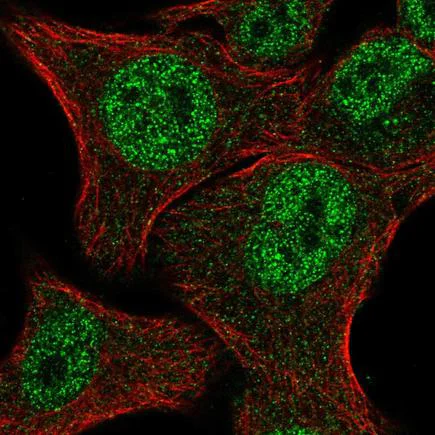
Immunocytochemistry/ Immunofluorescence - Anti-MBNL2 antibody (AB222242)
  • ICC/IF

Supplier Data

Immunocytochemistry/ Immunofluorescence - Anti-MBNL2 antibody (AB222242)

4% paraformaldehyde-fixed, 0.1% Triton X-100 permeabilized SK-MEL-30 cells stained for MBNL2 (green) using ab222242 at 4 μg/ml in ICC/IF.

Key facts

宿主種

Rabbit

クローン性

Polyclonal

アイソタイプ

IgG

キャリアフリー

No

交差種

Human

アプリケーション

ICC/IF

applications

免疫原

Recombinant Fragment Protein within Human MBNL2 aa 50-150. The exact immunogen used to generate this antibody is proprietary information.

Q5VZF2

Reactivity data

{ "title": "Reactivity Data", "filters": { "stats": ["", "Species", "Dilution Info", "Notes"], "tabs": { "all-applications": {"fullname" : "All Applications", "shortname": "All Applications"}, "ICCIF" : {"fullname" : "Immunocytochemistry/ Immunofluorescence", "shortname":"ICC/IF"} }, "product-promise": { "all": "all", "testedAndGuaranteed": "tested", "guaranteed": "expected", "predicted": "predicted", "notRecommended": "not-recommended" } }, "values": { "Human": { "ICCIF-species-checked": "testedAndGuaranteed", "ICCIF-species-dilution-info": "0.25-2 µg/mL", "ICCIF-species-notes": "<p>Fixation/Permeabilization: PFA/Triton X-100.</p>" }, "Mouse": { "ICCIF-species-checked": "predicted", "ICCIF-species-dilution-info": "", "ICCIF-species-notes": "" }, "Rat": { "ICCIF-species-checked": "predicted", "ICCIF-species-dilution-info": "", "ICCIF-species-notes": "" }, "Orangutan": { "ICCIF-species-checked": "predicted", "ICCIF-species-dilution-info": "", "ICCIF-species-notes": "" } } }

出荷温度及び保存条件

製品の状態
Liquid
精製方法
Affinity purification Immunogen
バッファー組成
pH: 7.2 Preservative: 0.02% Sodium azide Constituents: PBS, 40% Glycerol (glycerin, glycerine)
出荷温度
Blue Ice
短期保存期間
1-2 weeks
短期保存温度
+4°C
長期保存温度
-20°C
分注に関する情報
Upon delivery aliquot
保管に関する情報
Avoid freeze / thaw cycle

補足情報

This supplementary information is collated from multiple sources and compiled automatically.

Muscleblind-like 2 (MBNL2) is an RNA-binding protein important for alternative splicing regulation with a mass approximately 39 kDa. Scientists also call it MBNL2. It is a member of the muscleblind-like protein family and displays extensive expression in skeletal muscle heart and brain tissues. MBNL2 contains four zinc finger domains typical for nucleic acid binding and interacts with pre-mRNA to influence splicing stability and translation processes. This interaction contributes to the regulation of diverse cellular activities.
Biological function summary

MBNL2 plays significant roles in the control of RNA splicing editing and transport. It does not work alone but often operates as part of a larger protein complex. The protein influences post-transcriptional gene expression and is essential for maintaining the proper isoform expression of various target proteins. This regulation affects development differentiation and function of muscle and neuronal tissues. MBNL2 serves as an important player in adjusting splicing patterns in response to cellular signals and stresses impacting the cell's adaptability and function.

Pathways

MBNL2 is intimately involved in the myotonic dystrophy splicing pathway affecting muscle and neuron function. It has a functional relationship with other muscleblind-like proteins such as MBNL1. These proteins collectively collaborate to regulate exon inclusion and exclusion in response to physiological changes. Furthermore MBNL2 participates in the circadian rhythm pathway influencing how cells adapt to daily environmental variations. It modulates the expression and processing of transcripts central to maintaining circadian clock accuracy and stability.

Dysfunction of MBNL2 associates with myotonic dystrophy type 1 (DM1) where abnormal repeats in RNA bind to the protein sequestering it away from normal splicing targets. This sequestration results in mis-splicing of many pre-mRNAs leading to symptoms linked with the disease. In DM1 MBNL2 works dynamically with MBNL1 to maintain splicing patterns and disruptions in their function cause overlapping yet distinct disease phenotypes. Additionally improper regulation of MBNL2 also connects to certain neurodegenerative conditions where alternative splicing errors contribute to pathology.

製品プロトコール

For this product, it's our understanding that no specific protocols are required. You can visit:

ターゲットの情報

Mediates pre-mRNA alternative splicing regulation. Acts either as activator or repressor of splicing on specific pre-mRNA targets. Inhibits cardiac troponin-T (TNNT2) pre-mRNA exon inclusion but induces insulin receptor (IR) pre-mRNA exon inclusion in muscle. Antagonizes the alternative splicing activity pattern of CELF proteins. RNA-binding protein that binds to 5'ACACCC-3' core sequence, termed zipcode, within the 3'UTR of ITGA3. Binds to CUG triplet repeat expansion in myotonic dystrophy muscle cells by sequestering the target RNAs. Together with RNA binding proteins RBPMS and RBFOX2, activates vascular smooth muscle cells alternative splicing events (By similarity). Regulates NCOR2 alternative splicing (By similarity). Seems to regulate expression and localization of ITGA3 by transporting it from the nucleus to cytoplasm at adhesion plaques. May play a role in myotonic dystrophy pathophysiology (DM).
See full target information MBNL2

文献 (2)

Recent publications for all applications. Explore the full list and refine your search

Biomedicines 12: PubMed38540147

2024

Circulating Exosomes from Septic Mice Activate NF-κB/MIR17HG Pathway in Macrophages.

Applications

Unspecified application

Species

Unspecified reactive species

Shao-Chun Wu,Cheng-Shyuan Rau,Yi-Chan Wu,Chia-Jung Wu,Chia-Wen Tsai,Lien-Hung Huang,Chia-Wei Lin,Tsu-Hsiang Lu,Ming-Yu Yang,Ching-Hua Hsieh

EMBO molecular medicine 13:e13228 PubMed33724658

2021

Targeted genome editing in vivo corrects a Dmd duplication restoring wild-type dystrophin expression.

Applications

Unspecified application

Species

Unspecified reactive species

Eleonora Maino,Daria Wojtal,Sonia L Evagelou,Aiman Farheen,Tatianna W Y Wong,Kyle Lindsay,Ori Scott,Samar Z Rizvi,Elzbieta Hyatt,Matthew Rok,Shagana Visuvanathan,Amanda Chiodo,Michelle Schneeweiss,Evgueni A Ivakine,Ronald D Cohn
View all publications

Abcam product promise

当社は、高品質な試薬を通じてお客様の研究を力強くサポートすることをお約束いたします。ご使用いただく各段階で、常にお客様をサポートできる体制を整えております。万が一、製品が期待通りに機能しない場合は、「Abcam Product Promise」による当社保証制度に基づき、安心してご利用いただけます。
保証に関する詳細については利用規約をご確認ください。

Please note: All products are 'FOR RESEARCH USE ONLY. NOT FOR USE IN DIAGNOSTIC OR THERAPEUTIC PROCEDURES'.

For licensing inquiries, please contact partnerships@abcam.com