Anti-Lamin B1 抗体 [119D5-F1] - Nuclear Envelope Marker
Anti-Lamin B1 antibody [119D5-F1] - Nuclear Envelope Marker
- KO Validated
- Lab Essentials
- 詳細を見る
4
(6 Reviews)
|
(52 Publications)
Anti-Lamin B1 antibody [119D5-F1] - Nuclear Envelope Marker (ab8982) is a mouse monoclonal antibody detecting Lamin B1 in Flow Cytometry, IHC-Fr, ICC/IF. Suitable for Human, Mouse, Pig.
- KO validated for confirmed specificity
- Over 40 publications
- Trusted since 2002
別名を表示する
Lamin-B1
- ICC/IF
Lab
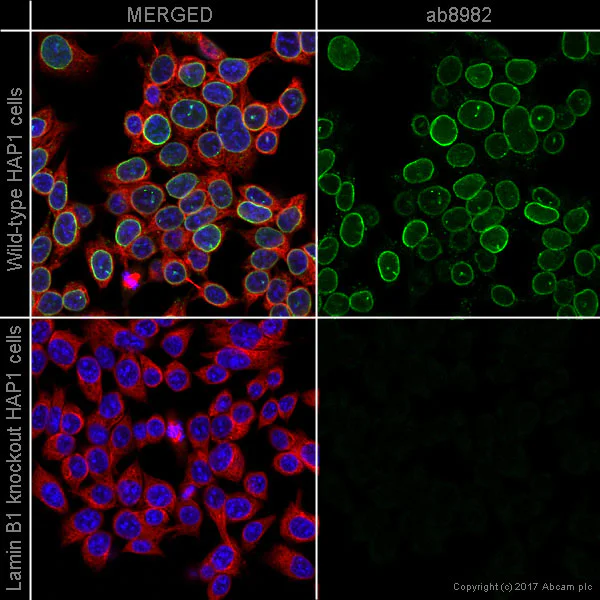
Immunocytochemistry/ Immunofluorescence - Anti-Lamin B1 antibody [119D5-F1] - Nuclear Envelope Marker (AB8982)
ab8982 staining Lamin B1 in wild-type HAP1 cells (top panel) and LMNB1 knockout HAP1 cells (bottom panel). The cells were fixed with 100% methanol (5min), permeabilized with 0.1% Triton X-100 for 5 minutes and then blocked with 1% BSA/10% normal goat serum/0.3M glycine in 0.1% PBS-Tween for 1h. The cells were then incubated with ab8982 at 0.5μg/ml and ab202272 at 1/250 dilution (shown in pseudocolour red) overnight at +4°C, followed by a further incubation at room temperature for 1h with a goat secondary antibody to Mouse IgG (Alexa Fluor® 488) (ab150117) at 2 μg/ml (shown in green). Nuclear DNA was labelled in blue with DAPI.
Image was taken with a confocal microscope (Leica-Microsystems, TCS SP8).
- ICC/IF
Characteriser
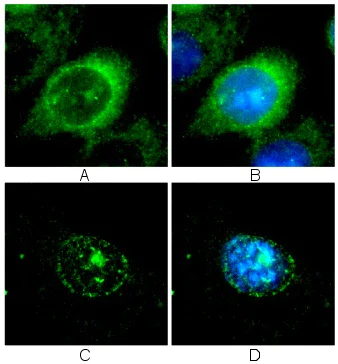
Immunocytochemistry/ Immunofluorescence - Anti-Lamin B1 antibody [119D5-F1] - Nuclear Envelope Marker (AB8982)
Methanol fixed HeLa and 3T3 cells (ab7179) were stained with ab8982 (1/50 and 1/20 respectively). The cells were fixed in 100% methanol for 6 minutes at -20°C. ab8982 clearly stains the nuclear envelope with very little background staining.
A : HeLa cells + ab8982 (1/50) (green)
B : HeLa cells counterstained with DAPI (blue)
C. 3T3 cells + ab8982 (1/20) (green)
D. 3T3 cells counterstained with DAPI (blue)
This image is courtesy of Marilena Ciciarello & Patrizia Lavia, University La Sapienza
- IHC-Fr
Supplier Data
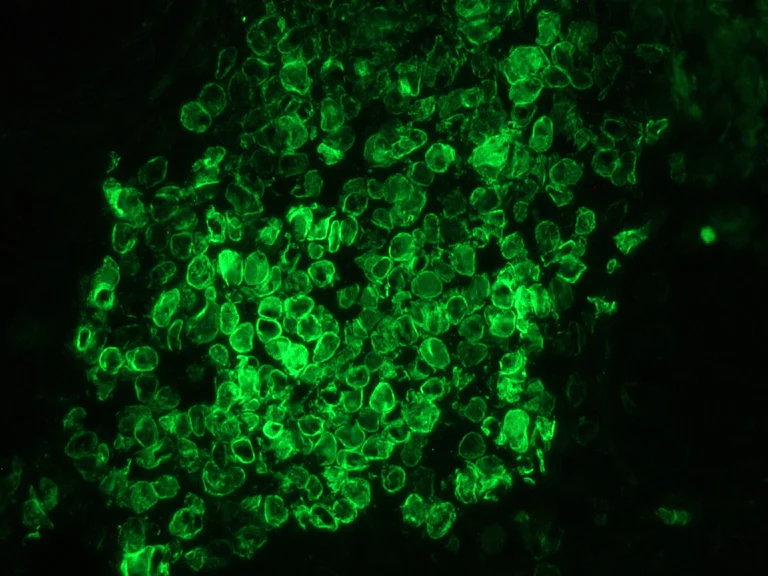
Immunohistochemistry (Frozen sections) - Anti-Lamin B1 antibody [119D5-F1] - Nuclear Envelope Marker (AB8982)
Immunohistochemistry on frozen sections of human kidney showing nuclear lamina staining in epithelial and connective tissue cells.
- IHC-Fr
Unknown
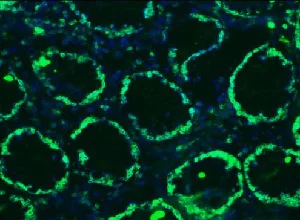
Immunohistochemistry (Frozen sections) - Anti-Lamin B1 antibody [119D5-F1] - Nuclear Envelope Marker (AB8982)
Immunohistochemistry on frozen sections of human colon showing nuclear lamina staining in epithelial and connective tissue cells.
- IHC-Fr
Supplier Data
Immunohistochemistry (Frozen sections) - Anti-Lamin B1 antibody [119D5-F1] - Nuclear Envelope Marker (AB8982)
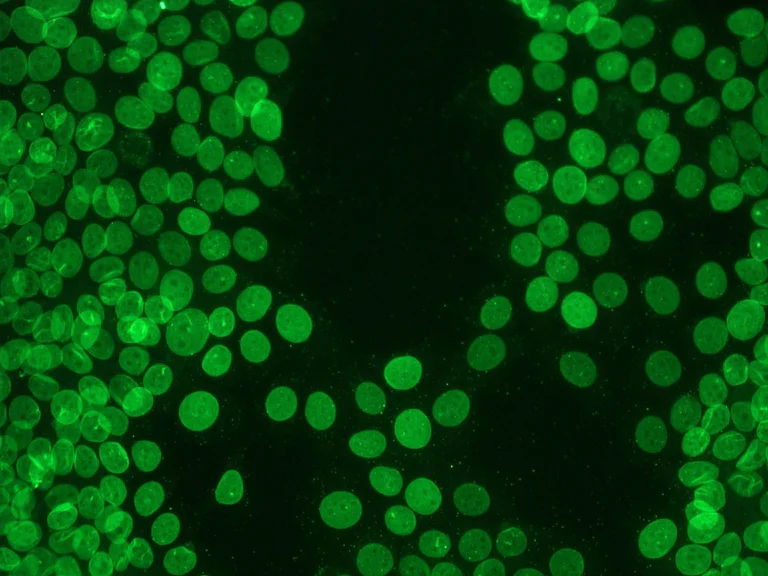
Immunohistochemistry of MCF-7 cell culture showing nuclear lamina staining.
- Flow Cyt
Unknown
Flow Cytometry - Anti-Lamin B1 antibody [119D5-F1] - Nuclear Envelope Marker (AB8982)
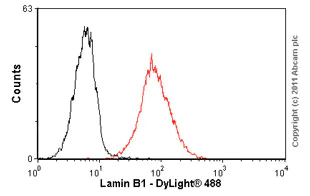
Overlay histogram showing HeLa cells stained with ab8982 (red line). The cells were fixed with 100% methanol (5 min) and then permeabilized with 0.1% PBS-Tween for 20 min. The cells were then incubated in 1x PBS / 10% normal goat serum (ab7481) / 0.3M glycine to block non-specific protein-protein interactions followed by the antibody (ab8982, 1μg/1x106 cells) for 30 min at 22°C. The secondary antibody used was DyLight® 488 goat anti-mouse IgG (H+L) (ab96879) at 1/500 dilution for 30 min at 22°C. Isotype control antibody (black line) was Mouse IgG1 [ICIGG1] (ab91353, 2μg/1x106 cells) used under the same conditions. Acquisition of >5,000 events was performed.
- IHC-Fr
Unknown
Immunohistochemistry (Frozen sections) - Anti-Lamin B1 antibody [119D5-F1] - Nuclear Envelope Marker (AB8982)
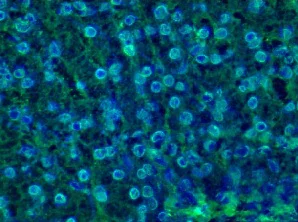
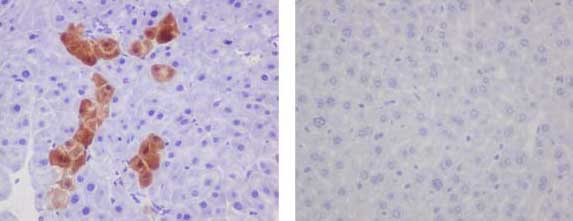
Immunohistochemistry on frozen sections of swine liver showing nuclear lamina staining in hepatocytes.
代替製品
Primary Antibodies
AB244577
Anti-Lamin A + Lamin C antibody [4C11] - BSA and Azide free
BOND RX™ Validated|KO Validated
- 0
- 0
Primary Antibodies
AB238303
Anti-Lamin A + Lamin C antibody [4C11]
BOND RX™ Validated|KO Validated|Trial Size

- 5
- 6
Primary Antibodies
AB194106
Alexa Fluor® 488 Anti-Lamin B1 antibody [EPR8985(B)] - Nuclear Envelope Marker
BOND RX™ Validated|RabMAb|Recombinant|KO Validated
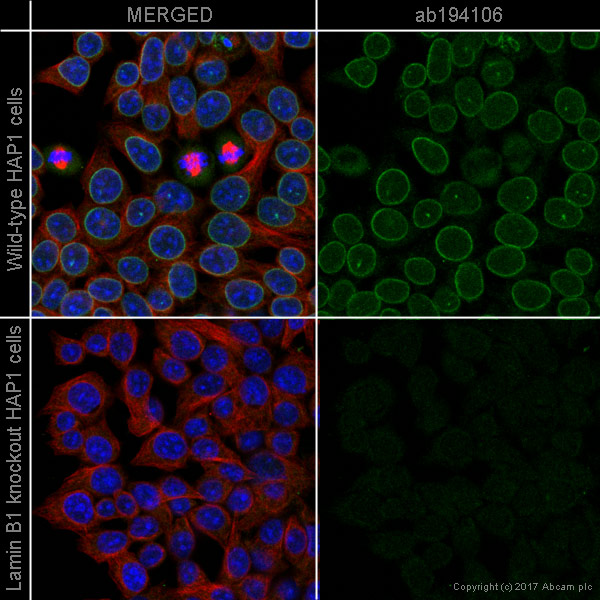
- 0
- 0
Primary Antibodies
AB194109
HRP Anti-Lamin B1 antibody [EPR8985(B)] - Nuclear Loading Control
BOND RX™ Validated|RabMAb|Recombinant|KO Validated
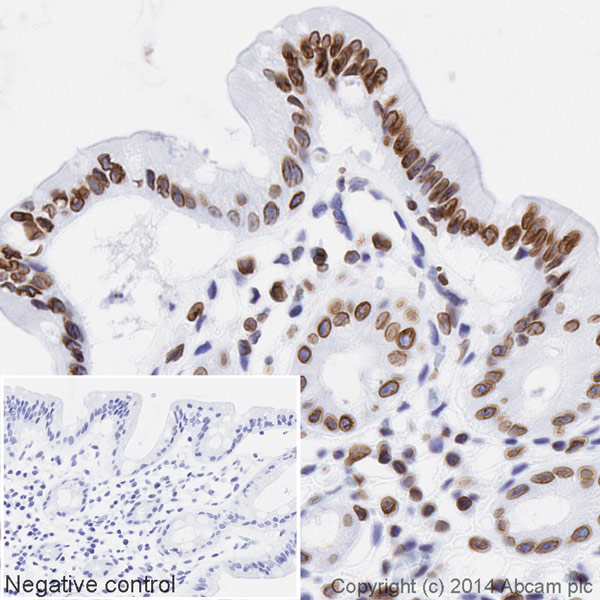
- 0
- 0
Primary Antibodies
AB133741
Anti-Lamin B1 antibody [EPR8985(B)] - Nuclear Envelope Marker
RabMAb|Recombinant|KO Validated|Lab Essentials|20ul selling size
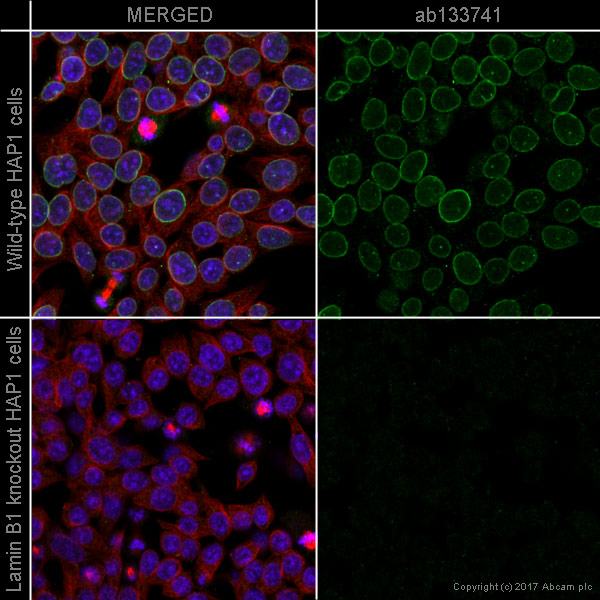
- 4
- 15
Primary Antibodies
AB220797
Anti-Lamin B1 antibody [EPR8985(B)] - BSA and Azide free
RabMAb|Recombinant|KO Validated

- 0
- 0
Primary Antibodies
AB229025
Anti-Lamin B1 antibody [EPR22165-121] - Nuclear Envelope Marker
BOND RX™ Validated|KO Validated|RabMAb|Recombinant|Lab Essentials|20ul selling size|Advanced Validation
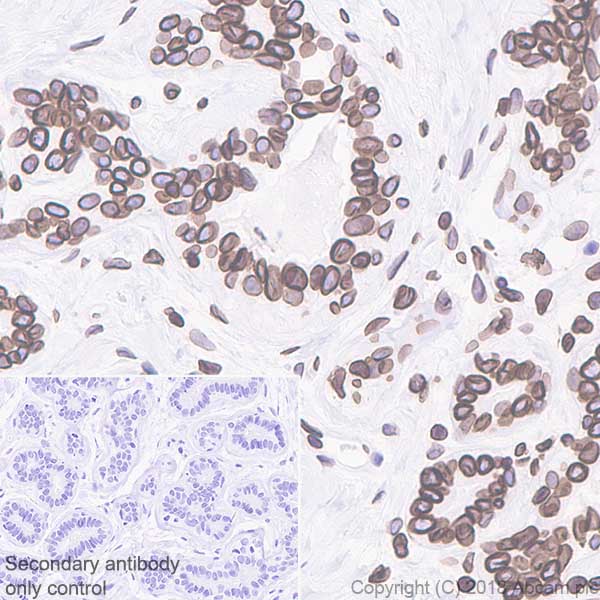
- 4
- 5
Primary Antibodies
AB194108
Alexa Fluor® 647 Anti-Lamin B1 antibody [EPR8985(B)] - Nuclear Envelope Marker
RabMAb|Recombinant|KO Validated

- 0
- 0
Primary Antibodies
AB216723
Alexa Fluor® 594 Anti-Lamin B1 antibody [EPR8985(B)] - Nuclear Envelope Marker
RabMAb|Recombinant

- 3
- 1
組合せ製品
Primary Antibodies
AB183734
RabMAb|Recombinant|Lab Essentials|20ul selling size
- 5
- 24
Primary Antibodies
AB1791
Anti-Histone H3 antibody - Nuclear Marker and ChIP Grade
Lab Essentials

- 5
- 233
Primary Antibodies
AB108595
Anti-Lamin A + Lamin C antibody [EPR4100] - Nuclear Envelope Marker
RabMAb|Recombinant|KO Validated|Lab Essentials|20ul selling size

- 5
- 9
Primary Antibodies
AB16667
BOND RX™ Validated|KO Validated|RabMAb|Advanced Validation|Recombinant|20ul selling size

- 5
- 133
Reactivity data
製品の詳細
Anti-Lamin B1 antibody [119D5-F1] - Nuclear Envelope Marker (ab8982) is a mouse monoclonal antibody and is validated for use in Flow Cytometry (Flow Cyt), Immunohistochemistry (IHC-Fr), Immunocytochemistry/immunofluorescence (ICC/IF) in Human, Mouse, Pig samples.
Trusted by the scientific community
Anti-Lamin B1 [119D5-F1] - Nuclear Envelope Marker (ab8982) was first used in a scientific publication in 2002 and has been cited over 40 times in peer-reviewed journals.
Reviewed by scientists
Anti-Lamin B1 [119D5-F1] - Nuclear Envelope Marker (ab8982) has over 5 independent reviews from customers.
Specificity confirmed
The specificity of Anti-Lamin B1 antibody [119D5-F1] - Nuclear Envelope Marker (ab8982) has been confirmed by Immunocytochemistry testing in Lmnb1 Knockout HAP1 cells.
出荷温度及び保存条件
製品の状態
精製方法
バッファー組成
出荷温度
短期保存期間
短期保存温度
長期保存温度
分注に関する情報
保管に関する情報
補足情報
This supplementary information is collated from multiple sources and compiled automatically.
Biological function summary
Lamin B1 serves many important functions by providing structural integrity and regulating gene expression through chromatin organization. Part of the nuclear lamina complex Lamin B1 interacts with other lamin proteins such as Lamin A and Lamin C forming a mesh-like structure that supports the nuclear envelope. This protein also affects cellular processes such as DNA replication RNA transcription and cell division indicating its broad impact on various cellular activities.
Pathways
Lamin B1 plays an important role in gene expression regulation and cell cycle control. It interacts with pathways involved in chromatin remodeling influencing the access of transcription factors to DNA which affects gene expression profiles. Lamin B1 associates with related proteins such as Lamin A/C and other nuclear matrix proteins to maintain cellular architecture stability and normal cell function. This organization is vital to ensure the accuracy of cellular processes and prevent anomalies during cell division.
製品プロトコール
- Visit the General protocols
- Visit the Troubleshooting
ターゲットの情報
文献 (52)
Recent publications for all applications. Explore the full list and refine your search
Journal of cellular and molecular medicine 29:e70507 PubMed40387430
2025
Applications
Unspecified application
Species
Unspecified reactive species
Biogerontology 26:110 PubMed40380982
2025
Applications
Unspecified application
Species
Unspecified reactive species
Nucleic acids research 53: PubMed39817518
2025
Applications
Unspecified application
Species
Unspecified reactive species
Nature communications 15:9570 PubMed39500881
2024
Applications
Unspecified application
Species
Unspecified reactive species
Nature 634:919-928 PubMed39415005
2024
Applications
Unspecified application
Species
Unspecified reactive species
Philosophical transactions of the Royal Society of London. Series B, Biological sciences 378:20220477 PubMed37778379
2023
Applications
Unspecified application
Species
Unspecified reactive species
Nature communications 14:4588 PubMed37563144
2023
Applications
Unspecified application
Species
Unspecified reactive species
Molecular & cellular proteomics : MCP 22:100529 PubMed36931626
2023
Applications
Unspecified application
Species
Unspecified reactive species
Nature communications 13:7732 PubMed36513638
2022
Applications
Unspecified application
Species
Unspecified reactive species
Nature communications 13:7414 PubMed36460681
2022
Applications
Unspecified application
Species
Unspecified reactive species
Abcam product promise
Please note: All products are 'FOR RESEARCH USE ONLY. NOT FOR USE IN DIAGNOSTIC OR THERAPEUTIC PROCEDURES'.
For licensing inquiries, please contact partnerships@abcam.com