JavaScript is disabled in your browser. Please enable JavaScript to view this website.
AB202022

Anti-Ku70 抗体 [2F7F5]

Anti-Ku70 antibody [2F7F5]

Be the first to review this product! Submit a review

|

(5 Publications)

Mouse Monoclonal Ku70 antibody. Suitable for Flow Cyt, WB, IHC-P and reacts with Human, Rat, Transfected cell lysate - Human, Recombinant fragment samples. Cited in 5 publications. Immunogen corresponding to Recombinant Fragment Protein within Human XRCC6 aa 1-250.

別名を表示する

G22P1, XRCC6, DNA repair protein Ku70, 5'-deoxyribose-5-phosphate lyase Ku70, 70 kDa subunit of Ku antigen, ATP-dependent DNA helicase 2 subunit 1, ATP-dependent DNA helicase II 70 kDa subunit, CTC box-binding factor 75 kDa subunit, DNA repair protein XRCC6, Lupus Ku autoantigen protein p70, Thyroid-lupus autoantigen, X-ray repair complementing defective repair in Chinese hamster cells 6, X-ray repair cross-complementing protein 6, 5'-dRP lyase Ku70, CTC75, CTCBF, Ku70, TLAA
6 Images
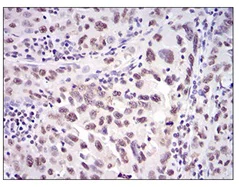
Immunohistochemistry (Formalin/PFA-fixed paraffin-embedded sections) - Anti-Ku70 antibody [2F7F5] (AB202022)
  • IHC-P

Supplier Data

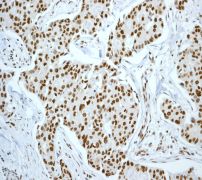
Immunohistochemistry (Formalin/PFA-fixed paraffin-embedded sections) - Anti-Ku70 antibody [2F7F5] (AB202022)

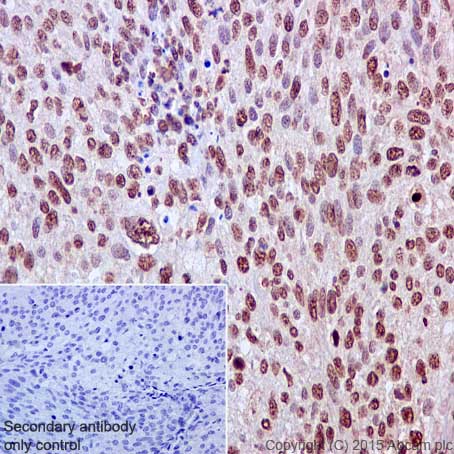
Immunohistochemical analysis of paraffin embedded Human endometrial cancer tissues labeling Ku70 using ab202022 at 1/200 dilution, followed by DAB staining.
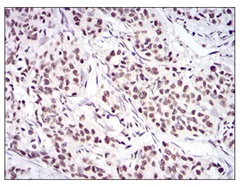
Immunohistochemistry (Formalin/PFA-fixed paraffin-embedded sections) - Anti-Ku70 antibody [2F7F5] (AB202022)
  • IHC-P

Supplier Data

Immunohistochemistry (Formalin/PFA-fixed paraffin-embedded sections) - Anti-Ku70 antibody [2F7F5] (AB202022)

Immunohistochemical analysis of paraffin embedded Human cervical cancer tissues labeling Ku70 using ab202022 at 1/200 dilution, followed by DAB staining.
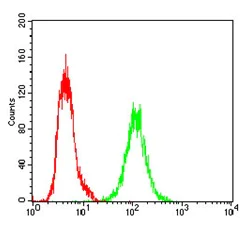
Flow Cytometry - Anti-Ku70 antibody [2F7F5] (AB202022)
  • Flow Cyt

Supplier Data

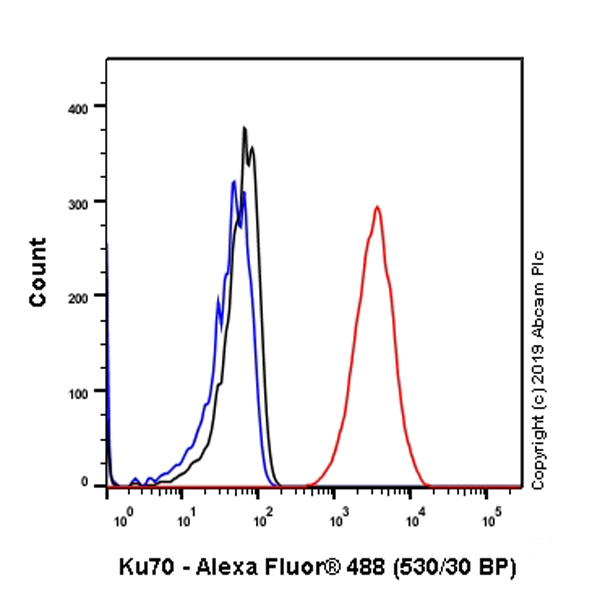
Flow Cytometry - Anti-Ku70 antibody [2F7F5] (AB202022)

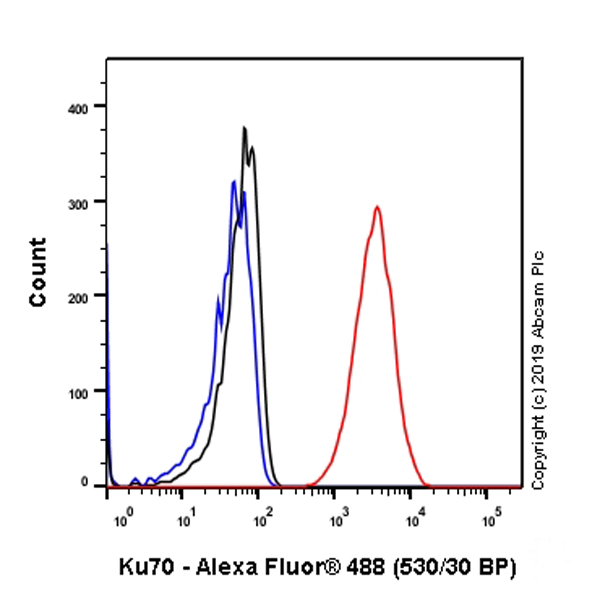
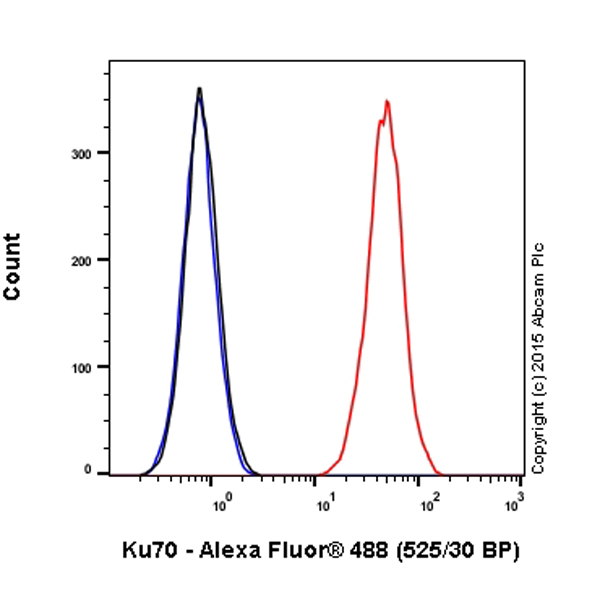
Flow cytometric analysis of A431 cells labeling Ku70 using ab202022 (green) at 1/200 dilution, and negative control (red).
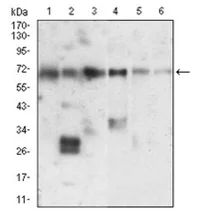
Western blot - Anti-Ku70 antibody [2F7F5] (AB202022)
  • WB

Supplier Data

Western blot - Anti-Ku70 antibody [2F7F5] (AB202022)

All lanes:

Western blot - Anti-Ku70 antibody [2F7F5] (ab202022) at 1/500 dilution

Lane 1:

HeLa cell lysate at 1 µg

Lane 2:

PC-2 cell lysate at 1 µg

Lane 3:

A549 cell lysate at 1 µg

Lane 4:

A431 cell lysate at 1 µg

Lane 5:

HepG2 cell lysate at 1 µg

Lane 6:

K562 cell lysate at 1 µg

Predicted band size: 70 kDa

false
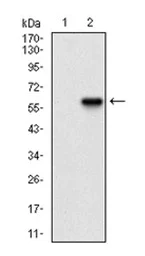
Western blot - Anti-Ku70 antibody [2F7F5] (AB202022)
  • WB

Supplier Data

Western blot - Anti-Ku70 antibody [2F7F5] (AB202022)

All lanes:

Western blot - Anti-Ku70 antibody [2F7F5] (ab202022) at 1/500 dilution

Lane 1:

Non transfected HEK293 cell lysate at 1 µg

Lane 2:

Ku70 (aa: 6-214)-hIgGFc transfected HEK293 cell lysate at 1 µg

Predicted band size: 70 kDa

false
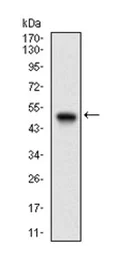
Western blot - Anti-Ku70 antibody [2F7F5] (AB202022)
  • WB

Supplier Data

Western blot - Anti-Ku70 antibody [2F7F5] (AB202022)

Expected MW is 49.7 kDa

All lanes:

Western blot - Anti-Ku70 antibody [2F7F5] (ab202022) at 1/500 dilution

All lanes:

Ku70 (aa: 6-214) recombinant protein. at 1 µg

Predicted band size: 70 kDa

false

Key facts

宿主種

Mouse

クローン性

Monoclonal

クローン番号

2F7F5

アイソタイプ

IgG1

キャリアフリー

No

交差種

Rat, Human

アプリケーション

IHC-P, WB, Flow Cyt

applications

免疫原

Recombinant Fragment Protein within Human XRCC6 aa 1-250. The exact immunogen used to generate this antibody is proprietary information.

P12956

Reactivity data

{ "title": "Reactivity Data", "filters": { "stats": ["", "Species", "Dilution Info", "Notes"], "tabs": { "all-applications": {"fullname" : "All Applications", "shortname": "All Applications"}, "FlowCyt" : {"fullname" : "Flow Cytometry", "shortname":"Flow Cyt"}, "WB" : {"fullname" : "Western blot", "shortname":"WB"}, "IHCP" : {"fullname" : "Immunohistochemistry (Formalin/PFA-fixed paraffin-embedded sections)", "shortname":"IHC-P"} }, "product-promise": { "all": "all", "testedAndGuaranteed": "tested", "guaranteed": "expected", "predicted": "predicted", "notRecommended": "not-recommended" } }, "values": { "Human": { "FlowCyt-species-checked": "testedAndGuaranteed", "FlowCyt-species-dilution-info": "1/200 - 1/400", "FlowCyt-species-notes": "<p><a href='/products/primary-antibodies/mouse-igg1-kappa-monoclonal-15-6e10a7-isotype-control-ab170190'>ab170190</a> - Mouse monoclonal IgG1, is suitable for use as an isotype control with this antibody.</p>", "WB-species-checked": "testedAndGuaranteed", "WB-species-dilution-info": "1/500 - 1/2000", "WB-species-notes": "<p></p>", "IHCP-species-checked": "testedAndGuaranteed", "IHCP-species-dilution-info": "1/200 - 1/1000", "IHCP-species-notes": "<p></p>" }, "Rat": { "FlowCyt-species-checked": "guaranteed", "FlowCyt-species-dilution-info": "", "FlowCyt-species-notes": "", "WB-species-checked": "testedAndGuaranteed", "WB-species-dilution-info": "1/500 - 1/2000", "WB-species-notes": "<p></p>", "IHCP-species-checked": "guaranteed", "IHCP-species-dilution-info": "", "IHCP-species-notes": "" }, "Recombinant fragment": { "FlowCyt-species-checked": "notRecommended", "FlowCyt-species-dilution-info": "", "FlowCyt-species-notes": "", "WB-species-checked": "testedAndGuaranteed", "WB-species-dilution-info": "1/500 - 1/2000", "WB-species-notes": "<p></p>", "IHCP-species-checked": "notRecommended", "IHCP-species-dilution-info": "", "IHCP-species-notes": "" }, "Transfected cell lysate - Human": { "FlowCyt-species-checked": "notRecommended", "FlowCyt-species-dilution-info": "", "FlowCyt-species-notes": "", "WB-species-checked": "testedAndGuaranteed", "WB-species-dilution-info": "1/500 - 1/2000", "WB-species-notes": "<p></p>", "IHCP-species-checked": "notRecommended", "IHCP-species-dilution-info": "", "IHCP-species-notes": "" } } }

出荷温度及び保存条件

製品の状態
Liquid
精製方法
Affinity purification Protein G
精製に関する特記事項
Purified from tissue culture supernatant.
バッファー組成
Preservative: 0.05% Sodium azide Constituents: PBS
出荷温度
Blue Ice
短期保存期間
1-2 weeks
短期保存温度
+4°C
長期保存温度
-20°C
分注に関する情報
Upon delivery aliquot
保管に関する情報
Avoid freeze / thaw cycle

補足情報

This supplementary information is collated from multiple sources and compiled automatically.

Ku70 also known as XRCC6 or K331 is a DNA repair protein with a molecular mass of approximately 70 kDa. It belongs to the Ku protein family which includes Ku80. This protein expresses mainly in the nucleus of cells across various tissue types. As a part of a heterodimer together with Ku80 Ku70 forms the Ku70/Ku80 complex which binds to free DNA ends allowing DNA repair processes to occur efficiently.
Biological function summary

The Ku70 protein plays a significant role in maintaining genomic stability. It is an important component of the non-homologous end joining (NHEJ) pathway a primary mechanism for repairing double-strand breaks in DNA. By forming the Ku70/Ku80 complex it accurately aligns DNA ends to facilitate repair and prevent chromosomal abnormalities. The Ku70 protein also involves in telomere maintenance and can influence cell cycle regulation.

Pathways

Ku70 contributes mainly to the NHEJ DNA repair pathway. This pathway is important for cellular response to DNA damage and involves other proteins such as DNA-PKcs (DNA-dependent protein kinase catalytic subunit) and XRCC4. Ku70's interaction with DNA-PKcs enables the activation of its kinase activity which is essential for the repair process. Additionally Ku70 is involved in the homologous recombination pathway where it interacts with proteins like Rad51 to ensure repair fidelity.

Research links the Ku70 protein to cancer and neurodegenerative diseases. Dysregulation or mutations affecting Ku70 can lead to genomic instability contributing to cancer development. Ku70 also shows connections to neurodegenerative conditions like Alzheimer's disease where its role in DNA repair and apoptosis regulation may impact neuronal cell survival. Interactions with p53 a protein important for DNA damage response further underline Ku70's influence in these disease contexts.

製品プロトコール

For this product, it's our understanding that no specific protocols are required. You can visit:

ターゲットの情報

DNA-binding protein critical for the DNA damage response, specifically in repairing double-strand breaks (DSBs) via the classical non-homologous end joining (NHEJ) pathway. It forms a heterodimer with XRCC5 (Ku80), creating the Ku70 : Ku80 heterodimer (Ku complex), which serves as a DNA end-binding complex. It primarily binds DSBs and recruits essential repair factors, assembling the core long-range NHEJ complex to facilitate the alignment and ligation of broken DNA ends (PubMed : 11493912, PubMed : 20493174, PubMed : 33854234, PubMed : 34352203, PubMed : 9742108). This pathway ensures the rapid repair of cytotoxic and mutagenic DSBs and contributes to the generation of diversity in T-cell receptors and antibodies through mechanisms such as V(D)J recombination (PubMed : 9742108). Likely acts as a 5'-deoxyribose-5-phosphate lyase (5'-dRP lyase), catalyzing the beta-elimination of the 5'-deoxyribose-5-phosphate at abasic sites near DSBs. This activity cleans the termini of abasic sites, a common form of nucleotide damage, preparing broken ends for ligation (PubMed : 20383123). It may also possess 3'-5' DNA helicase activity, although this has not been confirmed in vivo, and its physiological significance remains unclear (PubMed : 7957065). Beyond DNA repair, the protein contributes to telomere maintenance (PubMed : 29490055). It is also implicated in transcriptional regulation, acting as a cofactor for various transcription factors (PubMed : 12145306, PubMed : 8621488). It plays a role in the regulation of DNA virus-mediated innate immune response by assembling into the HDP-RNP complex, a complex that serves as a platform for IRF3 phosphorylation and subsequent innate immune response activation through the cGAS-STING pathway (PubMed : 28712728). Can also bind RNAs and recruits PRKDC to a wide range of cellular RNAs, including the U3 small nucleolar RNA, playing a role in the biogenesis of ribosomal RNAs (PubMed : 32103174). Additionally, it negatively regulates apoptosis by interacting with BAX, sequestering it from the mitochondria, and may possess deubiquitination activity targeting BAX (PubMed : 15023334, PubMed : 18362350, PubMed : 35545041).
See full target information XRCC6

文献 (5)

Recent publications for all applications. Explore the full list and refine your search

Experimental hematology & oncology 13:109 PubMed39497152

2024

Nuclear porcupine mediates XRCC6/Ku70 S-palmitoylation in the DNA damage response.

Applications

Unspecified application

Species

Unspecified reactive species

Yang Chen,Mingming Xiao,Yaqi Mo,Jinlu Ma,Yamei Han,Qing Li,Qinghua Zeng,Rebecca J Boohaker,Joshua Fried,Yonghe Li,Han Wang,Bo Xu

Cancer biology & therapy 25:2402588 PubMed39286953

2024

EX527, a sirtuins 1 inhibitor, sensitizes T-cell leukemia to death receptor-mediated apoptosis by downregulating cellular FLICE inhibitory protein.

Applications

Unspecified application

Species

Unspecified reactive species

Rongqi Guo,Yihui Wei,Yating Du,Luyue Liu,Haoqi Zhang,Ruiying Ren,Ruili Sun,Tingting Zhang,Xiwen Xiong,Lijun Zhao,Hongfei Wang,Xiaofang Guo,Xiaofei Zhu

Nature communications 13:1825 PubMed35383176

2022

Structure-based design of stabilized recombinant influenza neuraminidase tetramers.

Applications

Unspecified application

Species

Unspecified reactive species

Daniel Ellis,Julia Lederhofer,Oliver J Acton,Yaroslav Tsybovsky,Sally Kephart,Christina Yap,Rebecca A Gillespie,Adrian Creanga,Audrey Olshefsky,Tyler Stephens,Deleah Pettie,Michael Murphy,Claire Sydeman,Maggie Ahlrichs,Sidney Chan,Andrew J Borst,Young-Jun Park,Kelly K Lee,Barney S Graham,David Veesler,Neil P King,Masaru Kanekiyo

Frontiers in oncology 11:689063 PubMed34222016

2021

A Fibrinogen Alpha Fragment Mitigates Chemotherapy-Induced Rearrangements.

Applications

Unspecified application

Species

Unspecified reactive species

Julia Eberle,Rahel Stefanie Wiehe,Boris Gole,Liska Jule Mattis,Anja Palmer,Ludger Ständker,Wolf-Georg Forssmann,Jan Münch,J Christof M Gebhardt,Lisa Wiesmüller

Nature communications 11:3531 PubMed32669601

2020

Sequential role of RAD51 paralog complexes in replication fork remodeling and restart.

Applications

Unspecified application

Species

Unspecified reactive species

Matteo Berti,Federico Teloni,Sofija Mijic,Sebastian Ursich,Jevgenij Fuchs,Maria Dilia Palumbieri,Jana Krietsch,Jonas A Schmid,Edwige B Garcin,Stéphanie Gon,Mauro Modesti,Matthias Altmeyer,Massimo Lopes
View all publications

Abcam product promise

当社は、高品質な試薬を通じてお客様の研究を力強くサポートすることをお約束いたします。ご使用いただく各段階で、常にお客様をサポートできる体制を整えております。万が一、製品が期待通りに機能しない場合は、「Abcam Product Promise」による当社保証制度に基づき、安心してご利用いただけます。
保証に関する詳細については利用規約をご確認ください。

Please note: All products are 'FOR RESEARCH USE ONLY. NOT FOR USE IN DIAGNOSTIC OR THERAPEUTIC PROCEDURES'.

For licensing inquiries, please contact partnerships@abcam.com